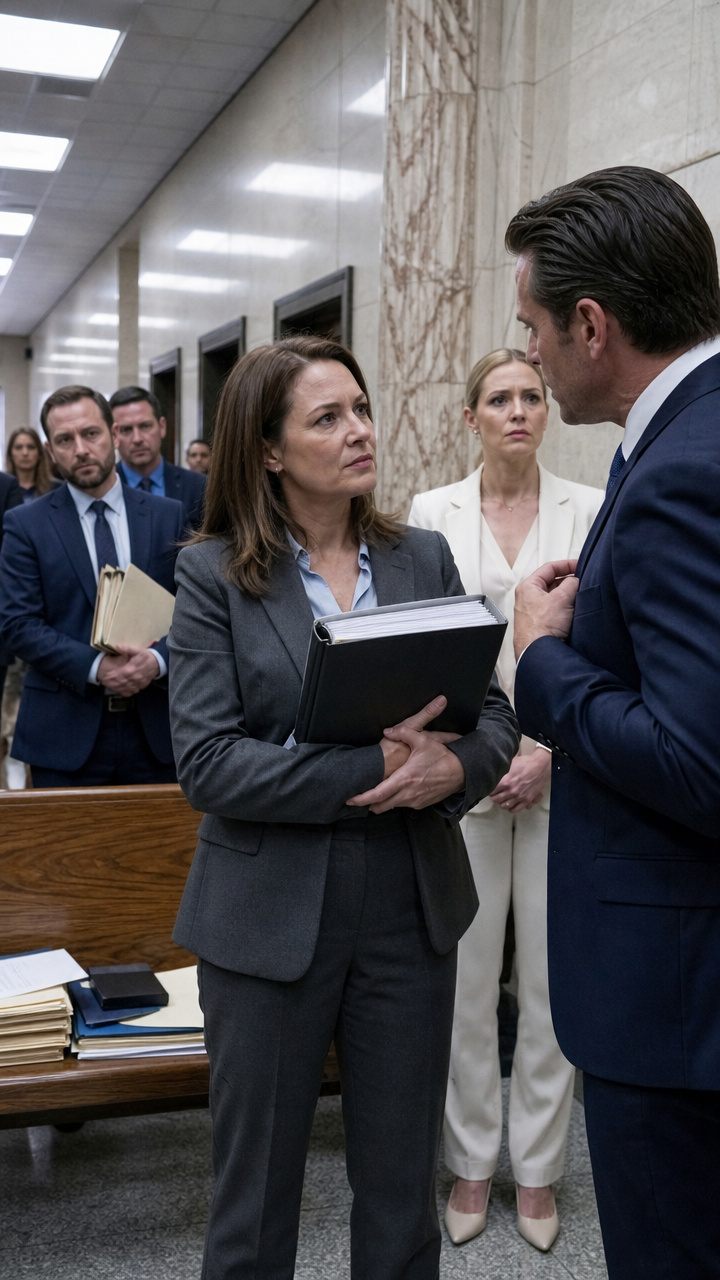
Victor carried an expensive leather briefcase.
It looked impressive.
It was not large enough to hold the day waiting inside it.
We met again in the courthouse corridor.
Daniel leaned toward me and promised that before the day ended, I would own nothing.
Arthur’s warning still echoed in my mind.
Do not react.
The clerk opened the doors.
We entered.
The courtroom was smaller and less dramatic than Daniel had expected.
Polished wood bore the marks of years. Tall windows softened the cold light. The air smelled of paper, dust, and old ventilation.
The judge was a woman in her sixties, with the expression of someone who had heard every excuse human beings could invent.
She had long ago lost patience with attractive explanations.
Victor spoke first.
He used too many words and presented the appearance of an argument as though it were the thing itself.
He described Daniel as a successful executive who had devoted every day and night to his career.
He described me as a bitter, wounded wife determined to destroy a man whose success she envied.
My contribution to the marriage, he said, had consisted of “minor bookkeeping tasks” and domestic support.
The apartment was ordinary marital property.
The missing inheritance was the result of unfortunate investments.
My request for a financial investigation was excessive and unnecessary.
He called me “Mrs. Carter” or “the petitioner.”
Then he made his most important mistake.
He described me as financially dependent on my husband.
Arthur did not object.
He said nothing.
He allowed Victor to build the entire structure.
Daniel was called to testify.
He did exactly what Arthur had predicted.
He lied with remarkable confidence.
He denied gambling.
He claimed his relationship with Sophie had begun only after our separation.
He described her as a colleague who had supported him through a difficult period.
He said the second mortgage had been taken out with my consent.
He claimed the money had been used for shared household needs.
Under oath, he declared that my grandmother’s inheritance had been invested honestly and had disappeared only because of falling markets.
He delivered every statement with grave sincerity.
He had probably practiced the expression in a mirror.
Then Arthur rose.
He did not create a dramatic pause. He simply gathered his files and approached the bench with the patient calm of a man accustomed to working with calculators.
“Your Honor,” he said, “this matter is actually very simple.”
He opened the first binder.
“This is not about feelings or interpretations.”
He placed a document before the judge.
“It is about records.”
He began with the inheritance.
“Mr. Carter has stated that these funds were lost in market fluctuations.”
He turned a page.
“The transfer records show otherwise.”
He lifted another document.
“At the time of the withdrawals, the money was not invested in any financial product.”
His voice did not change.
“It was repeatedly transferred to intermediaries connected to overseas gambling platforms.”
Victor sprang to his feet.
“Objection!”
Arthur continued as though he had not heard him.
“The payment classifications and transfer identifiers appear on page fourteen. The independent expert’s report appears on page nineteen. It establishes the connection between these networks and online gambling services.”
The judge raised one hand.
“Sit down, Mr. Langley.”
Victor sat.
Arthur turned another page.
“The total amount transferred was $124,000.”
The courtroom seemed to contract around us.
He continued.
“My client’s inheritance did not vanish because of market conditions.”
He paused.
“It was gambled away.”
Daniel’s shoulders tightened.
For the first time, the smooth surface of his confidence cracked.
Arthur moved to the mortgage.
“Mr. Carter also testified that the second mortgage was obtained with the consent of both spouses.”
He gave the judge several documents.
“That statement is false.”
His tone remained even.
“The down payment for this property came entirely from Mrs. Carter’s separate inheritance. The source of that equity can be traced without difficulty.”
He turned another page.
“More seriously, the second mortgage was obtained using a falsified electronic authorization.”
He presented the evidence one document at a time.
“The property records.”
“The login history.”
“The technical report showing that the relevant IP address belonged to Mr. Carter’s work computer.”
Then he presented the handwriting expert’s report.
“The signature attributed to Mrs. Carter does not match her authentic signatures. It was almost certainly imitated.”
Victor began flipping rapidly through his papers.
Daniel turned toward him with irritation.
Victor did not look up.
Arthur faced the judge.
“In plain terms, Your Honor, Mr. Carter pledged his wife’s property by forging her authorization.”
The second crack ran deeper than the first.
Victor attempted a weak defense.
“This may be a misunderstanding related to the signing process—”
The judge interrupted.
“Is the signature false or not?”