The room smelled of old books, cedar, and the faint trace of tobacco left in the walls from my grandfather’s time. Rain tapped against the windows. My father sat behind his walnut desk, one hand resting beside a photograph of my mother, Helen, who had died when I was still young enough to believe fathers could fix everything.
“Claire,” he had said tiredly, “I don’t dislike Nathan because he came from less. I distrust him because he wants too much, too quickly.”
I had cried. I had shouted. I accused him of being elitist, controlling, and cold.
“Nathan is ambitious,” I told him. “That isn’t a crime. He just needs someone to believe in him.”
My father looked at me for a long time.
Then he sighed.
In that single breath, I heard a man surrender—not because he agreed, but because he loved his daughter too much to lock her away from her own choices.
“Love should not make you blind,” he said.
I married Nathan anyway.
My father gave him a place at our table. Then he gave him a place in the company. After that, he gave him room to prove himself.
Nathan did not prove himself.
He multiplied.
He brought in his mother. His mother brought in the family. The family brought in vendors. The vendors brought in invoices. Somewhere along the way, the company my father had built through decades of discipline became hunting ground for people who smiled while they took.
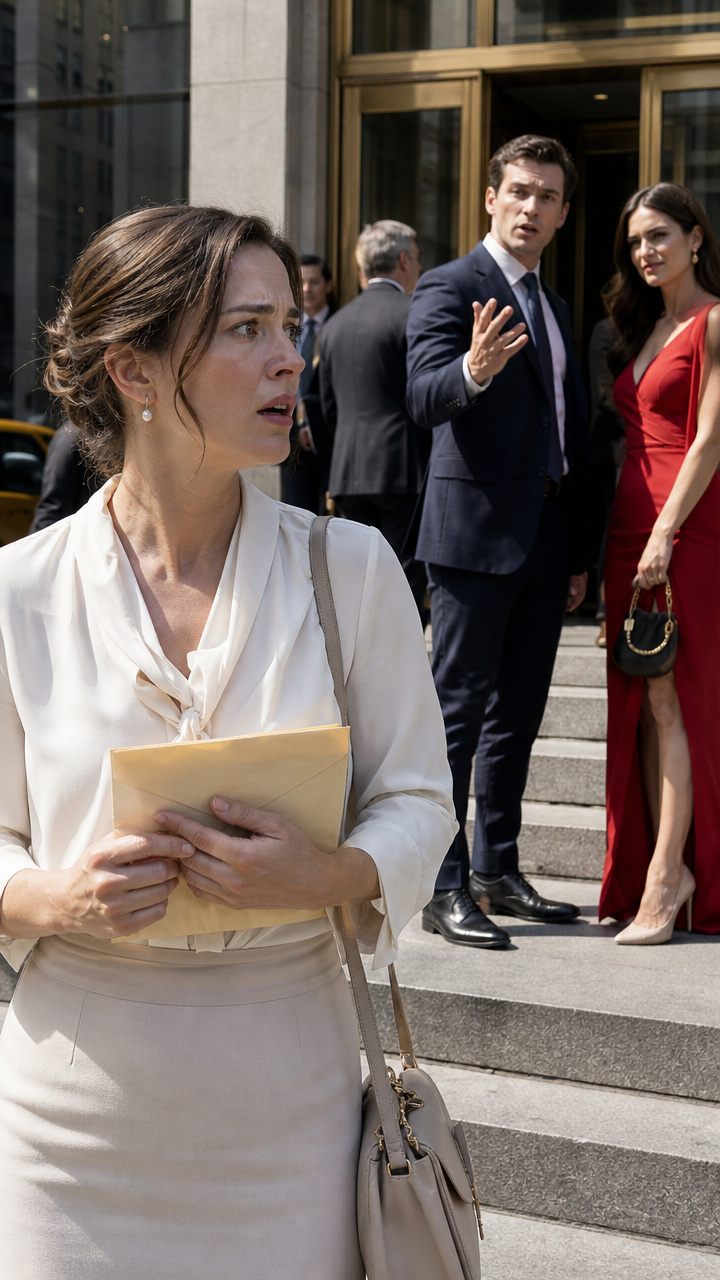
Now Nathan stood outside the courthouse telling me the roots were too deep.
I looked past him toward the traffic moving along the street—yellow taxis flashing between shadows, a delivery cyclist shouting at a sedan, the city carrying on as if my former life had not just ended on the steps behind me.
“We’ll see,” I said, “how deep those roots really are.”
Nathan frowned.
“What does that mean?”
I did not answer.
I turned and walked toward my SUV.
Vanessa called after me, “She still thinks she’s a queen.”
Nathan said my name once, louder.
I kept walking.
When I shut the car door, the city disappeared. Inside, the air smelled faintly of leather, perfume, and paper.
My hands were steady.
That surprised me.
For years, I had cried in bathrooms. In closets. In guest rooms after charity dinners where Nathan spent the entire night whispering into his phone. I had cried silently while Margaret complimented my china and asked whether my father had considered giving Nathan more authority. I had cried after finding messages from women whose names I did not know, then allowed Nathan to explain them away because I was afraid of what the truth would cost.
But sitting in that car with the divorce judgment inside my purse, I did not cry.
I opened my phone.
The photo gallery appeared first.
Thousands of pictures filled the screen.
Nathan bringing me soup when I was sick.
Nathan and me in Florence, his arm around my waist beneath a sunset he had barely looked at because he was texting someone else.
Nathan laughing beside my father at a Whitmore Holdings holiday gala.
Margaret in my kitchen wearing an apron, pretending to help with Thanksgiving dinner while casually asking about board appointments.
A Christmas photograph in Greenwich, all of us standing beneath garlands and white lights, smiling like a family.
I selected them all.
The phone asked whether I wanted to delete more than five thousand items.
I pressed confirm.
The screen flickered.
Five thousand pieces of evidence that I had loved the wrong man vanished into an empty folder.
It felt less like deleting memories and more like cutting away something infected.
Then I opened my contacts.
Dad.
For three years, that name had lived in my phone like a locked door.
Our conversations had become rare and careful after my marriage. Whenever he asked a question about Nathan, I became defensive. Whenever he hinted at concerns inside the company, I accused him of searching for someone to blame. Eventually, he stopped asking.
That was how silence grew between us.
Not all at once.
One avoided call at a time.
One unfinished dinner at a time.
One daughter choosing her husband’s lies over her father’s patience.
My thumb hovered above the call button.
Then I pressed it.
The phone rang three times.
A cough came through the line. Deep. Familiar. Older than I remembered.
“Claire?”
Just my name.
Just his voice.
The wall I had built inside myself cracked.
“Dad,” I whispered. “I was wrong.”
A long silence followed.
No lecture.
No anger.
No sharp satisfaction.
Only my father breathing on the other end, as though he had waited years to hear those words and did not want to frighten them away.
“I know the hearing was today,” he said quietly. “Are you alone?”
“Yes.”
“Good. Then cry if you need to. Home is still home.”
That was when the tears came.
They were not graceful tears. They were not quiet tears. They bent my shoulders forward until my forehead touched the steering wheel. They came from humiliation, pain, exhaustion, and the unbearable relief of no longer pretending.
“I defended him,” I said. “I defended all of them. I let them into your company. I let Margaret smile in your home. I let Nathan put his people everywhere.”