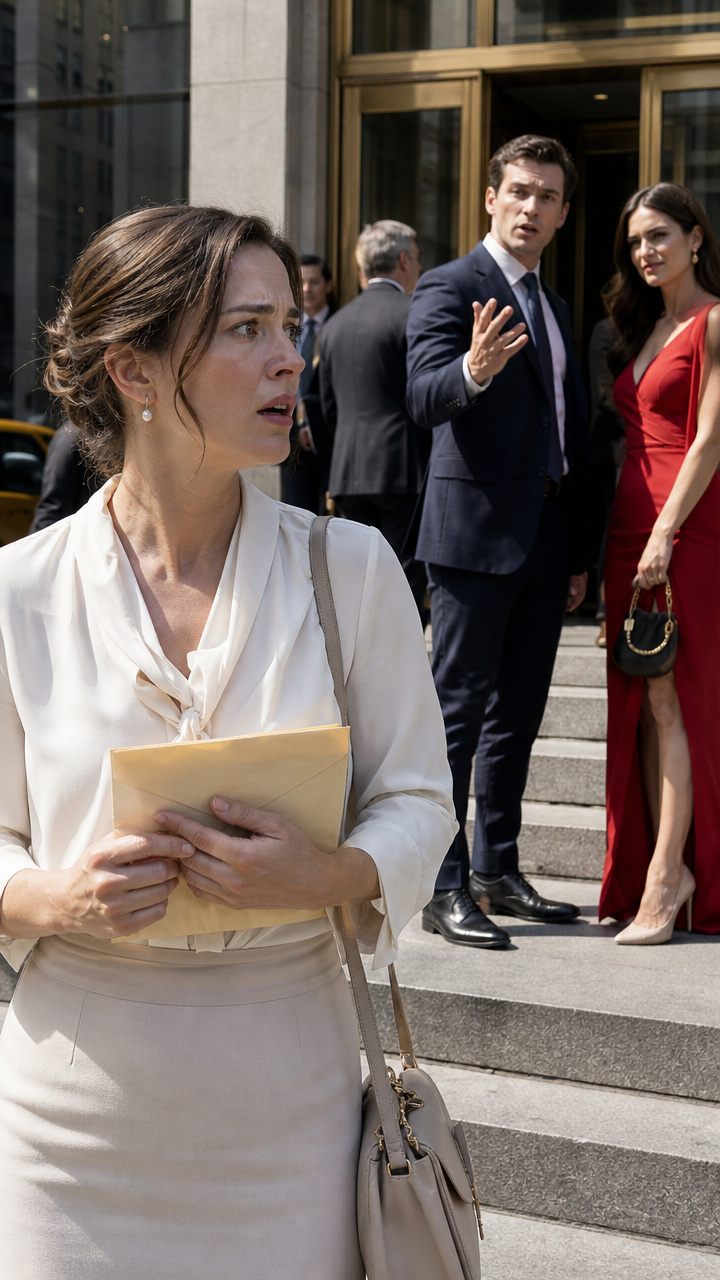
My father said nothing.
So I kept going.
I told him about Vanessa. The credit-card charges. The courthouse steps. Nathan’s warning. Procurement, accounting, vendor relations, and the way the Carter family had spread through Whitmore Holdings like mold behind painted walls.
When I finally stopped, my father’s voice had changed.
The tired father was gone.
The chairman had returned.
“The daughter of Richard Whitmore does not fall because of people like that,” he said.
I wiped my face with my sleeve.
“I don’t know how bad it is.”
“I do.”
I sat completely still.
“What?”
“I’ve known enough for some time,” he said. “Contracts. Vendor payments. Inflated invoices. Access records. Shell companies. At first, I didn’t have every piece, but I had enough to know we had a problem.”
“You knew?”
“Yes.”
“Why didn’t you tell me?”
His silence was heavier this time.
“Because you would have protected him,” he said. “And if I moved too soon, you would have believed I was destroying your marriage. I needed you to see it without my shadow in the room.”
The truth hurt because it was right.
I would have defended Nathan.
I would have called my father cruel.
I would have said Margaret was misunderstood. I would have accused him of punishing the Carters because they were not Whitmores.
I had been so blind.
Through the windshield, beyond the traffic and summer glare, I could see the glass tower of Whitmore Holdings rising over Midtown. Forty floors of steel, glass, payroll, contracts, employees, history, risk, and my father’s life.
For years, I had treated it as his world.
Not mine.
That ended in the parking lane outside the courthouse.
“Dad,” I said, and even to me my voice sounded different. “I’ll be at the main office at two exactly.”
“I’ll be ready.”
“Have Martin from HR there. Colin from security too. I want legal on standby. Before we enter the boardroom, every access card connected to Nathan and his relatives gets shut down. Email, database access, banking permissions, vendor portals, executive elevator clearance, company devices—everything.”
My father did not hesitate.
“Done.”
“And Dad?”
“Yes?”
“Don’t warn them.”
There was a pause.
Then a low breath of approval.
“Your mother would recognize that tone.”
I closed my eyes for one second.
Then I started the engine.
The motor came alive with a low growl.
Nathan had been right about one thing.
The roots were deep.
But he had forgotten who owned the ground.
At exactly two, I stepped out of my SUV in front of Whitmore Holdings.
The building rose over Midtown, its polished glass facade reflecting the city in clean silver lines. Near the entrance, the American flag moved gently in the warm wind beside the company flag. Beyond the revolving doors, the lobby gleamed with marble, steel, and money old enough not to shout.
For five years, I had entered that building mainly as Nathan’s wife.
That afternoon, I entered as Claire Whitmore.
I wore a black pantsuit with sharp shoulders and a narrow waist. My hair was pulled back. My heels struck the granite floor in a crisp rhythm that made conversations disappear before I reached the reception desk.
The receptionist looked up and froze.
“Miss Whitmore,” she said quickly.
Not Mrs. Carter.
Miss Whitmore.
Security straightened.
An assistant near the café lowered her phone. Two analysts beside the elevators stopped halfway through a conversation.
Silence followed me through the lobby like a change in weather.
Martin Hale, the head of human resources, waited beside the private elevator. He had worked with my father for nearly thirty years. His hair was gray now and his back slightly bent, but his eyes remained clear behind thin glasses.
Beside him stood Colin Brooks, head of security, with six officers in dark suits.
Martin carried a thick folder.
“Everything is ready,” he said.
I took the folder.
“Has Nathan noticed?”
“His account began returning errors twelve minutes ago. We expect him to call IT at any moment.”
“Good.”
The elevator doors opened.
We stepped inside.
No one spoke as the numbers climbed.
Thirty-four.
Thirty-five.
Thirty-six.
With every floor, something inside me became colder and calmer.
Forty.
The executive floor opened onto a corridor lined with framed photographs of company milestones. Groundbreakings. Ribbon cuttings. Charity events. My father shaking hands with governors, mayors, union leaders, and employees who had spent their lives building something real.
Near the end of the corridor, behind double-paned glass, I saw the boardroom.
Margaret Carter sat in the vice president’s chair.
Not near it.
Not beside it.
In it.
She wore a red velvet suit and a pearl necklace so large it looked theatrical beneath the recessed lights. One hand wrapped around a coffee cup. The other moved through the air as she laughed with the people gathered around the table.
Robert Carter, her brother and head of procurement, sat with his jacket open and his feet stretched beneath the glass table.
Laura Carter, her sister and chief accountant, scrolled through a tablet.