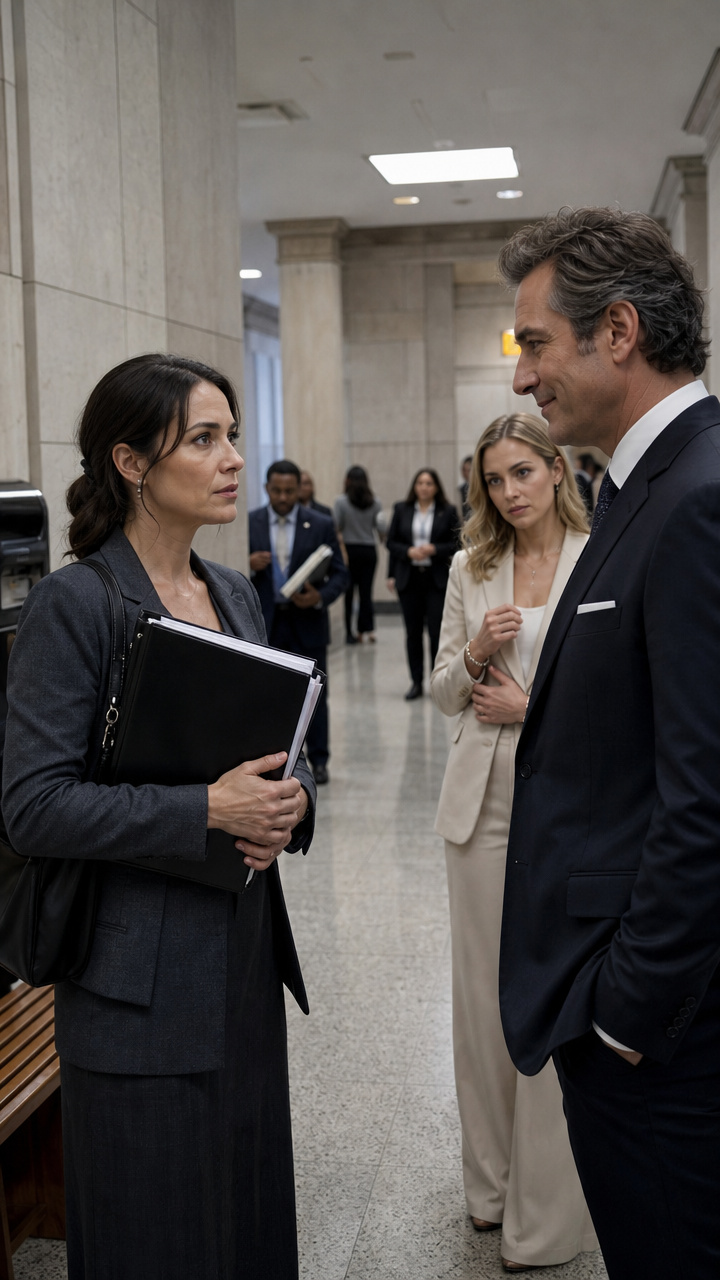
I requested the public records and compared them with the actual bank transfers.
First I found one discrepancy.
Then another.
The records showed deferred payments that never reached our household accounts. He reported consulting income, yet the family budget never saw it.
I followed every trace.
The money led to two limited-liability companies registered to virtual offices. Their names were so bland they seemed designed to discourage curiosity.
Their accounts were far more interesting.
Daniel moved money through those companies and used it to pay private expenses.
I was no longer documenting only adultery and extravagance.
I was mapping something larger: the blind faith of a man who believed he could move between systems forever without being properly examined.
Daniel was married to a woman who thought like an auditor.
For years, he had mocked my spreadsheets.
Emotion arrived at strange moments, never while I was analyzing the data. Among the numbers, my mind was clear. They quieted my feelings.
The pain came later.
I remembered the vacation we canceled because Daniel claimed work had entered its most demanding period. Then I saw a hotel charge in a coastal resort town dated exactly those days.
That was when it hurt.
I met Chloe properly at a company gathering.
She looked as though every detail of her appearance had been planned separately. Daniel introduced her with counterfeit warmth.
“This is Chloe. My right hand. I’d be lost without her.”
She laughed as though he had said something daring.
When I shook her hand, I looked at her wrist.
The clover bracelet was gone. Perhaps she had considered it too recognizable.
Instead, she wore a delicate gold chain.
I knew that one too.
It had appeared earlier in the account records.
“It’s wonderful to finally meet you,” she said.
She paused almost imperceptibly before the word finally.
Women sometimes use that pause to draw a quiet boundary—to let a wife know who now occupies more space in a man’s life.
“Likewise,” I replied. “How long have you worked for the company?”
“Eight months.”
Interesting.
The hotel charges had begun nine months earlier.
Throughout the evening, Daniel touched Chloe’s elbow more often than any professional relationship required. More often than he had asked whether I was cold during the entire previous winter.
Watching them no longer hurt.
It confirmed the evidence.
I chose Arthur Whitmore as my attorney for a reason.
I was not a panicked wife looking for comfort. I was preparing a case.
A former colleague gave me his name.
“He isn’t flashy,” she warned. “He won’t comfort you unless you ask him to. But if you have strong documents, he’ll immediately see where to strike.”
His office occupied the second floor of an old brick building. It smelled of paper, polished wood, and damp coats. There were no glass conference rooms or framed photographs of smiling clients.
Arthur sat behind a worn desk.
“Mrs. Carter,” he said without standing. “What brings you here?”
I liked him immediately. He did not waste words.
I took the first binder from my bag. It was nearly four inches thick, and every page contained notes explaining what it showed.
“I want to discuss financial misconduct.”
His eyebrows rose slightly.
“Most people begin with the affair.”
“An affair can be interpreted,” I replied. “These documents cannot.”
I started at the beginning.
The unauthorized business expenses.
The gambling.
The inheritance.
The mortgage.
The forged signature.
The hidden income.
I left out nothing. I did not dramatize. I sounded like a financial adviser presenting an audit to a board of directors.
In reality, that was exactly what I was doing.
Arthur rarely interrupted. His questions were short and precise. I could almost see him turning the structure over in his mind, examining each support beam of the invisible building and calculating where it would collapse.
When I finished, he removed his glasses and set them on the desk.
“You did not come here for consolation,” he said.
“No.”
“You want a strategy.”
“Yes.”
A slow smile appeared on his face.
“Excellent. Consolation usually costs more than it is worth.”
He tapped the binder.
“If these records survive scrutiny, we can challenge your husband’s claims to the house, demand compensation for assets he unlawfully dissipated, and force him to disclose the full extent of his property and income.”
He paused.
“That disclosure may create problems far beyond the divorce.”
“There is a condition?”
“One.”
He looked directly at me.
“You must not make a single careless move.”
“No arguments.”
“No outbursts.”
“No premature confrontation.”
“Not one word about what you know.”
“Daniel cannot learn the extent of your evidence.”
I considered that.
“What will it accomplish?”
“Men like your husband depend on underestimating everyone around them,” Arthur said. “Before the case reaches the courtroom, they have already written the ending.”
“Then let him keep writing.”
“Let him look down on you.”
“Let him behave badly.”
“Let him assume you are frightened.”