“Let his attorney prepare a simplified version of events.”
Arthur put his glasses back on.
“If he lies under oath—and he probably will, because arrogance and dishonesty travel well together—we will show him the true cost of false testimony.”
For the first time since finding the receipt, I felt relief.
Not because I wanted revenge.
Perhaps some part of me did.
But something else mattered more.
Another person had seen the same structure I had seen. I did not need to translate facts into emotional language for him to take them seriously.
He did not see suffering.
He saw leverage.
For the next month, only Arthur and I knew how thoroughly Daniel’s world was about to unravel.
The lawsuit was filed quietly.
Daniel immediately became more himself than ever.
He performed importance at every opportunity. He hired Victor Hayes, an attorney who looked like a polished display case and wore cuff links far more expensive than etiquette required.
Victor sent me a settlement proposal so insulting that, without the elegant letterhead, it might have passed for a joke.
I was offered a small sum and a limited share of the “liquid assets.” I was forbidden to ask questions about personal spending.
The message between the lines was obvious:
Daniel intended to keep the hidden system.
Arthur called me after reading the proposal.
“Your husband thinks you are too weak to fight.”
“He is wrong.”
“I know.”
A brief silence followed.
“That is why this will hurt him so much.”
When formal discovery began, the structure Daniel had built developed its first major cracks.
Victor filed long objections and delayed financial disclosures. Arthur did not pressure him. He waited.
Each delay became evidence of intentional obstruction. Every missing record strengthened our position.
We hired a digital-forensics specialist to analyze the electronic confirmation used for the second mortgage. An independent handwriting expert examined the signature.
The report was brief, unemotional, and devastating.
We requested the company records connected to Daniel’s reimbursement claims. The company’s legal department responded reluctantly, yet sent the documents faster than expected.
Apparently, someone inside the organization had already begun to suspect that something was wrong.
Daniel behaved as if the court had already awarded him everything. In his imagination, he divided money no one had given him.
Chloe appeared beside him more often. She posted a photograph from a rooftop bar with the caption:
“New chapters require brave decisions.”
Someone sent me a screenshot, perhaps believing that forwarding another person’s secret was a form of help.
I thanked them and added it to the evidence.
The more certain Daniel became of victory, the less careful he grew.
A week before the hearing, he called me for the first time in months.
I nearly let it go to voicemail.
“Emily,” he said, pretending to be generous, “we don’t have to drag this out.”
I said nothing.
“You never liked conflict. Accept the offer. You can buy a smaller place. You’ll still have that little business of yours. You’ll manage somehow.”
He paused.
“We both know you weren’t made for a fight.”
I stood in the kitchen looking at the basil growing on the windowsill.
“From now on, communicate through our attorneys.”
He gave a quiet laugh.
“Always so formal. That’s your problem. Life isn’t a spreadsheet.”
“No,” I said. “But divorces often end in one.”
I ended the call.
On the morning of the hearing, I wore a charcoal suit.
Not black. I did not want to look as if I were attending a funeral.
It was not dramatic or fashionable. It was simple, well cut, and calm. I wore no jewelry except a watch.
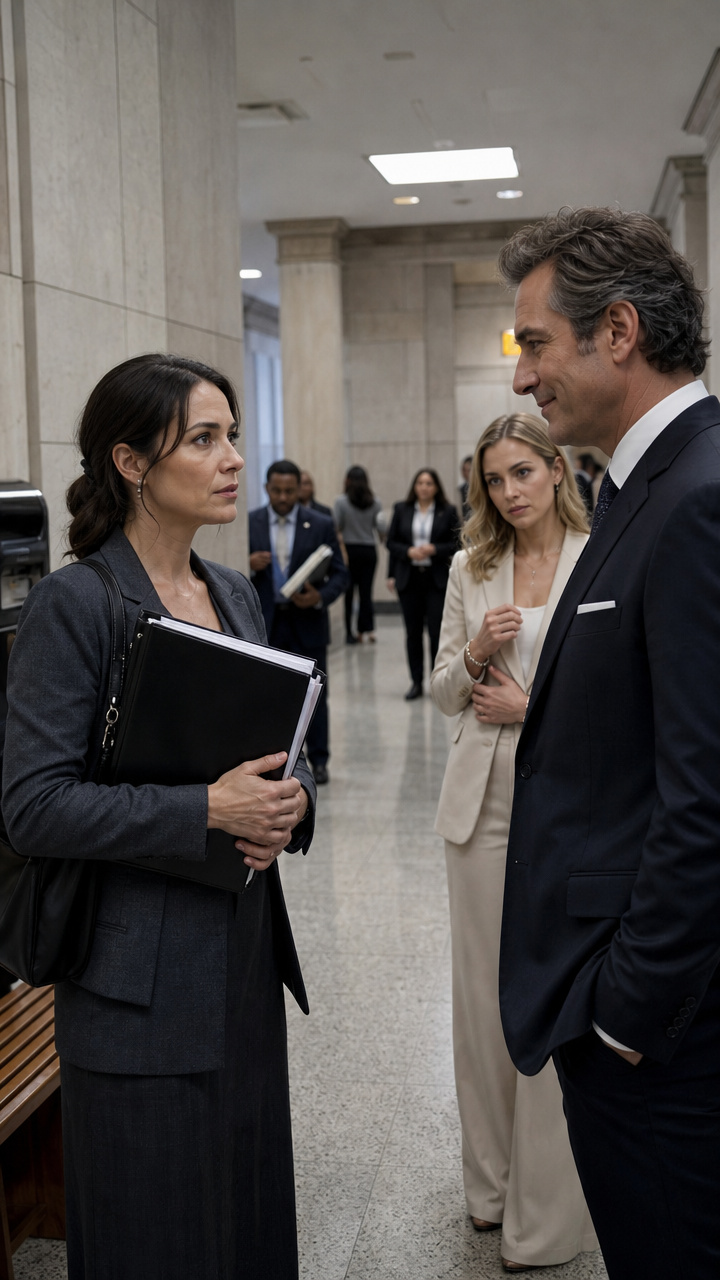
Daniel arrived in a navy suit with a wine-colored tie. Chloe followed several steps behind him, like a passing trend that had mistaken itself for destiny.
Victor carried an expensive leather briefcase. It looked impressive.
It would soon prove too weak to carry the day waiting for its owner.
The courtroom was smaller and plainer than the rooms shown on television. Polished wood bore the marks of years. Narrow windows softened the cold light. The air smelled of paper, dust, and an aging ventilation system.
The judge was a woman in her sixties with the expression of someone who had spent a lifetime listening to excuses and had no patience left for lies wrapped in expensive packaging.
Victor spoke first.
He used too many words. He described Daniel as a successful executive who worked day and night. He presented me as a bitter wife trying to drag her husband down.
He called my work “simple bookkeeping services.” He described the house as ordinary marital property. He attributed the loss of the inheritance to poor investments and called my request for a financial investigation excessive.
His greatest mistake was this sentence:
“A woman financially dependent on her husband.”
Arthur did not object.
He let Victor build the pile.
Then Daniel took the witness stand.
He did exactly what Arthur had predicted.
He lied.