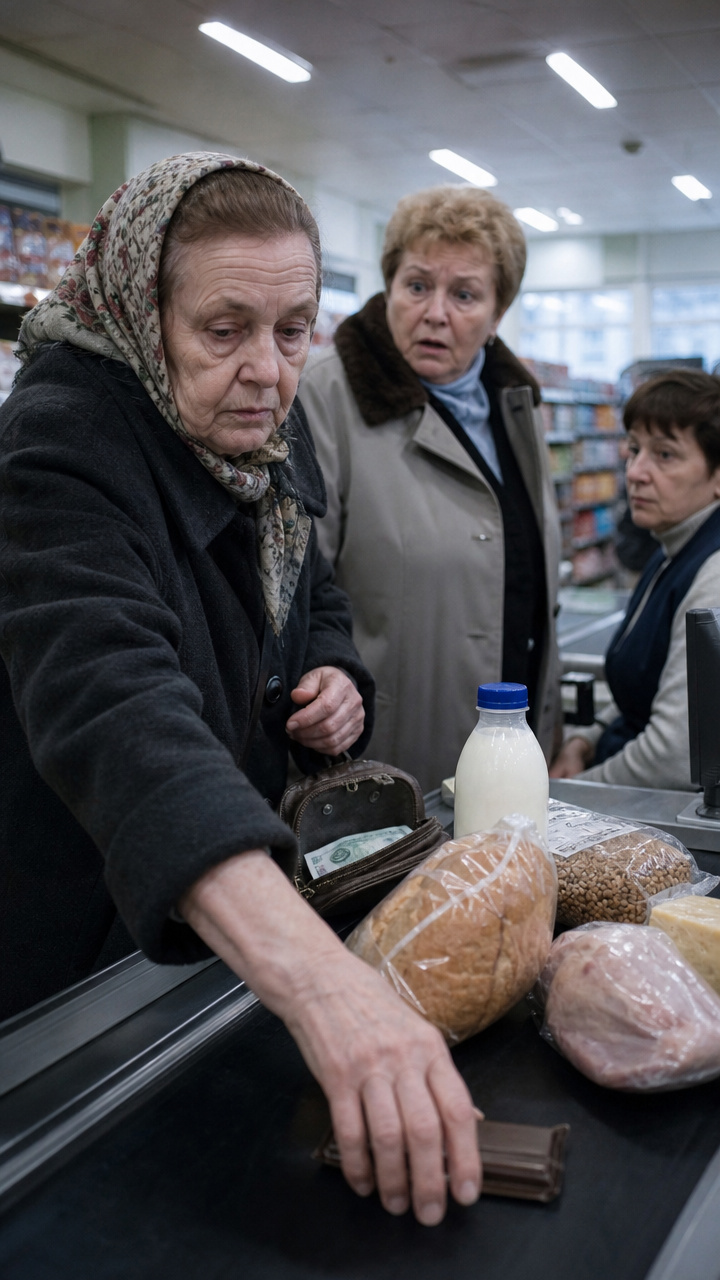
I wanted to turn away.
Honestly, I did.
I wanted to pretend I had not recognized her, leave the store quickly, and bury the encounter somewhere in the back of my mind.
But Margaret glanced in my direction.
And I knew at once that she recognized me too.
“Hello, Claire.”
I froze.
“Hello…”
We stood near the entrance while people moved around us with their carts. A child nearby begged his mother for chewing gum. Someone argued angrily on the phone beside the ATM.
And I looked at the woman whose life had once been cut in half by a single decision.
I had no idea what people were supposed to say in a moment like that.
“How have you been?”
There could hardly have been a more foolish question.
Margaret gave me a faint smile.
“I’m still here.”
Then she told me she knew Daniel had died.
She had heard it from her daughter.
The same little girl who had locked herself in her room thirty years earlier while her father packed his bags.
I asked how the girl was now.
Margaret studied my face.
“Do you truly want to know?”
I did not answer.
“She became disabled after an accident,” Margaret said. “It happened a long time ago. She walks with difficulty and can’t work properly. We live together.”
I had never known.
Daniel had never told me.
Or perhaps he had mentioned it once, and I had not really listened.
Or perhaps I had never asked a question in a way that required me to hear the answer.
I offered to drive Margaret home.
Even now, I do not know why.
Perhaps I wanted to silence the sudden, unpleasant feeling of guilt.
Or perhaps, for the first time in that entire story, I wanted to be something other than the winner.
I wanted to be a human being.
At first she refused.
Then, after a moment, she agreed.
She looked exhausted.
We barely spoke during the drive.
From time to time, I glanced at her from the corner of my eye: the old but clean coat, the worn purse resting in her lap, the gray hair pinned neatly at the back of her head.
And suddenly I remembered something Daniel had said thirty years earlier:
“She stopped being a woman a long time ago. All she knows is farming, complaints, and dissatisfaction.”
For the first time, I wondered whether she had ever stopped being a woman at all.
Perhaps she had simply been carrying a child, a household, and a husband who was already living emotionally with someone else.
I pulled up outside her building.
It was an ordinary old apartment block with five floors. The entrance door was peeling. Two elderly women sat on a bench nearby. Bright curtains hung in the windows on the ground floor.
For some reason, I said:
“I’ve thought many times that I should have spoken to you.”
Margaret did not turn around.
“When?”
I could not find an answer.
“I don’t know. Back then.”
Her voice remained calm.
“Back then, you didn’t want to talk. You wanted to win.”
The words were so accurate that I had nothing to say against them.
Margaret opened the car door, then paused. She closed it again and looked at me.
“Do you know,” she said, “I hated you for a very long time.”
I nodded.
“I understand.”
“No,” she replied. “You don’t.”
She tightened both hands around her purse.
“You didn’t only take my husband. You took my ordinary life.”
The sentence seemed to knock the air from my lungs.
I immediately wanted to argue.
To say that no one could steal a grown man unless he wanted to leave.
That Daniel had made his own choice.
That he had come to me willingly.
That if everything at home had truly been fine, he would never have gone.
I knew those arguments by heart.
For thirty years, they had protected me like armor.
But beside me sat a woman who had just returned a chocolate bar because she could not afford it.
And suddenly all my carefully prepared explanations sounded pitiful.
Margaret spoke quietly.
She did not shout.
She did not accuse me hysterically.
That made every word even heavier.
She told me that at the time she had been caring for Daniel’s mother after a stroke.
She was constantly taking their daughter to doctors.
She had been working two shifts.
And while she was doing all of that, her husband came home handsome and well-groomed, carrying the scent of my perfume on his shirt.
Yet she was still expected to be lighthearted, interesting, cheerful, and understanding.
When Daniel left, Margaret was only thirty.
She had not been an old woman.
She had not been some spiteful, joyless creature.
She had not been a wife who had “stopped taking care of herself.”
She had been a thirty-year-old mother with a child, a loan, and a sick mother-in-law.
And Daniel had left his mother in Margaret’s care for another six months while he and I arranged our new, happy life.
“I didn’t know,” I whispered.
Margaret turned toward me sharply.
“Did you want to know?”
I said nothing.
The answer was obvious.
No.
I had not wanted to know.
I needed a convenient story in which true love was stronger than circumstance.
A story where I had betrayed no one.
Where the first wife was responsible for the broken marriage.