A skirt. A blouse. Her hair carefully arranged.
She had prepared for this.
“Please come in, Officer,” she said. “Look at what I’m dealing with. A strange woman is living in my son’s apartment. She locks the bedroom, refuses to let me enter, and is tormenting an elderly person. I want you to take action and remove her.”
The word remove struck me almost physically.
My palms turned cold.
It was the same sensation I felt in the laboratory when I dropped a nearly finished dental piece and realized there was no way to repair it.
Helen remained by the door, clearly intending to hear everything.
The officer sighed.
“Let’s take this one step at a time. Who lives here?”
“I do,” Margaret answered. “Margaret Lewis. I’m registered at this address. I even have the stamp in my passport.”
She handed him the document.
He examined it and returned it.
“Who else?”
“My son, Daniel. He’s away on business. And her.”
He turned to me.
“Who are you?”
“Daniel’s wife. Claire Bennett.”
“Do you have documents relating to the apartment?”
“Of course.”
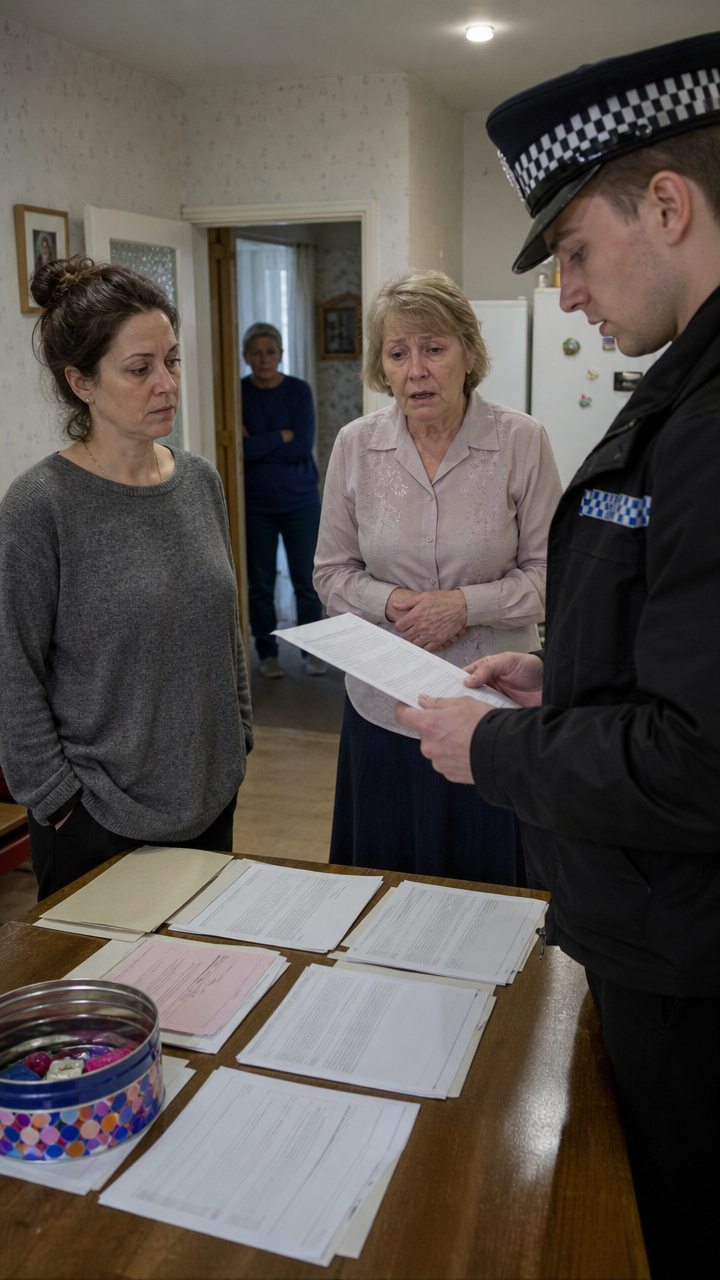
I brought over a stool, took the metal candy tin from the top shelf, and set it on the kitchen table.
The lid gave the same little crackle it had made twenty years earlier.
The officer spread the papers out in front of him.
Then he began reading aloud.
Calmly.
Precisely.
Like a report.
“Extract from the property register. Apartment measuring seventy-four point two square meters. Registered owner: Claire Bennett. Type of ownership: sole ownership. Registration date: 2019.”
“What?” Margaret whispered.
He continued.
“Purchase agreement from the same year. Buyer: Claire Bennett. Sale price: four hundred and thirty thousand dollars.”
He turned the page.
“Certificate of inheritance. Two-bedroom apartment on Civic Street. Heir: Claire Bennett. Year of inheritance: 2014.”
Another sheet.
“Sale agreement for that property. Sale price: four hundred and thirty-five thousand dollars. Bank statements show the funds were received and transferred during the same month toward the purchase of the present apartment.”
He raised his eyes.
“So the current apartment was purchased with funds from the sale of inherited property. The ownership record is quite clear.”
The kitchen became so quiet that I could hear the refrigerator running.
“That’s wrong,” Margaret said. “This is my son’s apartment. Daniel himself said in 2019, ‘We bought an apartment.’ He said we bought it!”
“‘We’ meant our family,” I replied. “You heard whatever suited you. In seven years, you never once asked whose name was on the paperwork.”
Margaret stopped shouting.
She stared at the documents.
Her lips moved, but no sound came out.
“Do you have any documents proving ownership?” the officer asked her.
“I’m registered here!”
“Registration does not make someone an owner. Ownership is established by this document.”
He tapped the property extract.
The woman who had spent thirty-seven years managing dormitory rooms through lists and records now stood in someone else’s kitchen without a single paper supporting her claim.
“Then at least remove her,” Margaret said, much more quietly.
“I won’t remove her,” Officer Miller replied. “The police do not decide civil property disputes. The sole owner is here lawfully, in her own home. I see no grounds for police intervention. If there are property claims between you, they must be addressed through civil court.”
He closed the folder.
“The call was officially registered, correct?” I asked.
“Yes. I’ll file a report.”
“Good. I may need it.”
That was when I made my decision.
I had not planned it in advance.
I simply understood that I would never have a more suitable moment.
A police officer was in the apartment.
A neighbor stood in the doorway.
All the documents were spread across the table.
I took a sheet of paper and a pen.
Then I sat down and began writing in block letters, the way my grandfather had taught me: anything important should be written clearly enough that no one could later argue over the handwriting.
“Demand for the release of residential premises and removal from the registration record by the thirty-first.”
I placed the paper in front of Margaret and offered her the pen.
“What are you doing?” she whispered. “Do you even understand what you’re doing?”
“Yes. I’m giving you four weeks. You must move out and remove yourself from the registration record by the thirty-first. If you do not, I will file a claim in district court.”
“I’m sixty-six years old!”
“I know. Three weeks ago, I cleared the table after your birthday celebration.”
Helen covered her mouth with one hand.
The officer looked away.
This was no longer his matter, but the situation had clearly become uncomfortable for him.
Margaret did not sign immediately.
Her hand trembled.
The signature came out crooked.
Then I took out my phone and called Rachel in front of everyone.
I switched on the speaker and placed the phone between the cups and the documents.
“Rachel, good evening. This is Claire. Your mother called the police today to have me removed from my own apartment. It didn’t work. She is moving in with you by the thirty-first.”