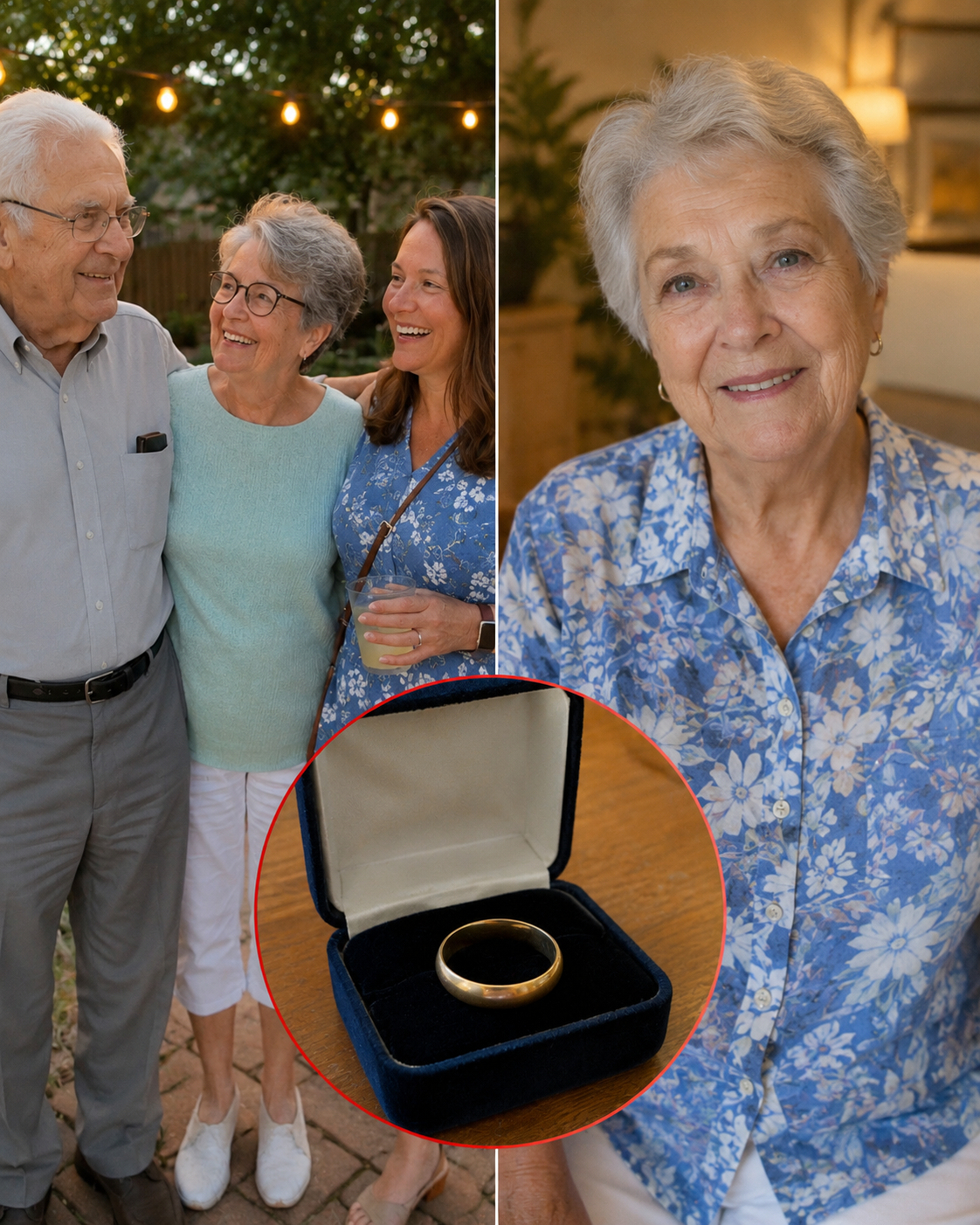
A few weeks after my father died, the bank opened a safe-deposit box he had kept for decades and handed me something I never expected to find among his things. What started as a small errand in the middle of grief led me into a part of his life none of us knew existed.
My father died last spring at eighty-two, and the first strange thing he did after death was send me to the bank.
A woman there told me I was the beneficiary on a safe-deposit box he had rented since 1978. She said it like routine paperwork. It did not feel routine to me.
Instead, there was a velvet pouch and a folded note.
My father was the kind of man who labeled extension cords and saved screws in old coffee tins. He believed in life insurance, fresh batteries, and not talking about feelings unless a funeral forced the matter. So of course I expected papers, maybe war medals, maybe my grandmother’s earrings wrapped in tissue.
Instead, there was a velvet pouch and a folded note.
Inside the pouch was a woman’s wedding ring, plain gold with a tiny nick near the stone, the kind of mark that comes from years of ordinary use. The note had only six words.
She looked at the ring, then at me, then back at the ring.
“Return this to Sarah. I’ve waited too long.”
I asked my mother if she knew a Sarah.
She looked at the ring, then at me, then back at the ring.
“Not that I know of,” she said.
But her voice had gone careful in the way grief makes people careful around anything sharp.
Then I started sorting through my father’s papers, partly because grief makes you clean drawers just to keep your hands busy, and partly because that note felt planted like a question mark under my skin.
Three evenings later I found the first payment.
Three evenings later I found the first payment.
It was small, yearly, and carefully buried.
My parents had kept separate accounts for practical things, a habit from the lean years when every bill had to be sorted by hand. My mother paid the house bills. My father handled insurance, taxes, and anything he could file away before anyone asked.
Once I knew what I was looking for, I found nearly forty of them, moving through different accounts, cashier’s checks, and once through a friend’s business. He had not hidden them because they were illegal. He had hidden them because secrecy made guilt easier to manage.
I told myself it could not be an affair.
He had hidden them so well that if I had not been looking for Sarah, I never would have seen her.
I told myself it could not be an affair.
My parents had spent more than fifty years moving through the world like two people who had learned the same rhythm and never lost it. My father brought my mother tea every night at nine. He sharpened her colored pencils because arthritis hurt her fingers.
Eventually I found Sarah’s name on an old business tax form from the year the store closed, listed beside the apartment over the shop.
I told her my father had died and the bank had given me the box.
A week later I was standing on the porch of a small white house with the ring in my pocket and my father’s note folded into my wallet.
An elderly woman opened the door before I knocked twice.
“Are you Sarah?”
The moment she saw the ring, she sat down hard in the doorway.
“He kept it all these years?” she whispered.
I told her my father had died and the bank had given me the box.
Sarah said the ring belonged to her husband’s wedding set, then stopped herself so abruptly I heard her teeth click.
What she gave me instead was one sentence.
“I promised never to explain unless he came himself,” she said.
I told her I was not leaving with half a story.
She asked me to go.
I did not.
What she gave me instead was one sentence.
“Your father was not the only man who failed me.”
That sent me looking in a direction I would never have imagined.
He remembered my father right away.
I pulled old business records at the county office and found my father’s name tied to a failed hardware store in the late seventies. The second name on the paperwork was Tom.
My father had never mentioned owning a business with anyone.
The old storefront was a laundromat now, but the barber next door had been there since before I was born and remembered everything.
He remembered my father right away.
“Careful man,” he said. “Steady man.”
My father signed papers without reading closely enough.
Tom was the opposite.
“Could sell a shovel during a drought,” the barber said. “And charm you while he borrowed the money to buy it.”
According to the barber, Tom borrowed against the store and the apartment above it without telling my father the full risk. My father signed papers without reading closely enough. When the business collapsed, Sarah lost both.
Tom disappeared.
My father was left with signatures he had not understood and a debt he never stopped trying to repay.