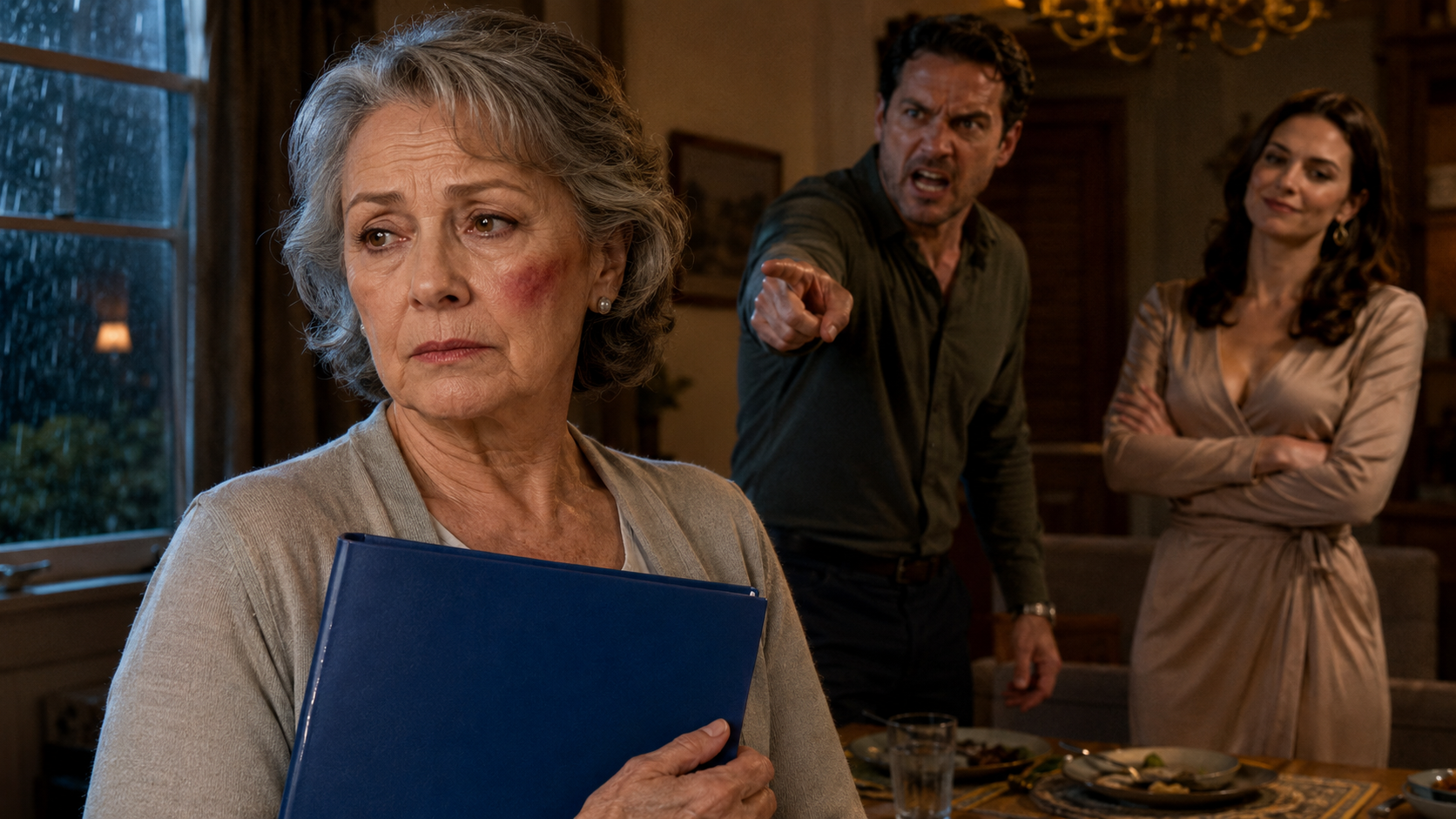
Her Son Raised His Hand at Dinner While His Wife Smirked, “This House Belongs to Us”—But They Never Knew What She Had Hidden in the Blue Folder

“You can throw my plate away, you can call me useless, you can even pretend I’m a stranger in my own home,” Evelyn Hart said, her voice shaking but clear. “But do not raise your hand to me again, Adrian.”

The dining room went still.

For a second, the only sound was the rain tapping against the kitchen windows and the faint ticking of the old wall clock Evelyn’s late husband had bought at a flea market twenty-seven years ago. That clock had survived three moves, one flood, two broken springs, and the death of the man who used to wind it every Sunday morning. Evelyn had always believed some things survived because they were made with care.

She used to believe that about families too.

Adrian stood at the end of the table with his jaw clenched, his face red from anger and wine. He was forty-two now, taller than his father had been, broader in the shoulders, dressed in the expensive gray shirt his wife had bought him for his birthday. To anyone outside the house, Adrian Hart looked like a successful man. He drove a polished black SUV. He wore cologne that lingered in rooms long after he left them. He spoke loudly on the phone about contracts, clients, renovations, and investments.

But inside that house, he spoke to his mother as if she were a debt he regretted inheriting.

Across from Evelyn, his wife, Bianca, leaned back in her chair and smiled over the rim of her wineglass. She was beautiful in the sharp way knives were beautiful under bright light. Her hair was smooth, her nails perfect, her voice sweet whenever neighbors were present. But when the front door closed, sweetness disappeared from her face like a mask being lifted.

“Oh, Evelyn,” Bianca sighed, as if bored by an old performance. “Don’t be dramatic. Nobody is attacking you. Adrian is just tired of your attitude.”

Evelyn looked down at the plate in front of her. Roast chicken with rosemary potatoes. She had cooked it because Adrian once loved it as a boy. He used to run into the kitchen when he smelled rosemary and ask if he could steal a potato before dinner. He used to hug her from behind while she washed dishes and tell her she was the best cook in the whole world.

That boy had vanished so completely that sometimes Evelyn wondered whether she had invented him to survive the man he became.

“I asked him not to sell the back garden,” Evelyn said quietly.

Adrian slammed his palm on the table so hard the silverware jumped.

“You asked?” he snapped. “You don’t ask anything. You live here because I let you live here.”

The words landed harder than the blow that came later.

Evelyn lifted her eyes slowly. Her cheekbones were thinner than they had been ten years ago. Her silver hair was pinned at the back of her neck, though a few strands had escaped from the humidity. At sixty-four, she still carried herself with the dignity of a woman who had worked too many years to bow easily. She had cleaned offices at night, typed invoices in a mechanic’s shop, sold handmade curtains, and stretched soup until it fed three people instead of one. She had buried a husband, raised a son, and paid every bill that ever crossed her table.

And now that son stood in her dining room telling her she had been permitted to exist.

“This is my home,” she said.

Bianca laughed.

Not loudly. Not wildly. Just one small, polished sound.

“Your home?” she said. “Evelyn, please. Look around. Adrian pays for everything now.”

“That is not true.”

“It feels true,” Bianca replied, smiling wider. “And honestly, perception matters.”

Adrian pointed toward the hallway. “You hear that? Even Bianca understands. You don’t. You keep clinging to old papers and old memories like they mean something.”

Evelyn’s fingers tightened around her napkin.

Old papers.

He had no idea.

Years earlier, when Evelyn’s husband, Thomas, had still been alive, he had warned her about trusting people too easily.

“Love your son,” Thomas had told her once, sitting at the kitchen table with his reading glasses low on his nose. “But don’t hand him your backbone and call it kindness.”

Evelyn had laughed then. Adrian had been twenty, sweet-faced, impatient, always asking for money but always kissing her cheek afterward. She had never imagined she would need protection from her own child.

After Thomas died, Adrian changed slowly at first. He borrowed small amounts and forgot to return them. Then he began criticizing the way Evelyn dressed, the way she cooked, the way she spent money. When he married Bianca, the criticism became organized. Bianca called it “help.” Adrian called it “getting Mom under control.”

They convinced Evelyn to let them move in “temporarily” after Adrian’s business slowed down. Temporary became two years. Then three. Then Bianca began replacing curtains, ordering new furniture, speaking to contractors, and telling guests how she planned to “modernize the place once everything was officially settled.”

Officially settled.

That phrase had followed Evelyn like a cold draft.

One winter afternoon, Adrian had brought home a stack of documents and told her they were necessary for tax reasons, estate planning, and future stability. He said the words quickly, confidently, like a man used to not being questioned. Bianca stood behind him with a pen and a smile.

Evelyn had nearly signed.

Nearly.

But Thomas had been gone only eighteen months then, and grief had made her cautious. She took the papers to a retired solicitor named Malcolm Reid, an old friend from church. Malcolm read them twice, then looked at Evelyn over his glasses.

“Do not sign these,” he said.

“What are they?”

“A trap dressed as paperwork.”

After that, Evelyn stopped telling Adrian what she knew. She allowed him to believe she was confused. She allowed Bianca to believe she was weak. She placed the unsigned transfer documents, the original deed, mortgage satisfaction letter, tax receipts, insurance records, and Malcolm’s written legal notes into a blue folder with a cracked plastic spine.

Then she locked it in the bottom drawer of Thomas’s old desk.

For three years, that blue folder sat in silence while Adrian grew bolder.

He changed the Wi-Fi password and forgot to tell her. He moved her favorite chair to the garage because Bianca said it made the living room look “depressing.” He told her not to answer the door when his friends came over because she “made everything awkward.” Bianca stopped letting Evelyn use the washing machine on weekends because those were “their laundry days.” They spoke about selling the garden, renovating the attic, renting out the spare room.

They spoke as if Evelyn were already dead.

That night, the fight began because Evelyn found a man measuring the back garden without her permission.

She had gone outside with a basket of damp towels and seen a stranger near the old apple tree Thomas planted the year Adrian was born. The tree leaned badly now, but every spring it still flowered. Evelyn loved it because Thomas used to say it was stubborn like her.

“What are you doing?” she asked the man.

He looked embarrassed. “Just taking measurements, ma’am. Mr. Hart said the rear section might be divided for development.”

Mr. Hart.

Not Mrs. Hart.

Not the owner.

Mr. Hart.

Evelyn sent the man away.

At dinner, she asked Adrian about it.

That was all.

One question.

And now her son stood over her with murder in his eyes over land that was not his.

“I will not allow anyone to cut down Thomas’s tree,” Evelyn said.

Adrian’s lips curled. “Dad is dead.”

The room became colder.

Evelyn stared at him. “Do not speak of your father like that.”

“Why not? You use him whenever you want sympathy. Dad’s chair, Dad’s clock, Dad’s tree, Dad’s house.” Adrian leaned closer. “He’s gone, Mom. And this house is mine now.”

Bianca set down her glass and gave Evelyn a look of triumph. “Ours, actually.”

Evelyn pushed back her chair.

“I think dinner is over.”

Adrian moved faster than she expected.

His hand closed around her wrist.

“Sit down.”

“Let go of me.”

“Sit down!”

Evelyn pulled away, and something inside Adrian snapped. His hand rose and struck her across the face.

The sound was small.

That was what shocked Evelyn most.

A slap did not sound like thunder. It sounded like a dropped book. A sharp, ordinary sound. Something that could happen in any home while the rain fell and the potatoes went cold.

Her head turned with the force of it. Her glasses slid from her face and hit the floor. Pain bloomed across her cheek. For a moment she could not breathe.

Bianca did not gasp.

She laughed.

Then she lifted her phone.

“Careful,” Bianca said lightly. “She’ll probably tell people you attacked her.”

Adrian’s chest rose and fell. He looked at his hand as if surprised to find it belonged to him. But the surprise lasted only a second. Pride returned. Anger returned. Cruelty returned.

“That,” he said, pointing at Evelyn, “is what happens when you forget who runs this house.”

Evelyn bent slowly and picked up her glasses. One lens was cracked.

She did not cry.

That frightened Bianca more than tears would have.

Evelyn placed the glasses on the table, stood straight, and looked at her son.

“You just made a decision for both of us,” she said.

Adrian scoffed. “What does that mean?”

“It means I am finished being patient.”

Bianca rolled her eyes. “Finished? What are you going to do, Evelyn? Call your little church friends?”

Evelyn looked at her daughter-in-law for a long moment.

“No,” she said. “I am going to call someone who knows where the bodies are buried.”

Bianca’s smile flickered.

Adrian stepped forward again. “Are you threatening me?”

Evelyn did not answer.

She turned and walked out of the dining room. Her knees trembled, but she did not let them see. In the hallway, she touched the wall to steady herself, passing framed photographs that told the lie of a happy family. Adrian at eight holding a baseball glove. Adrian at sixteen beside his first car. Adrian at his wedding, smiling while Evelyn stood beside him in a blue dress Bianca had later called “unflattering.”

Inside her bedroom, Evelyn locked the door.

Then the tears came.

Not loud, not dramatic, not the kind Bianca accused her of using for manipulation. These tears were silent and hot and humiliating. She pressed a towel against her mouth so no sound escaped. Her cheek throbbed. Her wrist hurt where Adrian had grabbed her.

But beneath the pain was something stronger.

A door closing.

Evelyn went to Thomas’s desk. The bottom drawer stuck, as it always did. She pulled twice, then reached under the edge for the small brass key taped behind the wooden lip.

Her hands shook as she unlocked it.

The blue folder was exactly where she had left it.

For years, she had thought of that folder as protection for the future.

Now the future had arrived at dinner.

She opened it on the bed.

The deed. Her name.

The letter from the bank confirming the house had been fully paid off six months before Thomas died.

The property tax receipts paid from her account.

The unsigned transfer documents Adrian once tried to rush her into signing.

Malcolm’s notes.

A copy of Thomas’s will.

And one envelope Evelyn had never opened because she could not bear to do it.

On the front, in Thomas’s handwriting, were four words:

For when you forget.

Evelyn sat on the edge of the bed.

Rain slid down the window glass. Downstairs, she heard Bianca murmuring angrily and Adrian opening another bottle. They were not worried. Of course they were not worried. They believed fear would return Evelyn to obedience by morning.

She opened Thomas’s envelope.

Inside was a single page.

My Evie,

You are stronger than you think, but you have always loved people past the point where they deserve it. I know you. You will forgive too much. You will explain away too much. You will say, “He is my son,” as if that makes every wound holy.

It does not.

If Adrian becomes a good man, love him freely.

If he becomes a cruel man, protect yourself without shame.

A mother gives life. She is not required to give herself as a sacrifice forever.

The house is yours. Keep it that way.

Live.

—T

Evelyn read the letter once.

Then again.

By the third time, she was no longer crying.

At 7:18 the next morning, Evelyn left the house with the blue folder under her coat.

Adrian and Bianca were still asleep.

She walked three blocks in the rain to the bus stop. Her cheek was swollen. She wore dark glasses though the sky was gray. An older woman waiting beside her glanced at the bruise but said nothing. Evelyn was grateful. Pity would have broken her; silence allowed her to stand.

At 8:05, she entered Malcolm Reid’s small office above a pharmacy.

He was seventy-two, narrow-shouldered, white-haired, and sharper than most men half his age. He looked up from his desk with a warm smile that disappeared the moment he saw her face.

“Evelyn.”

She placed the blue folder on his desk.

“My son hit me,” she said.

Malcolm closed his eyes for one second.

When he opened them, there was no shock left in them. Only focus.

“Sit down,” he said gently. “Tell me everything.”

So she did.

For the first time, she did not soften the story. She did not say Adrian was stressed. She did not say Bianca misunderstood. She did not say she had provoked him. She told Malcolm about the slap, the threats, the garden, the documents, the years of humiliation, the phone Bianca had lifted as if Evelyn’s pain were entertainment.

Malcolm listened without interrupting.

When she finished, he opened the blue folder and examined every page.

Then he said the words Evelyn had needed to hear for years.

“The house is yours. Not his. Not hers. Yours.”

Evelyn exhaled slowly.

“What can I do?”

“A great deal,” Malcolm said. “But first, we protect you. Not the house. You.”

By noon, Evelyn had seen a doctor, documented her injuries, and made a statement. By two, Malcolm had contacted the proper authorities and arranged for legal protection. By three, he had confirmed that no transfer of ownership had ever been completed. By four, he had advised Evelyn not to return home alone under any circumstances.

At five-thirty, Adrian arrived back at the house with Bianca.

They expected dinner.

They expected silence.

They expected Evelyn to move around the kitchen with a bruised face and lowered eyes.

Instead, they found two officers near the porch, Malcolm standing beside the front steps, and a locksmith closing his toolbox.

Adrian got out of the SUV and slammed the door.

“What is this?”

Bianca froze behind him. Her eyes moved from the officers to the locksmith to Malcolm.

“Adrian,” she whispered. “What did you do?”

It was the first honest question she had asked in years.

Adrian ignored her and marched forward.

“Where is my mother?”

Malcolm stepped toward him.

“Mrs. Hart is safe.”

“Safe?” Adrian laughed. “From what?”

One officer looked at him. “Mr. Hart, we need to speak with you regarding an incident that occurred last night.”

Adrian’s face hardened.

“There was no incident.”

Bianca shifted behind him.

Malcolm held up a copy of the documents from the blue folder.

“There is also the matter of the property.”

Adrian’s eyes narrowed. “What property?”

“This property.”

“You mean my house?”

“No,” Malcolm said. “I mean your mother’s house.”

The street seemed to go silent around them.

Bianca stared at Adrian. “You said it was transferred.”

“It was,” Adrian snapped.

“It was not,” Malcolm replied. “Your mother never signed the transfer. The deed remains in her name. The mortgage was satisfied years ago. She has full legal ownership.”

Bianca’s mouth opened.

No words came out.

For the first time since Evelyn had known her, Bianca looked ordinary. Not elegant. Not powerful. Just frightened.

Adrian pointed at Malcolm. “You don’t know what you’re talking about.”

“I know exactly what I’m talking about.”

“This is family business.”

“No,” Malcolm said. “Last night made it legal business.”

Adrian turned toward the officers. “She’s confused. She’s old. She doesn’t understand finances.”

One of the officers looked at him calmly. “Then she seems remarkably prepared for someone confused.”

Bianca took one step away from Adrian.

He noticed.

“Don’t start,” he hissed.

She swallowed. “You told me she had nothing.”

Adrian’s face twisted. “She was supposed to have nothing.”

The words came out before he could stop them.

Malcolm’s expression did not change, but his eyes sharpened.

Bianca heard it. The officers heard it. Even Adrian heard it, and for one brief moment shame flickered across his face.

Then rage covered it.

“That old woman ruined my life,” he said.

From across the street, Mrs. Ellison opened her curtains. A delivery driver slowed his van. Someone walking a dog stopped at the corner.

Adrian saw them watching and lowered his voice.

“Tell her to come out.”

“No,” Malcolm said.

“I want to talk to my mother.”

“You lost the privilege of demanding anything from her when you struck her.”

Adrian lunged forward, but an officer stepped between them.

“Sir, stay where you are.”

Bianca whispered, “Adrian, stop.”

He turned on her. “Shut up.”

And there it was.

The voice he used on Evelyn, now aimed at Bianca in public.

Something changed in Bianca’s face. It was small, but Malcolm saw it. So did the officer. So would Evelyn have, if she had been there.

Bianca touched her phone.

The officer noticed.

“Ma’am,” he said, “did you record anything last night?”

Adrian spun toward her.

“Don’t.”

Bianca’s hand trembled.

“You told me to record her,” she whispered.

“Delete it.”

“Ma’am,” the officer said firmly, “do not delete anything.”

Bianca looked at Adrian, and for the first time, her fear of losing comfort was stronger than her loyalty to cruelty.

“I have the video,” she said.

Adrian cursed so loudly Mrs. Ellison stepped fully onto her porch.

That evening, Evelyn sat in a quiet guest room at Malcolm’s sister’s house, wrapped in a soft green blanket. Her cheek still hurt. Her wrist was bandaged. A cup of tea cooled beside her.

Malcolm called at 8:40.

“It has begun,” he said.

Evelyn closed her eyes.

“Was he angry?”

“Yes.”

“Did he ask if I was all right?”

There was a pause.

“No.”

She nodded, though Malcolm could not see.

A final string inside her heart loosened and fell away.

For the next several weeks, Evelyn did not return to the house alone. Legal steps moved slowly, but they moved. Adrian shouted, threatened, apologized, blamed Bianca, blamed money, blamed stress, blamed Evelyn’s “coldness,” blamed his father’s death, blamed anyone except himself.

He left seventeen voicemails before the order stopped him.

The first was angry.

The third was pleading.

The seventh accused Evelyn of destroying the family.

The twelfth said, “Mom, come on, you know I didn’t mean it.”

Evelyn listened once, then stopped.

Malcolm told her she did not need to collect pain to prove it existed.

Bianca moved out of the house two days after the confrontation. She went to her sister’s apartment with three suitcases and a face stripped of confidence. She tried calling Evelyn once.

Evelyn answered.

For a few seconds, neither woman spoke.

Then Bianca said, “I’m sorry.”

Evelyn sat by the window, watching rain gather on the leaves outside.

“Are you sorry you laughed,” she asked, “or sorry you chose the wrong side?”

Bianca cried then.

Evelyn did not comfort her.

That was new.

A month later, Evelyn returned to the house with Malcolm, a locksmith, and Mrs. Ellison from across the street, who brought lemon biscuits and refused to let Evelyn carry a single box.

The house smelled stale. Adrian and Bianca had left drawers open, cabinets half-empty, and one broken glass in the sink. In the dining room, Evelyn found the table still scratched from the night Adrian slammed his hand down.

She ran her fingers over the mark.

For a moment, she saw him as a boy again. Bare feet on the kitchen tile. Jam on his chin. A gap where his front tooth had been. A child laughing under the apple tree while Thomas lifted him onto his shoulders.

Her heart cracked.

But it did not open.

That was the difference.

Grief visited her, but it no longer had a key.

By spring, Evelyn made her decision.

She would not sell the house to developers. She would not let Adrian’s greed be the last story the walls remembered. Instead, she divided the home differently. The upstairs rooms were renovated into a small rental apartment for traveling nurses. The back garden remained intact. Thomas’s apple tree was pruned by a careful gardener who said it had years left if treated gently.

Evelyn painted the front door deep blue.

Not because of the folder.

Because blue, Thomas once told her, was the color of distance and freedom.

On the first warm evening of May, Evelyn invited four women from church, Mrs. Ellison, Malcolm, and Malcolm’s sister for dinner. She cooked roast chicken with rosemary potatoes.

At first, she worried the smell would bring back the memory of that night.

But when her guests filled the dining room with laughter, the memory lost some of its teeth.

Mrs. Ellison lifted her glass of lemonade.

“To Evelyn,” she said. “Who kept the house and found herself.”

Evelyn smiled.

“No,” she said softly. “I did not find myself. I stopped abandoning myself.”

Everyone grew quiet.

Then Malcolm raised his glass too.

“To that, then.”

Later, after everyone left, Evelyn stood alone in the garden beneath the apple tree. Blossoms moved gently in the night breeze. The house behind her glowed with warm light. Her house. Her windows. Her walls. Her life.

She thought of Adrian.

She did not hate him.

That would have been easier, perhaps. Cleaner. But motherhood had roots too deep for simple endings. She loved the child he had been. She mourned the man he had chosen to become. And she understood, finally, that love did not require access.

Some doors could be closed with love.

Some locks could be changed with grief.

Some blue folders could hold more than documents.

Sometimes they held the last proof a woman needed that she had the right to save herself.

Evelyn looked up at the branches Thomas had planted long ago.

The tree was still standing.

So was she.

Her Son Raised His Hand at Dinner While His Wife Smirked, “This House Belongs to Us”—But They Never Knew What She Had Hidden in the Blue Folder
Kindness always comes back.