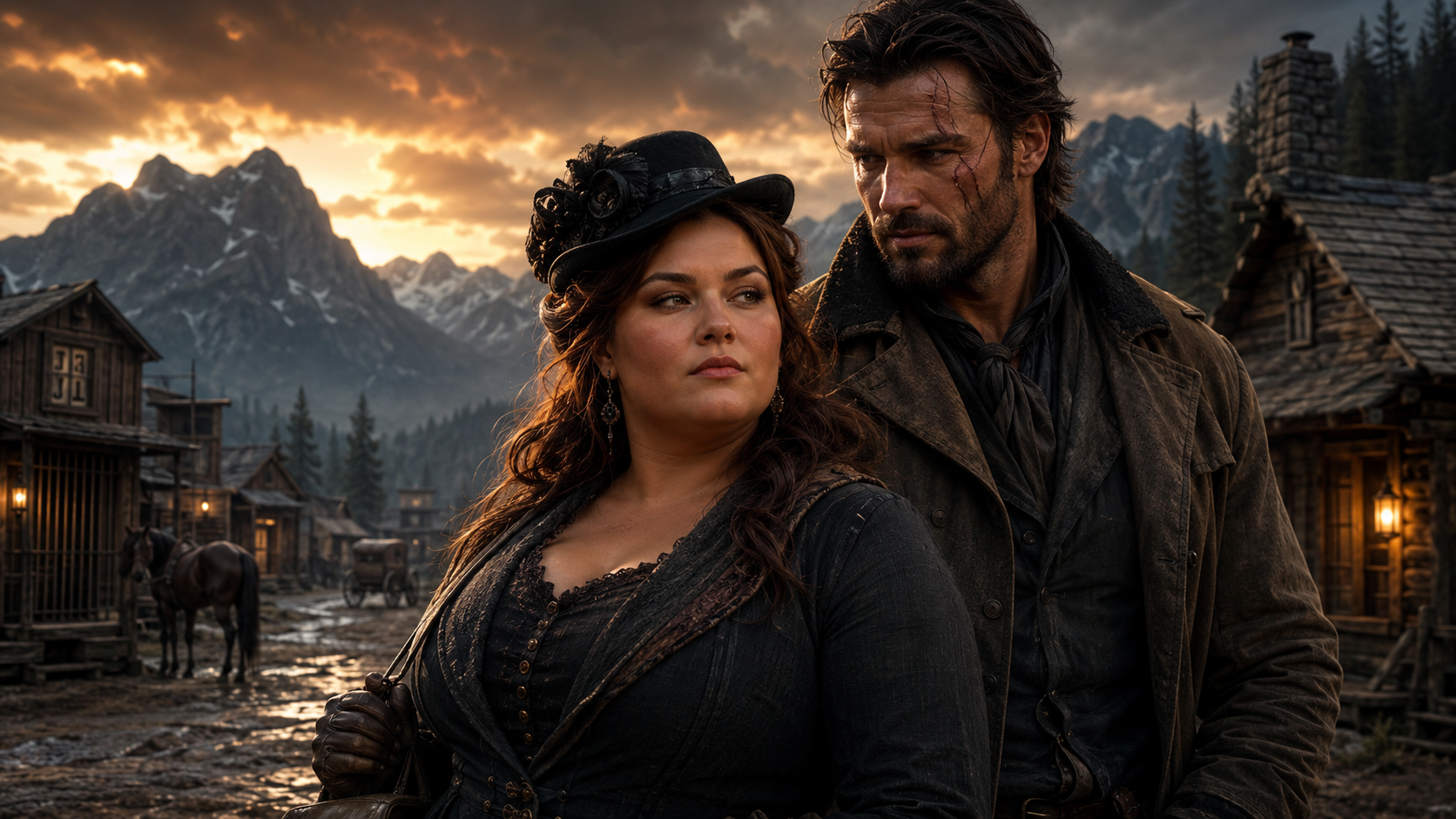
She released him.
For a second, neither of them moved.
Then he lowered his voice. “Back to the cabin.”
They had taken only three steps when something struck the ground at Miriam’s feet.
A stone.
Wrapped in white cloth.
Gideon raised his pistol toward the trees.
Miriam bent before he could stop her and picked up the cloth.
It was not cloth.
It was a torn piece of bridal veil.
Pinned through it was a scrap of paper.
The message had been written in block letters.
SIXTH BRIDE, SIXTH GRAVE.
Gideon went pale beneath the scar.
“You’re leaving at first light.”
“No.”
“You saw this.”
“I read it.”
“Then understand it.”
“I do.”
“No, you don’t.” His voice rose. “This is not a parlor game. Someone followed us. Someone came onto my land. Someone knows you’re here.”
“Good.”
“Good?”
“Yes. It means I frightened them.”
Gideon looked as if he could not decide whether to shake her or admire her.
“They threatened to bury you.”
“People who intend murder quietly do not usually send invitations first.”
“You’re gambling with your life.”
“I have been doing that since I opened my sister’s trunk.”
His anger faltered.
The crying sound began again, farther away now.
Miriam turned toward it.
This time, beneath the false sobbing, she heard something else.
A metallic scrape.
A hinge.
Not a ghost.
Not a woman.
A device.
She said, “Tomorrow we search the ridge.”
“We?”
“Yes.”
“No.”
“Then I search alone and fall into a ravine. You will feel terrible.”
“You are difficult.”
“You are observant.”
He exhaled through his nose.
The crying stopped once more.
Above them, the pines shifted in the wind like witnesses changing their stories.
They did not sleep much.
Gideon dragged a chest against the cabin door and sat in a chair facing the window with his pistol on his knee. Miriam lay on the cot, still dressed, a blanket pulled over her. The fire burned low. Shadows moved across the ceiling.
Around midnight, Gideon spoke.
“Mrs. Bell.”
“Yes?”
“Why did your sister come to Briarfall?”
“To start over.”
“From what?”
“A man who mistook love for ownership.”
Gideon said nothing.
Miriam watched the fire sink and glow.
“Beatrice was pretty in a way that made people forgive her before she spoke,” she said. “I was not. So I learned to speak clearly.”
“That sounds lonely.”
“It was useful.”
“Useful things can still be lonely.”
She turned her head toward him.
His scar looked harsher in the firelight. Not monstrous. Simply permanent.
“How did it happen?” she asked.
He knew what she meant.
“A mine blast. I was twenty-two. My father was trapped below. I went in after him. Came out with half my face opened and him dead in my arms.”
“I’m sorry.”
“Most people ask if it hurt.”
“Did it?”
“Yes.”
“Then I’m sorrier.”
His eyes lowered.
After a while he said, “When the first bride ran, I understood. When the second ran, I expected it. By the fifth, I thought maybe the mountain was warning women away from me because I had stopped deserving company.”
Miriam felt the ache in that confession more than she wanted to.
“Loneliness is a poor judge of worth,” she said.
“So is a town.”
“Yes. But towns are louder.”
At dawn, they found footprints by the creek.
Two sets.
One large, one narrow.
Both leading away from the cabin toward the east ridge.
Gideon knelt in the mud. “Not mine.”
“Crowe?”
“Maybe. The larger print has a nailed heel.”
“Does Elias Crowe wear nailed heels?”
“No. But his freight men do.”
They followed the tracks with a rifle, a lantern, rope, and two biscuits wrapped in cloth. Miriam insisted on bringing her notebook. Gideon looked at it as if paper could not possibly help in a forest full of threats.
“You would be amazed what men confess to paper,” she said.
“I prefer when they confess to my fist.”
“That is why one of us is frequently tied behind jails.”
He grunted.
The trail climbed through black pines and granite outcrops. Twice Gideon offered a hand over difficult stones. Twice Miriam accepted without apology. She did not mistake help for weakness, and he did not offer it like charity. That made the taking easier.
They found the first machine inside a hollow stump.
It was a small bellows, a reed pipe, and a cord threaded through brush.
When the cord was pulled from a distance, the air pushed through the reed and made a sound like a woman crying.
Gideon stared at it.
His face emptied.
Then filled with something worse than anger.
“Ruthie,” he said.
Miriam crouched beside the stump. “Someone used this to drive her away.”
“She thought it was a spirit.”
“She was meant to.”
He ripped the device free and hurled it against a rock. It shattered.
Miriam did not stop him.
Some grief deserved the dignity of breaking something.