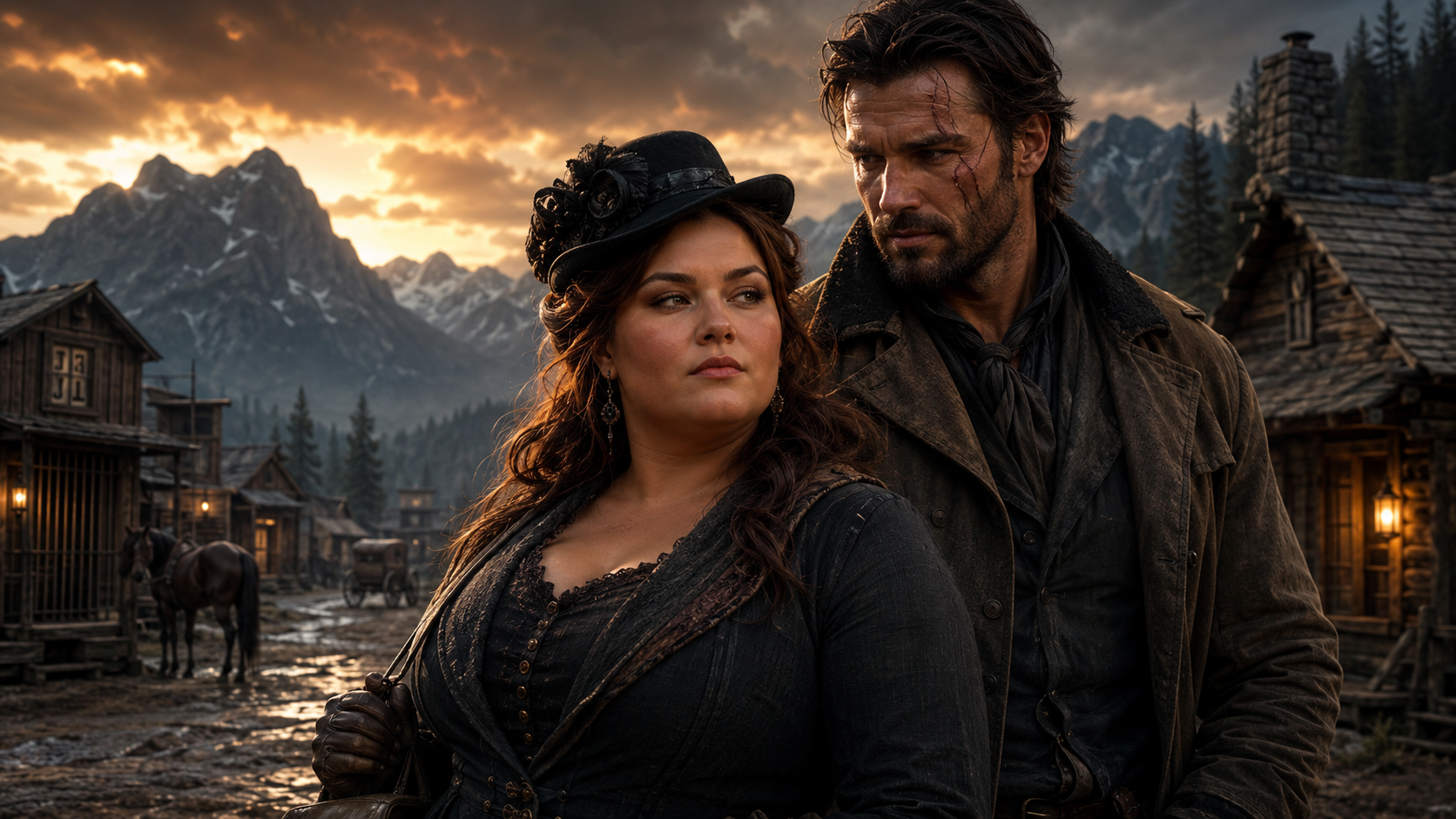
The crowd followed her.
Briarfall’s jail sat at the end of the street, a square timber building with iron bars and a crooked sign. Behind it, in a yard churned with mud, a man stood with his wrists tied to a hitching post.
He was taller than Miriam expected.
Not merely tall, but built like the mountain had taken a human shape and forgotten to make it gentle. His shoulders strained against a weather-dark coat. His hat lay in the mud. Black hair fell across his brow. A long scar cut from his left temple down across his cheek and vanished into the beard along his jaw.
It was not a tidy scar.
It was pale, raised, and brutal.
It pulled slightly at the corner of one eye, giving his face a permanent look of pain or anger, depending on what a person wanted to see.
The town had clearly chosen anger.
Miriam chose pain.
Sheriff Cale Dobbs stood a few feet away with a shotgun resting over one arm. He was a thick man with nervous eyes.
“Gideon Rusk,” Elias said smoothly, stepping into the yard, “you have a visitor.”
Gideon did not look at the storekeeper.
He looked at Miriam.
His eyes were gray.
Not cold, exactly.
Tired.
He looked at her face first. Then at the trunk behind her. Then at the crowd. His mouth tightened.
“You should leave,” he said.
His voice was low, rough from disuse or weather.
Miriam stepped closer. “That is a poor greeting for a man expecting a bride.”
“I stopped expecting brides after the third one.”
“And yet you wrote.”
“I answered a letter. That is not the same as asking a woman to ruin herself.”
A murmur moved through the crowd.
Miriam heard the word ruin repeated twice.
She looked at the sheriff. “Why is he tied?”
Sheriff Dobbs shifted his weight. “Disturbance.”
“What sort?”
“He struck Mr. Crowe.”
Miriam turned her head toward Elias.
Elias touched a finger to the bruise blooming along his jaw. “A misunderstanding.”
Gideon’s expression darkened. “Tell it plain.”
“All right,” Elias said, still smiling. “Mr. Rusk accused me, in front of witnesses, of hiding his mail.”
“Were you?”
The question landed quietly.
Elias’s smile vanished.
Sheriff Dobbs stared at her. “Mrs. Bell, you don’t know what you’re stepping into.”
“That is why I asked.”
Gideon looked at her more carefully now.
Elias gave a small laugh. “You see? Already he has begun. This is how it happens. First he convinces a woman the town is against him. Then he takes her up that ridge where no one can hear her change her mind.”
Miriam studied him.
“Did the first five change their minds before or after speaking with you?”
The yard went silent.
Gideon’s shoulders went still.
Elias Crowe did not move.
But something in his face tightened, like a shutter pulled too quickly across a window.
“I beg your pardon?” he said.
“The five brides. Did they speak with you before they fled?”
“That is an offensive question.”
“Yes.”
Miriam turned back to the sheriff. “Untie him.”
Sheriff Dobbs laughed once. “Ma’am, this is not your business.”
“It became my business when your town used my arrival as theater.”
“He assaulted a man.”
“Then charge him or release him.”
Dobbs looked at Elias.
Miriam noticed that too.
So did Gideon.
A small change passed over Gideon’s face. Not surprise. Confirmation.
Elias sighed as if surrounded by unreasonable children. “Sheriff, let him go. We don’t need more unpleasantness in front of Mrs. Bell.”
The sheriff hesitated, then untied Gideon’s wrists.
Gideon pulled free and rubbed one wrist with the opposite hand. The rope had bitten deep enough to leave blood.
Miriam took a handkerchief from her sleeve and held it out.
He stared at it.
The crowd stared harder.
“Take it,” she said. “Before you bleed on your own pride.”
Something almost like amusement moved through his eyes.
He accepted the handkerchief.
Their fingers did not touch.
He wiped the blood from his wrist and handed it back.
“Keep it,” Miriam said.
“I’ll ruin it.”
“It is a handkerchief, Mr. Rusk. Its purpose is not decoration.”
A faint sound escaped him.
Not quite a laugh.
Not quite forgotten.
But close enough that the town seemed offended by it.
Miriam saw it then: the town did not merely fear Gideon Rusk.
They needed him to be fearsome.
A monster was useful.
A lonely man was not.
Gideon picked his hat from the mud and struck it once against his thigh. “My horse is at the livery.”
“My trunk is behind me.”
“You brought a trunk?”
“I dislike arriving unprepared.”
“You won’t need half of what’s in it.”
“You don’t know what’s in it.”
He looked toward the ridge road. “Trail turns mean after dusk.”
“Then we should not waste daylight.”
Elias stepped forward. “Mrs. Bell, I urge you—”
Miriam faced him fully.
“Mr. Crowe, I have received your warning, your insult, and your performance. That is enough of you for one afternoon.”