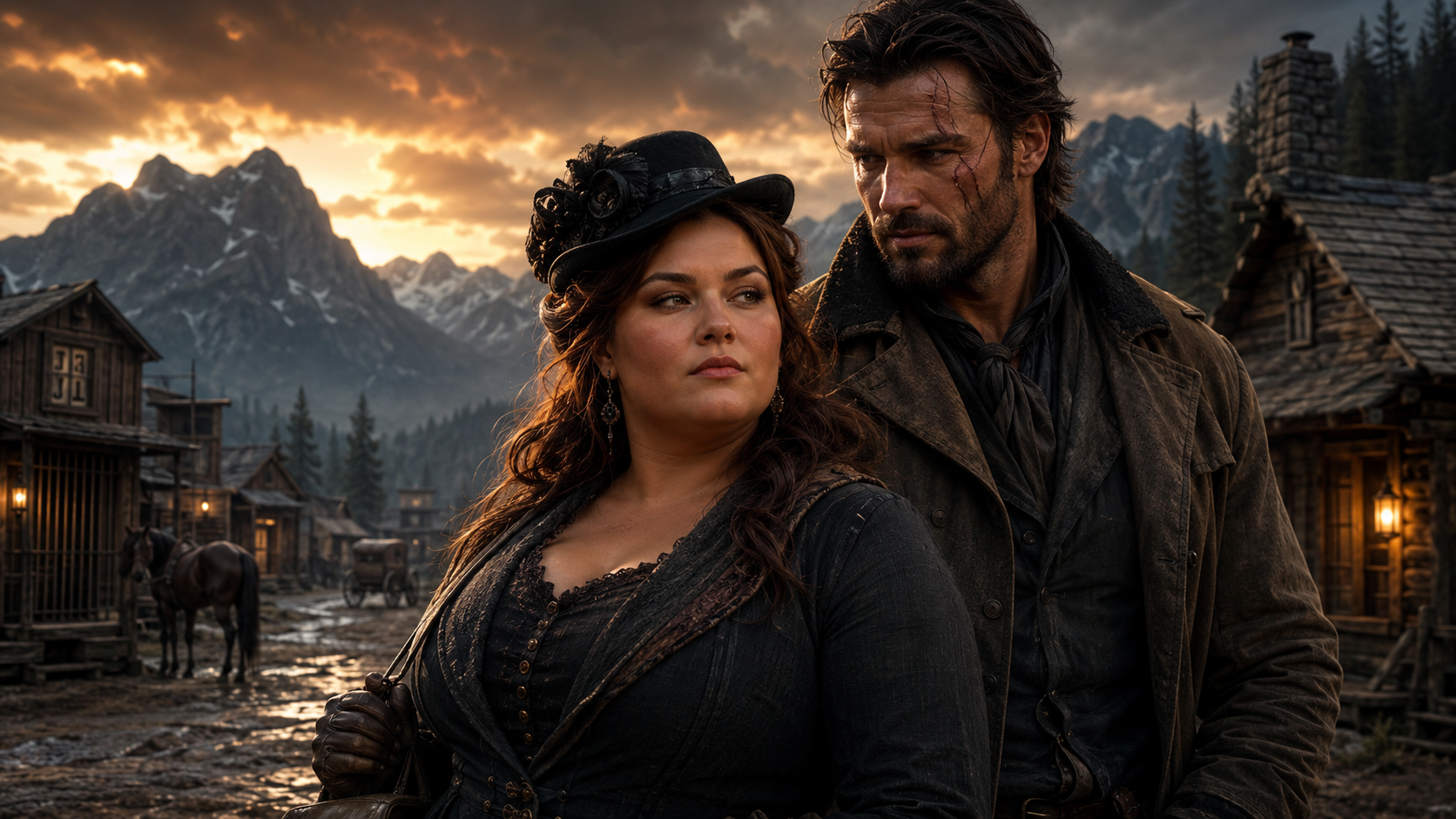
A few people gasped.
Gideon looked at her as if she had done something more dangerous than slap a wolf.
Elias bowed slightly.
But his eyes had gone flat.
“As you wish,” he said. “The mountain keeps what it takes.”
Miriam smiled without warmth.
“Only if no one digs.”
For the first two miles, Gideon said nothing.
Miriam rode a brown mare he had borrowed from the livery, while he rode ahead on a black horse with one torn ear. Her trunk had been tied to a pack mule that looked as offended by the arrangement as the town had been by her confidence.
The road climbed quickly out of Briarfall.
Below them, the town shrank into a scatter of roofs, smoke, and judgment. Above them, Blackpine Ridge rose dark and steep, its trees packed so tightly that sunlight entered in broken pieces. Spring had touched the valley, but winter still hid beneath the pines. Snow lingered in the shadows. Meltwater ran in silver threads down the rocks.
Miriam’s thighs ached after the first hour.
She did not complain.
A lifetime in a large body had taught her the price of admitting discomfort. People used it as proof. Proof she was weak. Proof she was burdensome. Proof she had no business attempting anything difficult.
So she set her jaw and rode.
Gideon slowed after a while.
“You can say if you need to stop.”
“I know.”
“You’re not saying it.”
“I don’t need to stop.”
“You’re gripping the saddle horn like you plan to strangle it.”
“I dislike falling.”
“So do most people.”
“Then most people are sensible.”
He glanced back. “The fourth bride cried by now.”
“I am not the fourth bride.”
“The second fainted.”
“Did she have a tight corset?”
“Yes.”
“Then she was defeated by architecture, not the mountain.”
This time Gideon did laugh.
It was brief and rusty, but real.
Miriam kept her face forward, giving him the dignity of not being watched while surprised by his own humanity.
After another stretch of silence, he said, “You didn’t come here to marry me.”
“No.”
He nodded once, as if the answer hurt less because he had already expected it.
“Then why?”
“My sister.”
His horse slowed.
Miriam reached inside her coat and removed the folded letter again. “Her name was Beatrice Bell. She came west two years ago to work as a seamstress. Six months later, she wrote that she had discovered something in Briarfall. Something dangerous. Then she stopped writing. The official notice said fever took her.”
Gideon’s face changed.
“You’re Beatrice’s sister.”
“You knew her?”
“Everyone did. She mended half the town’s clothes and refused to let men pay late.”
“That sounds like her.”
“She died at Crowe’s boardinghouse.”
“So I was told.”
His eyes narrowed. “You don’t believe it?”
“My sister was buried in a borrowed dress. When her effects were returned, the hem of her own dress had been ripped open and poorly sewn shut. Inside it was a scrap of paper with your name on it, the words Blackpine Ridge, and a drawing of a bird with a broken wing.”
Gideon stopped his horse.
The forest seemed to lean closer.
“A bird?” he asked.
“A crow, I think.”
He looked back toward the valley, though Briarfall had long disappeared.
“Elias Crowe.”
“Yes.”
“What else was on the paper?”
“Numbers. I think they were parcel records.”
Gideon’s jaw worked. “Why didn’t you take this to the sheriff?”
“Sheriff Dobbs wrote the notice of death.”
He had no answer for that.
Miriam tucked the letter away. “I wrote to you because your name was hidden in my sister’s dress. Your reply was cautious, bleak, and badly punctuated, but it did not sound like a murderer.”
“Generous.”
“I am known for my charity.”
“You called me stubborn twice.”
“You are.”
“I answered three questions.”
“You avoided nine.”
He looked at her then, and for the first time the scar did not dominate his face. His attention did.
“What do you want from me, Mrs. Bell?”
“The truth.”
“Truth is rarely enough.”
“It is when a lie is standing on someone’s grave.”
Gideon turned forward again.
The road narrowed.
A hawk screamed above the trees.
After a while, Miriam asked, “What happened to the five brides?”
“They left.”
“That is the town’s answer. I asked for yours.”
His shoulders stiffened.
“First was Cora Lane. She saw my face at the stage stop and turned white. Elias Crowe offered her a room to recover. By morning she was gone.”
“And the second?”
“Agnes Miller. She made it to the church steps. Someone told her I had buried my mother under the kitchen floor. She left before supper.”
“Had you?”
“No.”
“Where is your mother buried?”
“Under the aspen trees above my pasture.”
“The third?”
“Lydia Marsh. She came to the cabin. Stayed two nights. On the third, she found a dead raven nailed above the door and said it was an omen.”
Miriam felt a cold pressure at the back of her neck.
“A raven?”