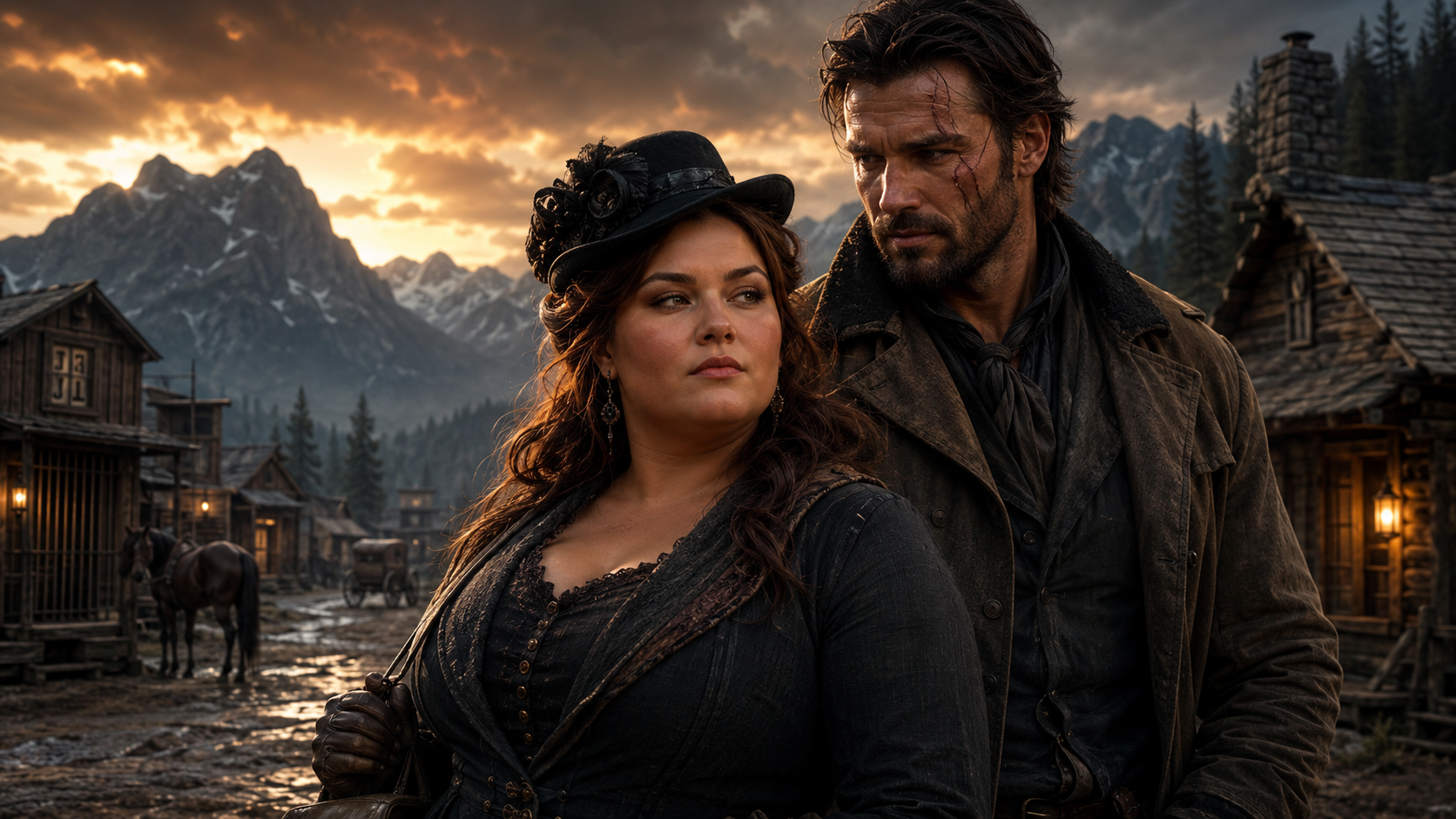
By the time the sixth bride stepped down from the mail wagon, the town had already decided how her story would end.
They had decided it before she put one boot in the mud.
They had decided it before the driver climbed down to lift her trunk.
They had decided it before she straightened her dark traveling dress, adjusted the little hat pinned to her chestnut hair, and looked around at the steep-roofed buildings of Briarfall with the calm, measuring eyes of a woman who had buried too many people to be frightened by gossip.
“She’s bigger than the last one,” someone whispered from the porch of the general store.
“Bigger than all five put together,” another voice muttered.
A few people laughed.
Not loudly. Not bravely.
Briarfall was the sort of town where cruelty liked to pretend it was only observation.
Miriam Bell heard them.
She had spent thirty-four years hearing people believe her body made her deaf, stupid, desperate, harmless, grateful for any crumb of kindness thrown in her direction. She had heard women call her sweet when they meant plain. She had heard men call her sturdy when they meant undesirable. She had heard children repeat insults they were too young to invent.
So she did what she had learned to do.
She let the words pass over her like rain over stone.
Then she reached into her coat pocket, took out a folded letter, and looked once more at the name written on it.
Gideon Rusk.
The scarred rancher of Blackpine Ridge.
The man five brides had come to marry.
The man five brides had fled.
The man the town said was cursed, cruel, half-mad, and hungry for a wife only because no woman with sense would touch him after seeing his face.
Miriam had not come because she wanted a husband.
She had come because her sister had died with Gideon Rusk’s name hidden in the hem of her mourning dress.
The mail wagon driver dragged her trunk from the back and set it down in the mud with a grunt.
“Best leave that here,” he said, not meeting her eyes. “No need hauling it up the ridge if you’ll be back by morning.”
Miriam looked at him.
“I paid you to bring it from Helena.”
“You did.”
“Then I expect it handled like it belongs to a paying passenger, not a doomed animal.”
The driver blinked, startled by the coolness in her voice.
From the general store porch, the laughter stopped.
Miriam bent, gripped the trunk handle herself, and pulled it upright. The mud sucked at the wheels. She pulled again. The trunk came free with an ugly wet sound.
Someone clapped slowly.
The man doing it stood in front of the general store with a cigar between his fingers and a smile that showed every tooth but no warmth.
He was lean, silver-haired, and dressed too well for a town with more snow than money. His waistcoat was blue velvet. His boots were polished. His watch chain flashed against his stomach when he moved.
“Mrs. Bell, I presume,” he said.
“Miriam Bell.”
“Elias Crowe.” He tipped his hat. “Owner of this establishment, half the freight office, and most of the patience left in this town.”
“That sounds exhausting.”
His smile thinned.
A woman beside him coughed into her glove.
Elias Crowe came down the steps. “We’ve been expecting you. Gideon Rusk rarely comes to town unless forced, and when he does, most people prefer not to stand too close.”
“I was told he would meet me.”
“You were told a hopeful lie.” Elias looked past her toward the road climbing into the pines. “Blackpine Ridge is a hard place. Harder than it looks. I feel honor-bound to say that before you make the same mistake as the others.”
“The others?”
“Surely you know.” He lowered his voice as though offering kindness, but his words were meant for the whole street. “Five women came before you. Five decent women. Each of them believed she could tame loneliness. Each of them discovered loneliness was not the danger.”
Miriam folded the letter and tucked it away.
“What was the danger?”
Elias Crowe’s eyes gleamed.
“Gideon Rusk.”
At that moment, a boy came running around the corner so fast he nearly slipped in the mud.
“Mr. Crowe!” he shouted. “Sheriff’s got Rusk tied behind the jail!”
The street changed.
Windows opened.
Doors creaked.
Men stepped from shadows with sudden interest. Women gathered their skirts and moved toward the jail in pairs, eager and afraid.
Elias’s expression flickered.
Only for a heartbeat.
Miriam saw it.
Then he smiled again. “It appears your bridegroom has made your decision easier.”
“My decisions are rarely made by crowds.”
She took hold of her trunk and began dragging it toward the jail.
“Mrs. Bell,” Elias called after her, “that is not wise.”
Miriam did not look back.
“I have survived a train wreck, a winter childbirth that ended in two graves, and a room full of church ladies deciding which pies were acceptable for a funeral supper. I do not frighten easily.”