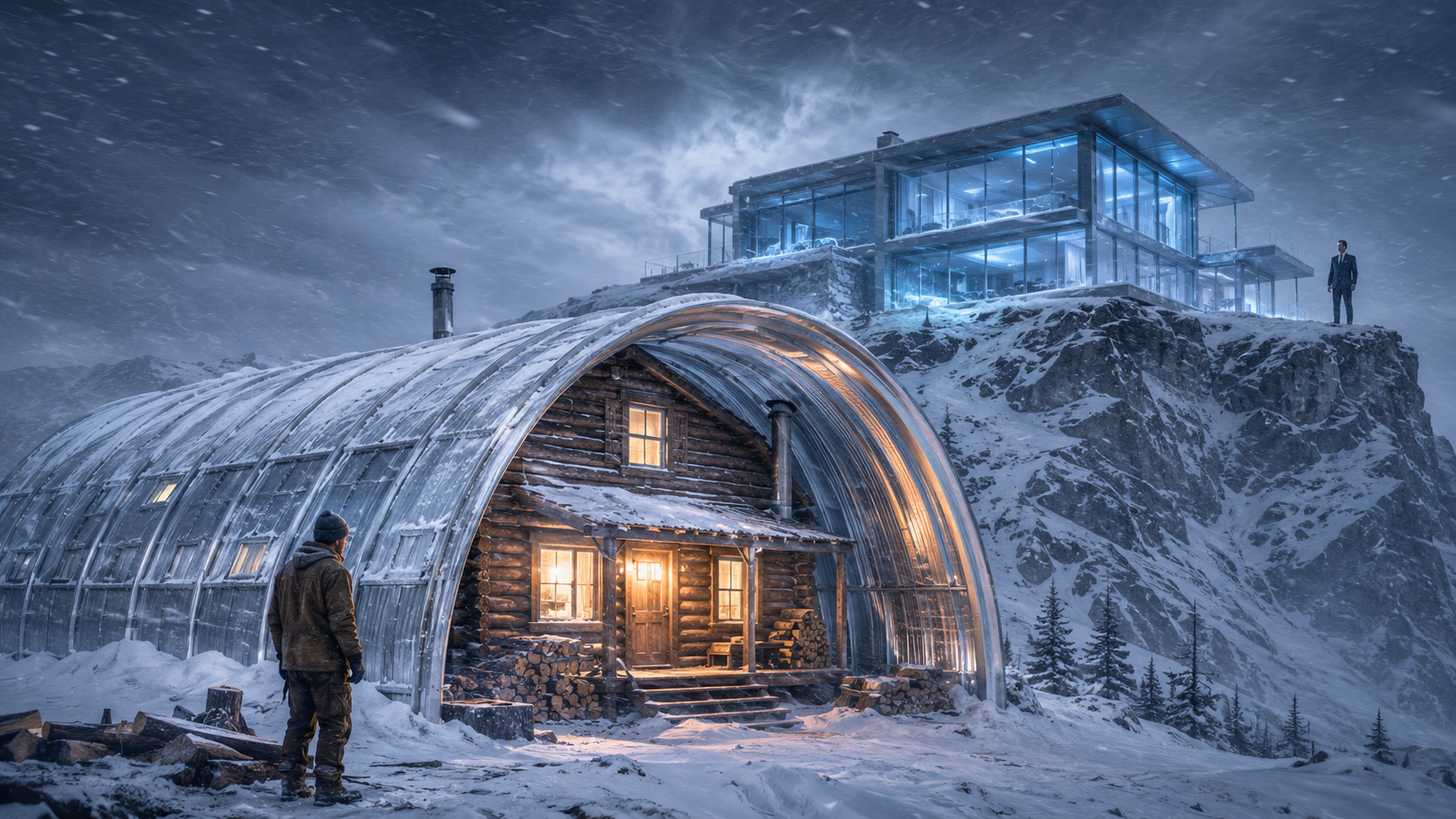
Sterling’s pride fought hard. Pride had built companies, crushed rivals, bought silence, rewritten headlines, and renamed failures as strategy. But fear had his grandson’s blue lips in its arms.
Ten minutes later, Sterling Vale stepped into the worst storm of his life beside his daughter and her child, walking downhill toward the house he had called a coffin.
The walk should have taken twenty minutes.
It took nearly an hour.
Snow erased the path. Twice Sterling fell. Once Lenora slipped, and Sterling caught both her and Milo with a sound that was half grunt, half sob. The wind made speech useless. Their flashlight beams became short white tunnels full of flying ice.
When the curved silver shape finally appeared through the storm, Sterling stopped.
For one irrational moment, it did not look like a coffin.
It looked like a ship.
Not built to impress the sea.
Built to survive it.
Then he was pounding on Caleb Rowan’s door.
Mara opened it.
For a heartbeat, she looked at Sterling Vale standing there covered in ice, Lenora behind him with Milo limp in her arms.
Then she stepped aside.
“Bring him in.”
No one asked why they had come. No one mentioned the store. No one repeated the joke.
Inside the cabin, the air felt impossible.
Warmth did not blast from vents. It did not perform. It simply stayed. It rested in the logs, in the floorboards, in the quilts, in the iron stove, in the still air of a room that had stopped fighting the wind.
Mara worked over Milo with the calm tenderness of a mother who had seen cold hurt children before. She stripped off his wet outer layers, wrapped him in warmed blankets, and held sweet tea to his lips when he stirred. Caleb fed two pieces of birch into the stove, not because the room needed them, but because fear needed something to do with his hands.
Jasper and Nell watched from the table, wide-eyed and silent.
Sterling stood near the door, melting snow dripping from his coat onto the floor. Without an audience, he looked smaller.
Lenora sat beside Milo, holding his hand.
After several minutes, the boy coughed, whimpered, and opened his eyes.
“Mom?”
Lenora broke.
She bent over him and cried with her whole body. Mara put a hand on her shoulder.
“You’re safe,” Mara said. “Both of you.”
Sterling turned toward the wall, but not quickly enough to hide the tears in his eyes.
Caleb saw them and looked away.
There are moments when being right arrives dressed like shame. Caleb had imagined, more than once, what it would feel like for Sterling Vale to stand inside the warm cabin. He had imagined satisfaction. Perhaps even the perfect sentence delivered at the perfect time.
But standing there while a child thawed under his daughter’s quilt, Caleb felt no triumph.
Being right did not feel good when the proof had nearly died.
Later, when Milo slept and the storm hammered harmlessly against the steel shell outside, Sterling approached Caleb.
“I want to understand it,” he said.
His voice was rough.
Caleb almost refused. He was tired. The man had mocked him, dismissed him, and nearly let pride freeze his own family. But then Caleb looked at Milo sleeping beneath Nell’s patchwork quilt and understood that knowledge withheld out of bitterness could become its own kind of cruelty.
So he took a lantern and led Sterling into the air gap.
The corridor between the cabin and the outer shell was narrow, dim, and strange. On one side stood the original log wall, warm enough to smell faintly of cedar. On the other side curved the corrugated steel shell, cold but dry. The storm struck the metal above them with a thousand tiny fists, yet inside the gap the air barely moved.
Sterling touched the log wall.
“It should be colder,” he said.
“Yes.”
“Why isn’t it?”
“Because the wind can’t touch it.”
Caleb lifted the lantern.
“Most people think walls lose heat only because they aren’t thick enough. That matters. But out here, wind is the thief. Moving air strips heat from surfaces fast. Last winter, this wall took the full force of it. I could burn wood all night and still lose.”
Sterling listened.
“The metal isn’t the blanket,” Caleb continued. “That is what people misunderstood. Steel conducts heat. They saw metal and thought cold. I’m not using it as insulation. I’m using it as armor. The shell takes the wind. The air gap stays mostly still. Still air slows heat loss. The cabin finally gets a calm space around it.”
He pointed to the low vent.
“The vents keep moisture from building up. The baffles stop drafts. The gap breathes slowly, but the wind never gets a straight shot at the logs.”
Sterling ran his hand over the wall.
“And your temperature?”
“Tonight? Fifty-five degrees warmer than outside.”
Sterling closed his eyes.
For a long moment, only the storm spoke.
Then he said, “I called it a coffin.”
Caleb looked at him.
“Yes.”
Sterling swallowed.