“I was wrong.”
Caleb did not answer immediately.
An apology from a proud man can be a beginning or a performance. The difference is what he does after the room stops listening.
Finally Caleb said, “You were cold tonight. That teaches faster than arguing.”
Sterling opened his eyes.
“My house cost thirty million dollars.”
“I know.”
“And this works better.”
“In this storm, yes.”
Sterling almost laughed, but it broke apart before it became sound.
“I built something to prove I could defeat the mountain.”
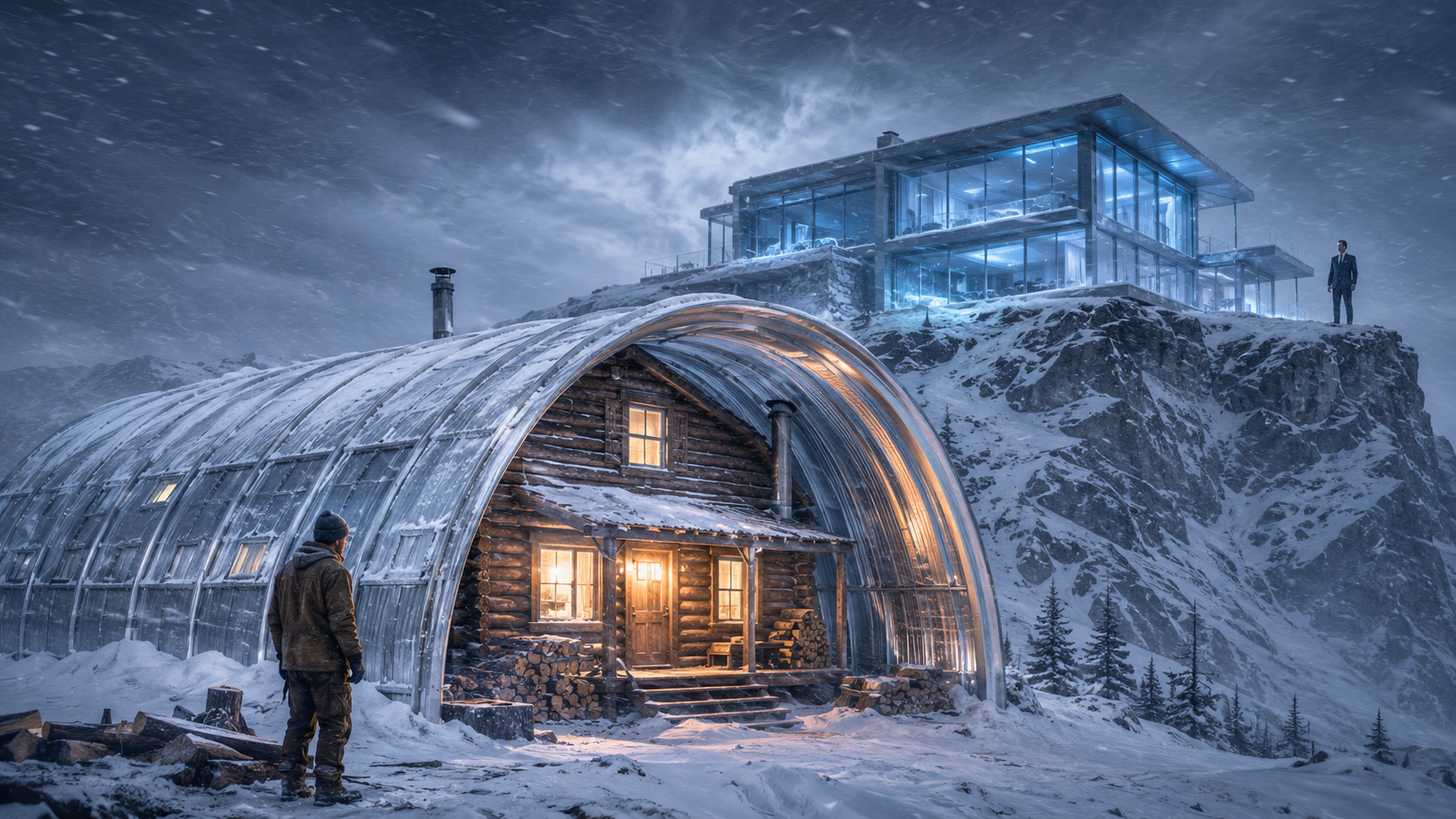
Caleb looked at the steel shell, trembling faintly under the wind.
“I built something because I knew I couldn’t.”
By morning, the storm had not ended, but the valley had changed.
Word traveled the way it always did: through radio calls, snowmobile reports, a lineman’s wife, the diner owner’s cousin, and Graham, who told the truth to a mechanic and watched it outrun him.
Sterling Vale had walked to Rowan’s Folly in the night.
His grandson had been warmed there.
The silver coffin had stayed warm.
The glass palace had frozen.
By afternoon, three neighbors arrived at Caleb’s door asking to see the air gap. By evening, Earl Madsen stood in the yard with his cap in his hands, staring at the curved shell like it had personally insulted his entire philosophy of lumber.
Caleb opened the outer door.
Earl cleared his throat.
“Suppose a man wanted to build something similar for a workshop.”
Caleb raised an eyebrow.
“A workshop?”
“Or a cabin.”
“Your cabin?”
Earl looked toward the road.
“Maybe.”
Mara, standing behind Caleb, coughed into her hand to hide a smile.
The cold snap lasted six more days.
The Aerie’s systems were repaired, but Sterling did not return to speaking about mastery. Not right away. He sent supplies down to the Rowans without attaching a speech to them. Caleb sent most of them back and kept only the medical kit for the children. Sterling tried again, this time sending a handwritten note instead of a truckload of pride.
It said simply:
I would like to learn before I build again.
Caleb read it twice.
Mara watched him.
“Well?”
“He wants to learn.”
“And?”
Caleb folded the note.
“Then he can start by listening.”
Spring came late that year.
When the snow melted, the silver shell still stood. It had dents from wind-thrown branches and scratches from ice, but the cabin inside was dry. The logs looked better than they had in years. The children had stopped waking with cold hands. Mara had stopped sleeping with one ear tuned to the stove.
People still called the structure odd.
But no one called it foolish.
That summer, Caleb helped three families build wind shells around exposed homes and one around the school’s north wall. He refused payment beyond materials, meals, and help when it was the next person’s turn. Sterling funded a community workshop without putting his name on it, which was the first useful thing his pride had ever done quietly.
At the workshop, Caleb stood before ranchers, carpenters, mechanics, and skeptical men who had once laughed into their coffee.
He did not give them a grand speech.
He held up a piece of corrugated steel.
“This is not magic,” he said. “It is not expensive intelligence. It is a shield. The lesson is simple: before you make heat, stop letting the wind steal it.”
Sterling stood in the back, silent.
Lenora sat beside Mara with Milo and Nell sharing cookies between them.
Afterward, Sterling approached Caleb in the yard.
“I owe you more than an apology,” he said.
“Yes,” Caleb replied.
Sterling accepted that like a man learning the weight of words.
“What do I owe?”
Caleb looked across the valley. The school roof flashed in the sun. The mountains stood high and indifferent. The wind moved through the grass, softer now, but never gone.
“Build differently,” Caleb said. “And when someone with less money knows something you don’t, listen before the storm makes you.”
Sterling nodded.
Years later, people in the valley still told the story whenever winter began sharpening its teeth.
They told it at Bell’s Diner when the first snow hit the windows. They told it at the lumberyard, though Earl pretended not to enjoy it. They told it to newcomers who asked why so many homes around Blackpine Ridge had curved outer shells, wind porches, baffled vents, and strange quiet corridors around old walls.
Some versions made Sterling crueler than he had been.
Some made Caleb wiser than he felt.
Some exaggerated the cold, the walk, the frozen mansion, the boy’s blue lips, the number on the thermometer.
But the heart of the story stayed true.
A rich man built a palace to impress the mountain.
A poor engineer built a shield because he respected it.
When the storm came, the mountain did not care what anything cost.
It only tested what worked.
And the strange silver cabin, mocked by everyone, held its warmth through the night