Inside: sixty-eight.
Mara stared at the numbers.
Caleb said nothing.
She took his hand.
At The Aerie, everything worked beautifully for four days.
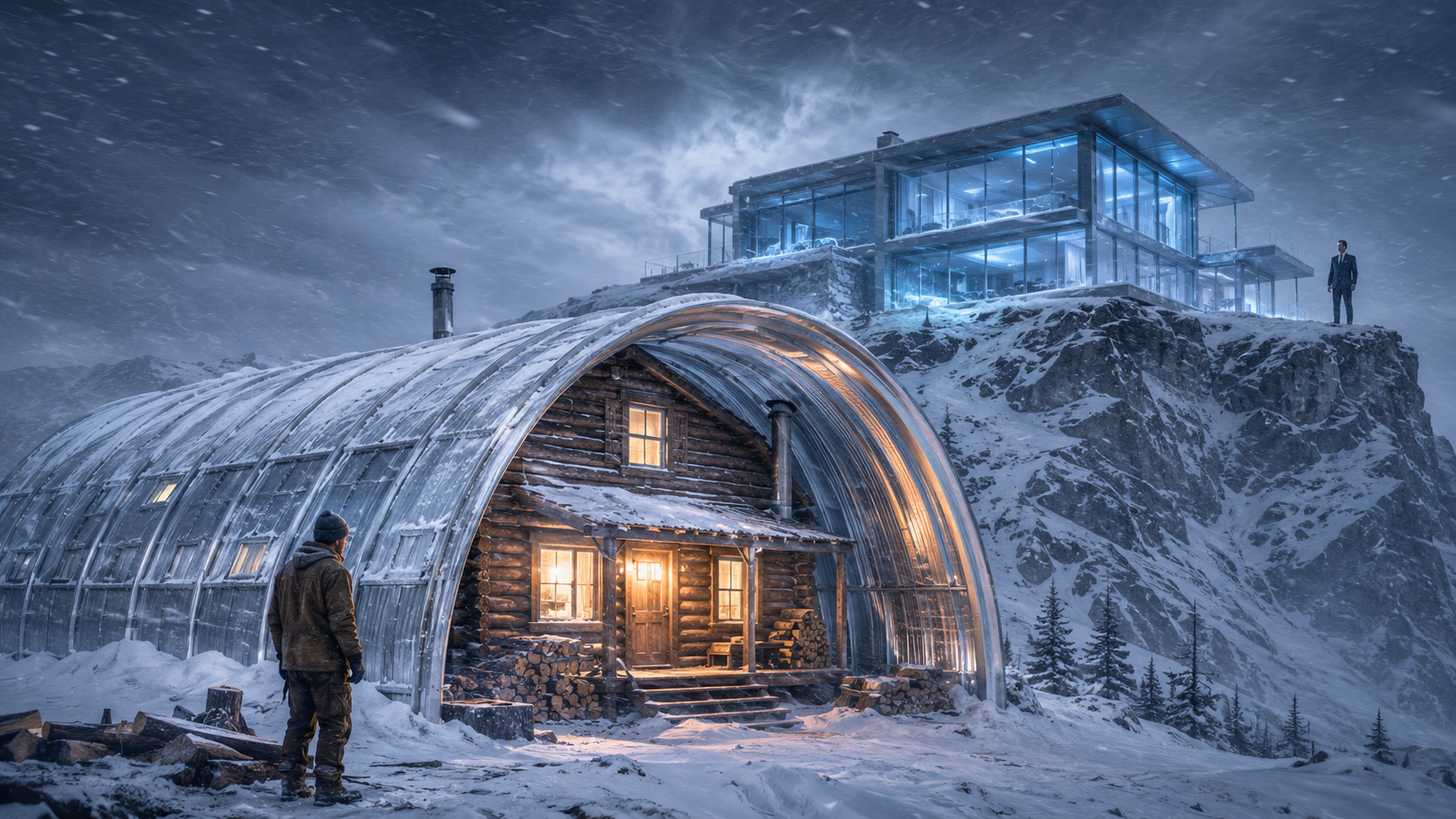
The heated floors glowed beneath Italian stone. Sensors adjusted. Pumps circulated. Automated dampers whispered open and shut. The glass walls presented the storm like theater. Guests wore cashmere and drank brandy while the mountain vanished behind white fury.
Sterling made a point of mentioning this during a small holiday gathering he refused to cancel.
“My friends,” he said, lifting a glass before the enormous north windows, “this is the difference between enduring nature and mastering it. Weather is not romance. Weather is a problem to be engineered.”
His guests laughed because Sterling’s guests usually laughed on schedule.
Lenora stood near the fireplace with Milo leaning against her leg. She looked past the glass into the violent dark and thought of Caleb Rowan’s armored cabin below, low to the ground, curved back turned toward the wind.
Then the lights flickered.
Only once.
Sterling noticed.
So did Lenora.
So did the house manager, a pale man named Graham, who touched his earpiece at once.
The lights steadied.
Sterling smiled.
“Even civilization coughs,” he said.
More laughter.
Two hours later, the first alarm sounded in the service wing.
Powder snow, driven fine as flour by the wind, had packed into exterior intake vents and frozen there. The geothermal system began cycling irregularly. Backup propane heat engaged, but dampers in the upper climate system stuck half-open when moisture froze along actuator housings. The generator strained against ice-clogged airflow. The mansion was too intelligent in too many places, and each intelligent part assumed another intelligent part would compensate.
No single failure doomed the house.
Together, they began stealing warmth.
At 2:17 in the morning, Graham woke Sterling.
“Sir, we have a temperature drop in the north hall.”
Sterling sat up, annoyed before he was afraid.
“How much?”
“Nine degrees in under an hour.”
“Switch zones.”
“We tried.”
“Then override the dampers manually.”
“Some are frozen, sir.”
Sterling stared.
The phrase seemed indecent. Frozen dampers belonged in roadside motels and abandoned cabins, not inside a residence whose mechanical room had cost more than most houses in the county.
“Call the contractor.”
“Lines are down. Satellite is unstable.”
“Wake maintenance.”
“They’re already below, sir.”
For the next three hours, The Aerie fought the storm and lost by increments.
The great north wall of glass turned into a black mirror radiating cold. Warm air rose into vaulted spaces and vanished. Fireplaces designed for beauty could not heat rooms built like cathedrals. Guests gathered in coats around decorative flames. Staff taped towels over door seams. The generator coughed, restarted, strained, and coughed again.
By dawn, breath fogged in the main hall.
Sterling refused to leave.
The road was impassable, he said. The lodge had supplies. The systems would stabilize. The cold front would break. Panic helped no one.
People wanted to believe him because fear makes confidence look like competence.
At noon, Milo began coughing.
By late afternoon, his fever rose.
Lenora wanted to get him out, but Sterling insisted The Aerie remained safer than any attempt to travel. The road to town had vanished under drifts. Trees had fallen. Visibility was almost nothing. He spoke with the authority of a man accustomed to deciding reality for other people.
So Lenora stayed.
She wrapped Milo in blankets near the largest fireplace and watched the flames lick stone that had been chosen for appearance, not survival.
At sunset, the storm worsened.
A gust shattered an exterior glass panel in the west gallery. It was not the main wall, not a collapse, not the catastrophe architects feared. But it was enough. Needle-cold air screamed through the wing until staff sealed the opening with plywood, plastic, and shaking hands.
Then the generator stopped for eleven minutes.
For eleven minutes, The Aerie went dark.
Milo stopped answering his mother.
Lenora did not scream. She became very calm.
She lifted her son. His body felt too light, too slack, too far away. She carried him through the candlelit hall to where Sterling stood with Graham over a mechanical diagram.
“We’re leaving,” she said.
Sterling turned. “Lenora—”
“Now.”
“The road is impossible.”
“Not to town.”
He stared at her.
She said, “To the Rowan cabin.”
His face changed as if she had struck him.
“No.”
“My son is freezing inside your masterpiece.”
“There are guest rooms with fireplaces.”
“He needs warmth that stays. He needs people who are not pretending.”
Graham looked at the floor.