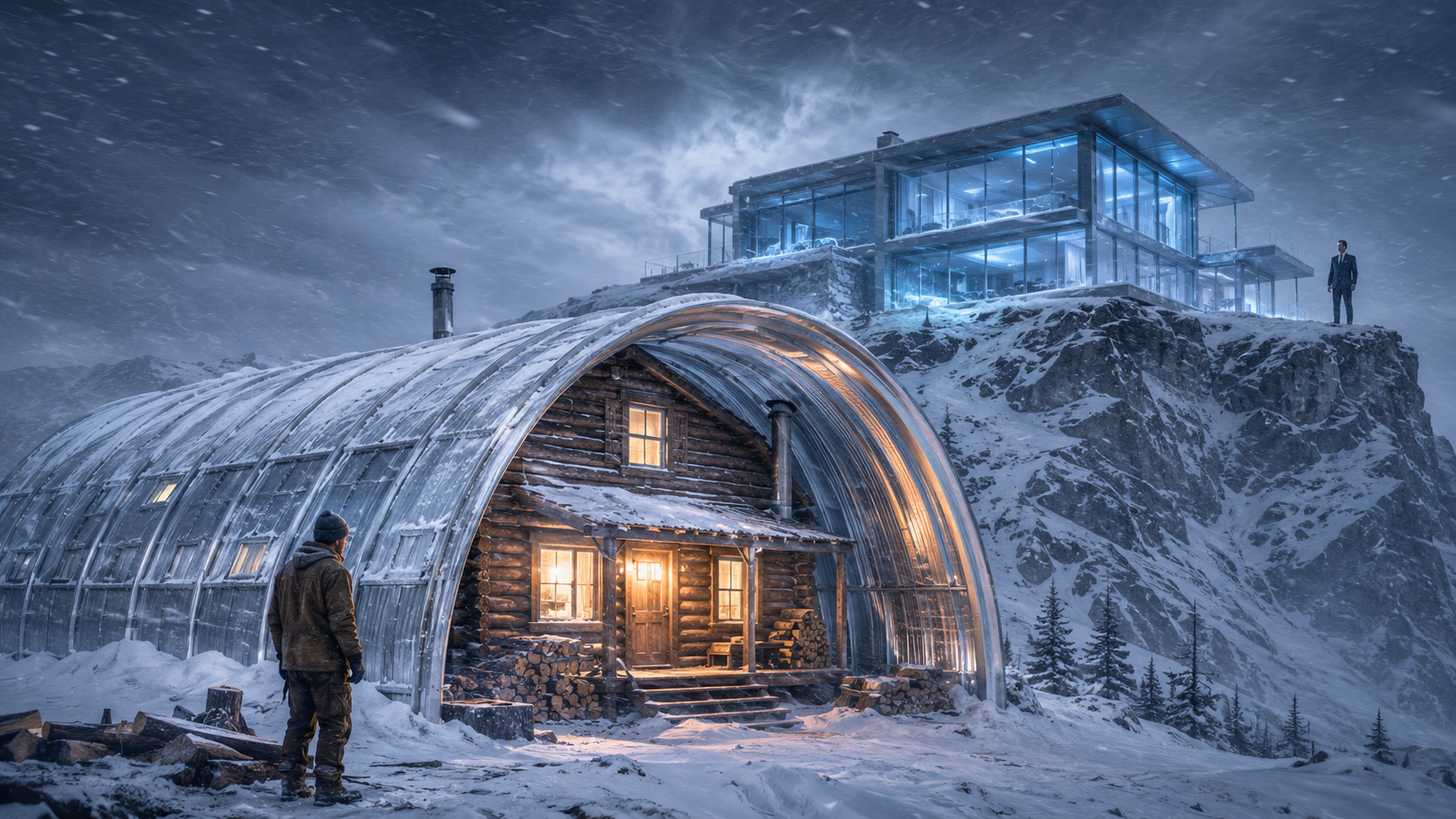
When it was finished, there was no denying it looked strange.
From the road, the Rowan cabin appeared to have been swallowed by a silver tunnel. The curved metal roof arched over the old log structure. The original cabin still stood inside, but its roofline was hidden, its walls protected, its windows looking out through covered gaps and framed openings. In certain light, the whole place looked less like a house than a stubborn machine built by someone who had run out of patience with weather.
Jasper loved it at once.
“We live in a fortress,” he announced.
Nell disagreed.
“We live inside a turtle.”
Mara walked the air gap slowly, one hand on the original log wall, the other near the steel shell.
“It still looks ridiculous,” she said.
Caleb nodded. “Feel the wall.”
She stopped.
Outside, the wind tore across the field, flattening dead grass and rattling the pines. Inside the corridor, the air was cold but still. Not warm, exactly. But calm. The steel took the violence. The log wall behind it was no longer under attack.
Mara placed her palm against the cabin wall and understood.
“It’s not being stripped,” she said.
“No,” Caleb replied. “It finally gets to hold what the stove gives it.”
The first snow came a week later.
By early December, the valley had divided into three camps: those who mocked Caleb openly, those who worried privately, and those who were waiting to see whether the absurd thing might work before choosing a side. Earl called it Rowan’s Folly. The waitress at Bell’s Diner said she hoped it worked because Mara was too good a woman to spend another winter stuffing rags under doors. Sterling Vale ignored it publicly, which meant his staff joked about it privately.
The only person at The Aerie who did not laugh was Sterling’s daughter, Lenora.
Lenora Vale had returned to Montana that autumn with her five-year-old son, Milo, after a divorce that the newspapers called graceful because wealthy people had paid lawyers to make pain look tidy. She had grown up around money the way fish grow up around water. She knew its comforts. She knew its poison. She loved her father, but she also knew he confused being obeyed with being correct.
The first time Milo saw the Rowan place from the back seat of the car, he pressed his mittened hands to the window.
“Mom,” he said, “that house has armor.”
Lenora slowed.
Caleb stood on a ladder adjusting a vent cap. Mara passed screws up to him from her coat pocket. Jasper and Nell dragged a sled through the snow near the woodpile. It should have looked foolish.
Instead, Lenora felt a small ache in her chest.
The place looked protected.
Not grand. Not expensive. Not impressive.
Protected.
That evening at dinner, Sterling mentioned Caleb’s cabin while slicing elk beneath a chandelier made from antlers no Vale had ever hunted.
“The man will rot his own house from the outside in,” Sterling said. “Condensation alone will ruin him.”
Lenora took a sip of wine.
“Maybe he knows something.”
Sterling stared at her as if she had complimented a raccoon on its architectural insight.
“He knows how to bolt scrap together.”
“He was an engineer.”
“A field engineer.”
“Sometimes the field is where people learn what survives.”
The table went quiet.
Sterling set his knife down.
“That sort of thinking is why people accept poor solutions.”
“No,” Lenora said carefully. “Sometimes it is why people survive when perfect solutions fail.”
Sterling’s jaw tightened.
His wife had died nine years earlier in a storm outside Aspen, when a helicopter pilot tried to beat weather that should have been respected. Sterling had bought safer aircraft afterward, better radar, better pilots, better everything except the humility to admit that sometimes the wisest system was refusal.
“Systems fail,” Lenora said softly.
“Systems fail when people neglect them,” Sterling replied.
“And people fail too.”
No one spoke after that.
Then winter came down hard.
The cold front arrived like punishment. The temperature fell below zero and stayed there. Nights sank to minus twenty, then minus thirty. Wind poured over Blackpine Ridge at sixty miles an hour, turning loose snow into a white smoke that found every crack, every hinge, every vent, every weakness.
In the valley, trucks refused to start. Water lines froze. Bell’s Diner closed after the kitchen drain iced solid. The school canceled classes when frost formed on the inside of the windows and one child’s wet scarf froze stiff on a metal coat hook.
At the Rowan cabin, the stove burned steadily.
For the first time since they had moved there, Mara woke before dawn and did not see her breath. Jasper kicked his blankets off in his sleep. Nell complained the cabin was too warm. Caleb checked the thermometer on the interior wall, then the one in the air gap, then the one outside.
Outside: minus twenty-six.
Air gap: eleven degrees above zero.