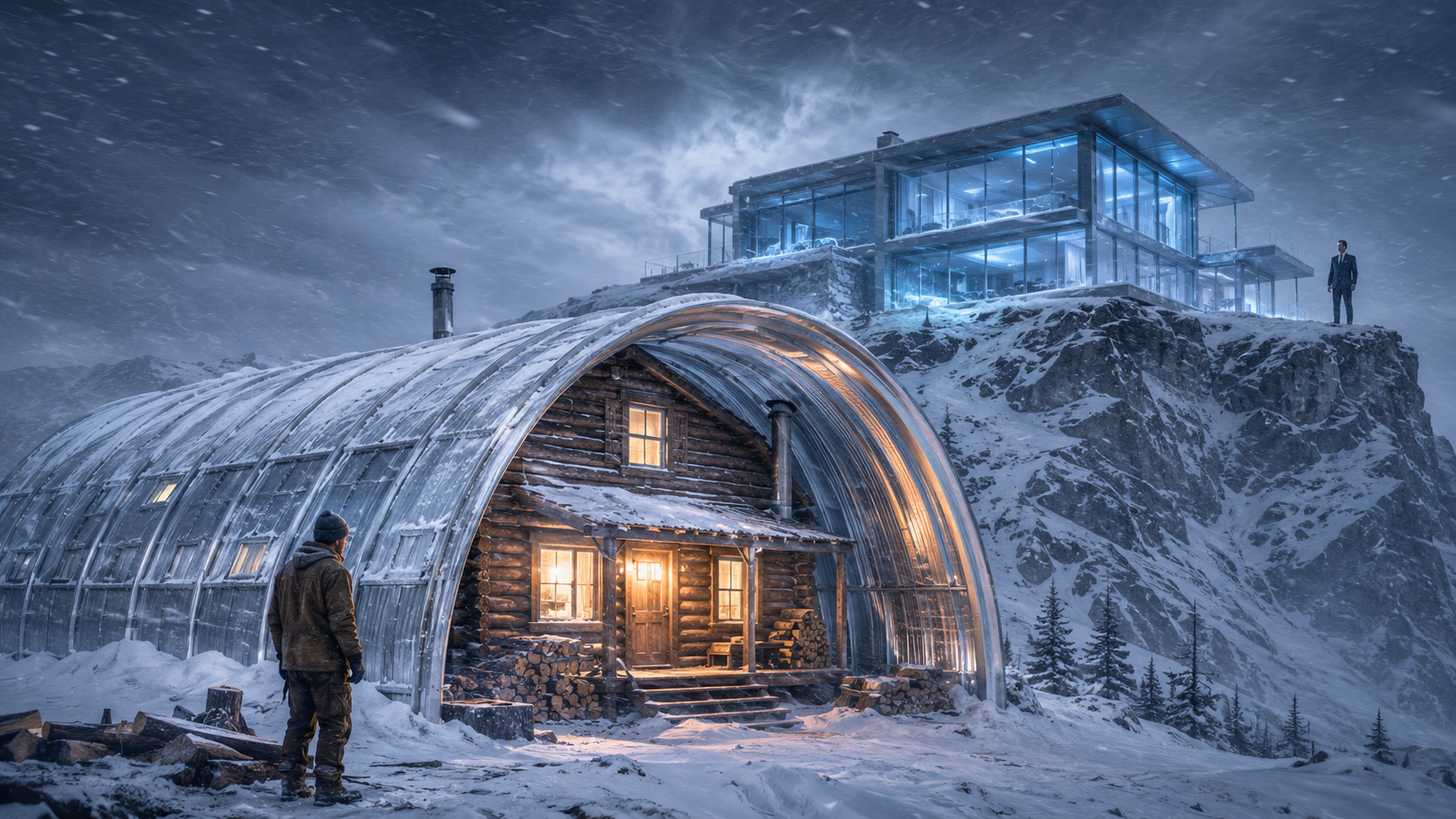
He called it The Aerie.
Everyone else called it Vale’s glass palace.
Sterling heard about Caleb’s project at Granger’s Supply, while buying kerosene heaters for the workers’ quarters near his lodge. He did not call them workers’ quarters. He called them auxiliary accommodations. A man with a cashmere scarf and polished boots could rename almost anything if people wanted his money badly enough.
Earl told the story with pleasure.
“Rowan’s putting a tin shell over his cabin,” he said. “Says it’ll keep him warm.”
Sterling turned, amused.
“A tin shell?”
“Like one of those half-round army huts.”
Sterling laughed with the polished cruelty of a man who had learned to make ridicule sound like conversation.
“That is not construction,” he said. “That is surrender.”
The men in the store laughed because Sterling Vale expected laughter and most people found it cheaper to give him what he expected.
Caleb was standing near the stove pipe section, holding a can of sealant.
Sterling noticed him.
“You’re Rowan, aren’t you?”
Caleb looked at him. “I am.”
“The man building the silver coffin.”
The store quieted. Not out of respect. Out of appetite.
There is a special hunger in small places when a rich man humiliates a poor man publicly. Even people who dislike the rich man lean closer to hear how far he will go.
Caleb set the sealant on the counter.
“I’m building an exterior windbreak around a dead-air space.”
Sterling smiled. “Of course you are.”
“It reduces convective heat loss.”
“Convective.” Sterling repeated the word as if tasting something cheap. “That sounds very technical for something my grandfather solved with thicker walls.”
“Your grandfather probably didn’t build a house with forty feet of glass facing the winter wind.”
The room sharpened.
Sterling’s smile did not vanish, but something colder stepped behind it.
“My home was designed by one of the best firms in the country.”
“I’m sure it was.”
“You have an opinion on it?”
Caleb should have said no.
Mara would later tell him that a man could keep his dignity without kicking a wolf just because the wolf wore Italian leather. But Caleb had spent too many nights watching frost form on the inside of his children’s window while men in town acted as if cold were a moral test and not a physical problem.
So he said, “It faces the wind wrong.”
Someone inhaled sharply.
Sterling stepped closer.
“Say that again.”
“Your mansion faces the wind wrong,” Caleb said. “That north wall is beautiful, but it’s a sail. It will be comfortable as long as every system works perfectly. If the power fails, or the intakes ice, or your dampers freeze, that glass will drain heat faster than you can replace it.”
Sterling’s voice dropped.
“My house has geothermal heat, propane backup, triple-pane structural glass, computer-managed climate zones, and generators that could run half this county.”
“Then I hope all of it works.”
For a moment, no one moved.
Then Sterling turned toward the men by the counter and raised his voice.
“Gentlemen, if Mr. Rowan’s junkyard tunnel keeps him warmer than my lodge keeps me, I will eat my own boots.”
Laughter burst through the store.
Caleb paid for the sealant and left.
That night, Mara found him outside under a work light, bolting the first steel rib into place. The curved arch rose above the cabin like the skeleton of some enormous sleeping animal.
“You heard what he said,” she guessed.
“Most of the county heard what he said.”
“Does it bother you?”
Caleb tightened a bolt until the wrench groaned.
“Yes.”
She waited.
He looked down at his hands.
“Not because he laughed. Because if I’m wrong, the children stay cold and everyone gets to say they knew better.”
Mara stepped closer, took the wrench from him, and put her hand over his.
“Caleb Rowan, listen to me. We were already freezing doing what everyone else does. If your strange idea fails, we are no worse than before. If it works, our children sleep warm. That is worth looking foolish for.”
He looked at her in the glow of the work lamp, and the loneliness of the idea loosened.
Together, they built the shield.
For four weeks, Caleb worked from first light until the stars came out. He set posts exactly two feet from the cabin walls. He anchored the steel ribs to a timber frame bolted into the extended foundation. He overlapped corrugated panels and sealed every seam against driven snow. He cut low vents near the foundation and high vents near the ridge, then baffled them so air could move slowly without becoming a draft.
He built a narrow service corridor between the original log walls and the new steel shell. He made a small airlock entry with two doors, because every winter door was a wound. He ran the chimney through both roofs with careful clearance and mineral wool protection, because heat meant nothing if fire took the house.