“For twenty-one years,” she said, “I was introduced as Grant Whitmore’s wife, as if that explained my entire purpose. Many of you sat in my dining room when the first fund nearly failed. Some of you accepted calls from me when Grant was too proud to admit he couldn’t make payroll. My father’s property became the bridge loan that kept this firm alive.”
She took a breath.
“My labor was unpaid because we called it marriage. My silence was mistaken for consent because silence was convenient.”
Lionel Ash, white-haired and severe, stood from the board table.
“Grant. Are these accounts real?”
Grant wiped his mouth with the back of his hand.
An ugly, clumsy gesture from a man who prized control.
“Lionel, you know me.”
“That is not an answer.”
Grant looked at Mara with open hatred.
“You have no idea what you’ve done.”
Mara held the microphone steady.
“I turned on the lights. Whatever people see now was already in the room.”
Then the ballroom doors opened.
Two federal agents entered with hotel security and a woman from the state attorney general’s office.
They did not arrest Grant on the spot.
Real justice rarely moves at television speed.
But they approached the board and spoke quietly.
The effect was immediate.
The launch was suspended.
Whitmore Capital’s counsel asked Grant to step away from the microphone.
Reporters rushed toward the aisles.
Investors began making calls.
Julian Crowe tried to leave through a side exit and was intercepted by cameras rather than agents.
For a man like Julian, that may have been worse.
Selene stood, pulling Milo close.
“Grant,” she said.
Panic had replaced triumph.
Grant did not go to her.
He was staring at the collapsing architecture of his own life.
Mara saw Milo’s wet face above Selene’s sleeve, and anger loosened just enough for mercy to enter.
She walked to a hotel manager near the wall.
“Please take the child somewhere quiet. Away from cameras. He doesn’t understand this.”
The manager nodded and guided Selene toward a private corridor.
Selene paused beside Mara.
Hatred and fear fought across her face.
For a moment, Mara expected one last insult.
Instead Selene whispered, “He told me you knew.”
Mara looked at her.
“No, he didn’t. He told you I didn’t matter.”
Selene flinched as if the words had found a wound she had been hiding from herself.
Then Milo tugged her hand, and she followed the manager out.
Grant reached Mara near the edge of the stage.
Without the microphone, his voice was low.
“You destroyed me.”
“No,” Mara said. “You built a life out of lies and invited witnesses.”
“You think Noah will thank you for this? You put his father on trial in public.”
Mara looked across the room.
Noah stood near the control booth, pale but upright, Lydia beside him.
He was watching Grant without triumph.
Only grief.
The exhausted grief of a son finally realizing his father’s approval had always been a locked door with no room behind it.
“Our son learned the truth before I did,” Mara said. “That trial started long before tonight.”
Grant’s mouth twisted.
“He is weak because of you.”
“No,” Mara said. “He is decent in spite of you.”
For the first time, Grant had no answer.
The aftermath did not feel like victory.
It felt like standing inside a house after a tornado.
Grateful to be alive.
Unable to ignore the wreckage.
Before midnight, the board suspended Grant pending investigation. The Meridian Fund launch was postponed indefinitely. Whitmore Capital issued a statement about serious concerns regarding undisclosed financial arrangements.
By morning, every business outlet had its version.
Billionaire financier accused of hiding assets, funding mistress through shell companies, and fabricating claims against wife.
Mara did not watch.
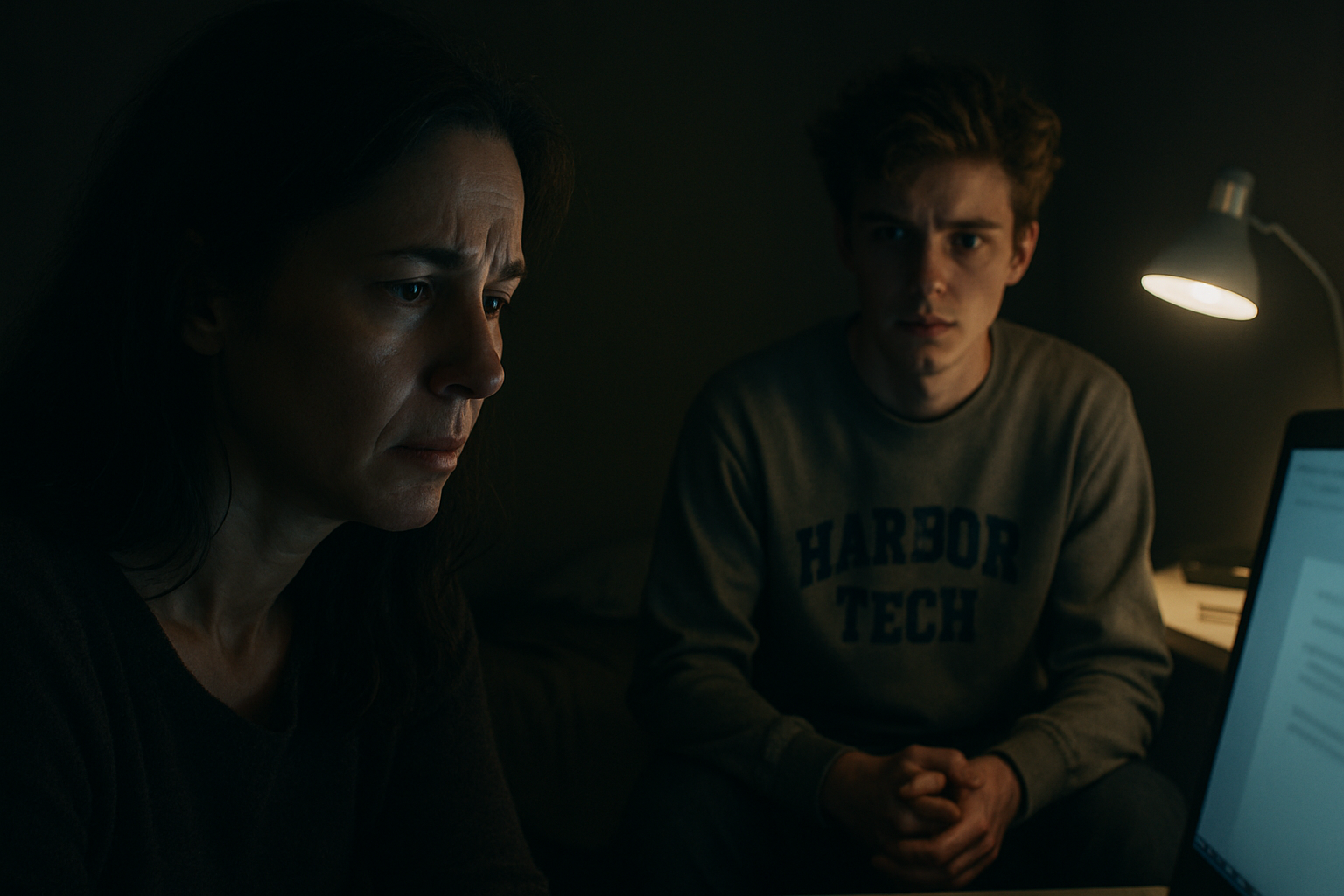
She went home with Noah and Lydia, kicked off her heels in the foyer, and stood beneath the chandelier while the house hummed with expensive emptiness.
Noah sank onto the sofa.
Without the files and urgency, he looked hollow.
Mara sat beside him.
“I’m sorry,” he said.
She turned, stunned.
“For what?”
“For not telling you sooner. For making it public. For maybe ruining everything.”
Mara took his hand.
“You did not ruin everything. You refused to let ruin happen quietly.”
He stared at the floor.
“I hated him tonight.”
“That is allowed.”
“I also felt bad for him for about two seconds. Is that stupid?”
“No,” Mara said. “That’s human. People don’t stop being complicated because they hurt us.”
Noah’s eyes filled.
“Do you think he ever loved me?”
It was the question Mara had feared.
She could have lied.
Mothers often lie out of mercy.
But lies had already taken enough from him.
“I think your father loved the idea of legacy,” she said carefully. “I think he loved what having a son proved about him. I don’t know if he knew how to love you the way you deserved. But his failure is not proof that you were hard to love.”
Noah bent forward and cried without sound.
Mara wrapped her arms around him.
He was taller now. Broader.
But grief folded him back into the child Grant had disappointed again and again.