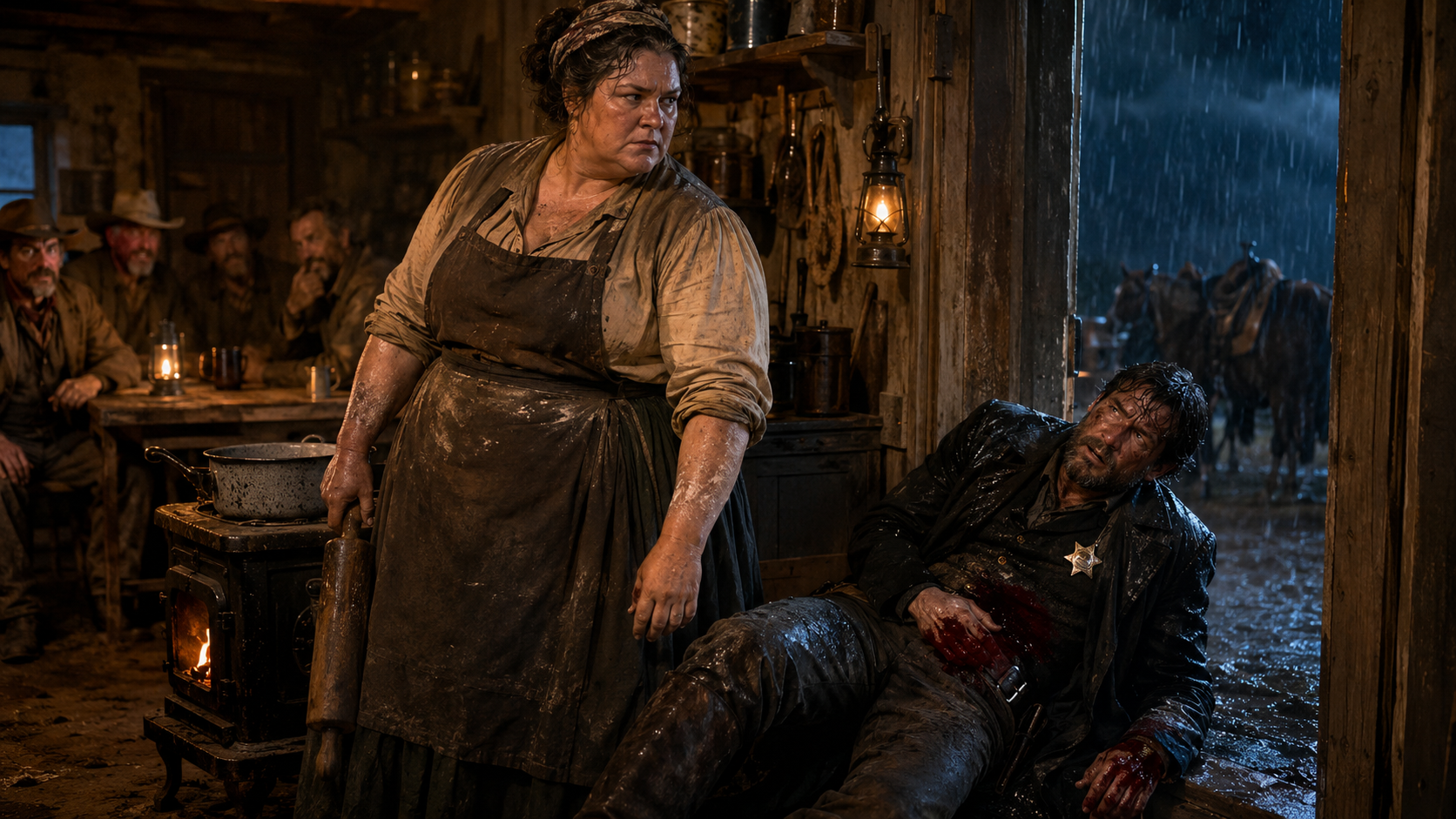
“What’s that got to do with me?”
Beatrice shifted her weight.
“Nothing,” she said. “You forgot too much.”
She drove her heel into his knee.
Elias cursed and jerked. The knife lifted from her throat for half a breath.
Half a breath was enough.
Rowan fired.
The bullet struck Elias in the shoulder. Beatrice dropped. Deputies tackled Boone. Sneed tried to run through the pantry and found Wycliff waiting with a fireplace poker.
The staff formed a bucket line before anyone gave the order. Cooks, maids, porters, bellboys, and guests in nightclothes passed water hand to hand until the flames hissed and died.
When it was over, the kitchen was blackened, the flour ruined, Boone Rusk unconscious, Elias Rusk bleeding and chained, and Percival Sneed sobbing into his own hands.
Beatrice stood in the middle of the wreckage with soot on her face.
Rowan came to her.
“Are you hurt?”
She touched the shallow cut at her throat.
“Not enough to stop breakfast.”
He stared at her.
Then he laughed once, breathless and broken with relief.
She held up the red tin.
“My father comes first.”
The trial lasted eleven days.
People came from three counties to fill the courtroom. Men who had built clean reputations on dirty money suddenly found themselves named in Arthur Callow’s careful records. Old lies cracked open. Dead workers were remembered properly. Families who had been blamed for thefts and sabotage stood together in the back of the room and listened as truth, late and limping, finally arrived.
Elias and Boone Rusk were convicted for murder, robbery, and the killing of Arthur Callow.
Percival Sneed turned witness to save his neck and lost his future anyway.
Beatrice sat through every hour.
She did not cry when the verdict came.
She cried later in the Grand Heron kitchen, holding the red tin against her chest while the morning bread rose on the table beside her.
“My father wasn’t careless,” she said.
Rowan stood close, not touching until she leaned into him.
“No,” he said. “He was brave.”
She closed her eyes.
“I spent so long being ashamed.”
“Of him?”
“Of what they made us carry.”
Rowan’s voice roughened.
“Then put it down.”
She did.
Not all at once. Grief never leaves like a guest who remembers his hat. It lingers. It sits in corners. It asks for one more cup of coffee.
But it changed shape.
Beatrice became the most talked-about cook in the territory. Travelers came for her coffee-rubbed beef, her peach pudding, her winter bread, her pepper stew, her Sunday chicken, and the biscuits she claimed could fix bad marriages if served hot enough.
Some people still laughed when they saw her.
Then they ate.
Afterward, they spoke more carefully.
Rowan stayed in Bitter Creek. His wounds healed. His badge remained. But something in him softened—not weakened, only unknotted. He had spent years chasing killers across hard country, believing justice was something you hunted down with a gun. Beatrice taught him that justice could also be a table where truth was served hot and no one was allowed to leave hungry for dignity.
Their friendship became the town’s favorite subject.
Beatrice ignored the gossip.
Rowan tried to ignore it and failed badly.
One evening, after closing, he found her alone in the kitchen, rolling dough by lamplight. The scar at her throat had faded to a pale line. Flour dusted her cheek. Her sleeves were pushed to her elbows.
“You should sleep,” he said.
“You should stop giving orders in my kitchen.”
“I’m a marshal.”
“Not in here.”
He smiled.
She cut biscuits with the rim of a glass.
“I’ve been thinking,” she said.
“That sounds dangerous.”
“It is.”
He leaned against the counter.
She did not look at him.
“I think we should marry.”
Rowan straightened so fast he nearly knocked over a bowl.
“What?”
She finally looked up, annoyed.
“Must I repeat every important thing?”
“No. I just—Beatrice—are you asking me?”
“I am informing you of a sensible plan. You may participate by saying yes.”
He laughed, then stopped when he saw her face.
She was nervous.
Beatrice Callow, who had faced killers in a burning kitchen, was afraid of this.
Rowan crossed the room slowly.
“Yes,” he said.
Her eyes shone.
“You haven’t heard the terms.”
“I accept them.”
“You don’t know what they are.”
“You’ll tell me for the rest of my life.”
She tried not to smile and failed.
“I take up space,” she said quietly.
He took her flour-covered hands.
“Good. Take mine too.”
She looked down at their hands.
“I am stubborn.”
“I noticed.”
“I will feed strays.”
“I was one.”
“I will argue when you are wrong.”
“Then I’ll be well-corrected.”
Her voice dropped.
“And I will not be made small.”
Rowan cupped her face with both hands.
“Beatrice Callow, you found me dying on a dirty floor and dragged me back into the world. You can fill every room I ever stand in.”