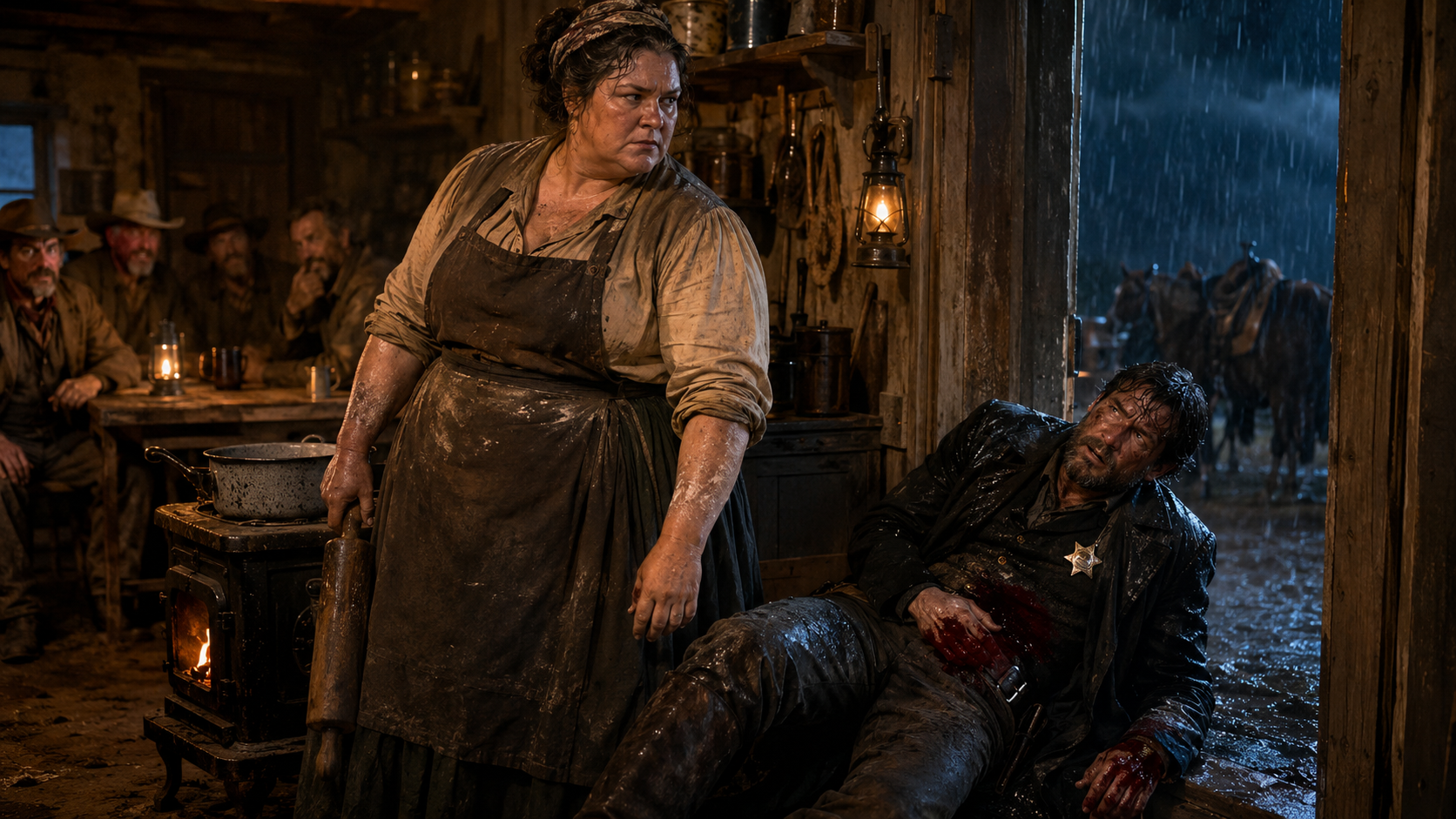
She kissed him first.
The biscuits burned.
Neither of them cared.
They married in the Grand Heron dining room in early autumn, beneath garlands of wildflowers and lantern light. Wycliff cried and denied it. The scullery girl served as Beatrice’s attendant. Half the town came, including people who had once mocked her and now looked ashamed enough to be forgiven someday, though not too quickly.
Beatrice wore a blue dress made by her own hands because no dressmaker in Bitter Creek understood that a woman could be large and beautiful without needing either fact corrected.
Rowan wore his badge.
During the vows, he promised to come home alive whenever possible and honest always.
She promised to feed him, argue with him, and never let silence become a wall between them.
When the preacher pronounced them married, the kitchen staff cheered loudest.
Years passed.
Bitter Creek grew. The Grand Heron became famous. Beatrice trained women no one else would hire—widows, immigrants, farm girls, former saloon singers, freedmen’s sons, quiet boys with quick hands, loud girls with sharper tongues. She cared only whether they worked clean, tasted often, and respected the fire.
“A kitchen,” she liked to say, “doesn’t care what fools call you. It cares whether you burn the gravy.”
Rowan became known as the marshal who could end a fight before the first shot. He still carried a gun. He still used it when he had to. But he learned from Beatrice that not every danger needed a bullet. Some needed bread. Some needed listening. Some needed a woman with a skillet and no patience for nonsense.
On their twenty-fifth anniversary, they sat on the porch of the house they had built above town. Bitter Creek glowed below them, no longer a mud hole with ambition, but a living place full of lamps, voices, horses, children, church bells, supper smoke, and memory.
Beatrice’s hair had silver in it now. Rowan’s beard had gone almost white. Her body was still broad and strong. Her laugh still filled the air like a door thrown open.
“Do you ever think of that first night?” she asked.
“The night you threatened to shoot a paying customer?”
“The night I saved your life.”
“You charged me for stew.”
“You lived, didn’t you?”
He took her hand.
“I did.”
She leaned against him.
“They said not to waste supper on a dead man,” she murmured.
Rowan kissed her knuckles.
“Good thing you never listened.”
Below them, the town carried on.
Some lives are saved by doctors. Some by badges. Some by courts, bullets, letters, or the truth finally dragged into daylight.
And some are saved by a heavyset cook standing over a stove in a storm, refusing to let the world decide who is already dead.