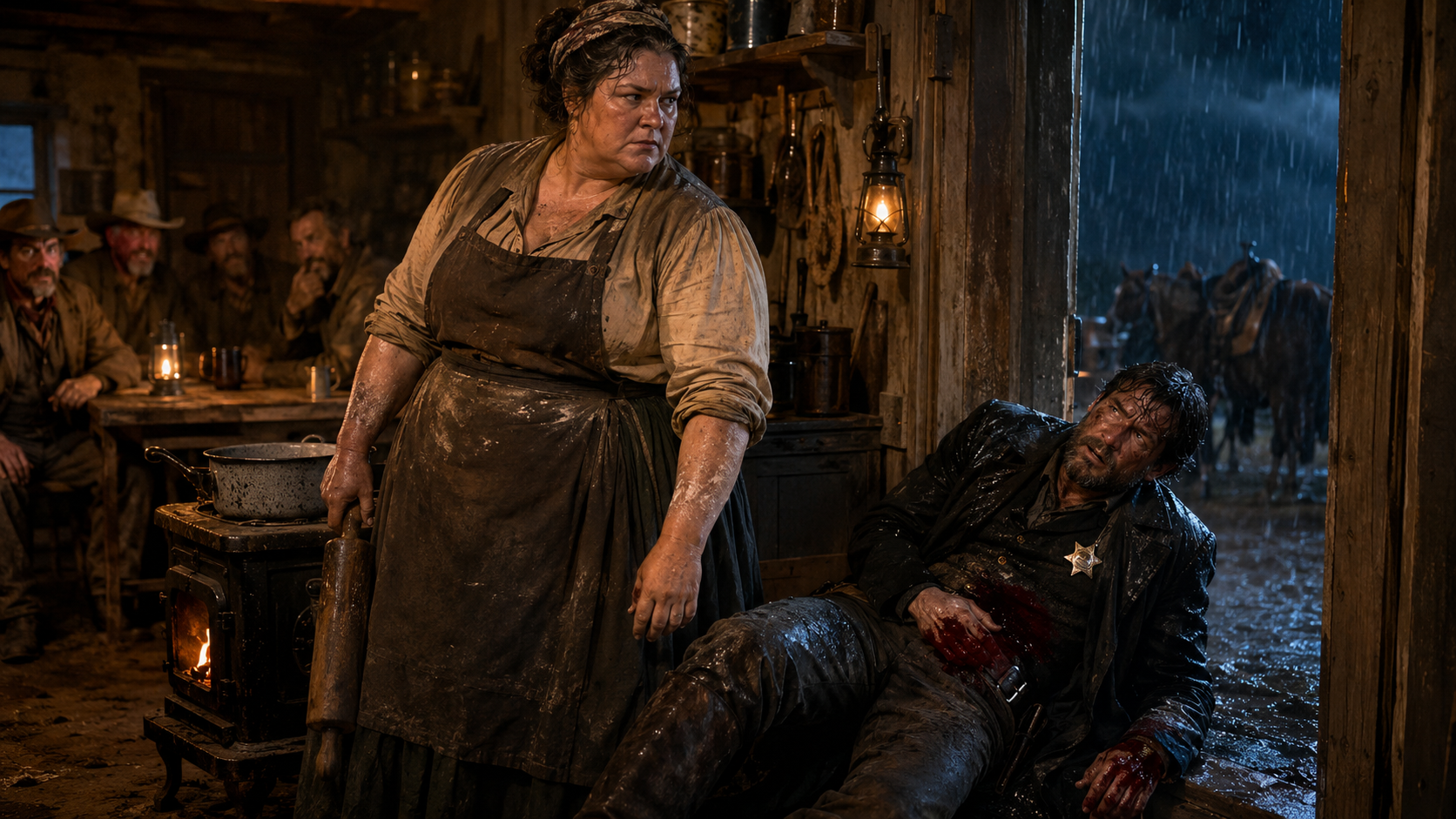
Rowan’s voice was low. “Then make them swallow the laugh with their first bite.”
She glanced at him.
He was serious.
That made it worse somehow.
“People like you always say brave things to people like me.”
“People like me?”
“Men with badges. Men with names that open doors. Men who can walk into a room without first apologizing for the amount of space they occupy.”
Rowan took that in.
Then he nodded once.
“You’re right.”
She had not expected that.
“I have opened doors,” he said. “Some I deserved. Some I didn’t. But I know this: no door stays respectable if cowards guard it.”
Beatrice’s throat tightened.
“Are you trying to be poetic?”
“I’m trying not to faint.”
That time, she laughed.
By noon, they were on the road.
Her wagon was painted green once, though dust and weather had chewed most of the color away. The mule, Queen Esther, had a mean temper and one white ear. Beatrice drove with her shoulders squared and her eyes forward. Rowan rode beside her on a borrowed horse, wrapped in a spare blanket, pretending the pain did not tear through him every time the trail dipped.
The country opened around them in raw, merciless beauty. Red hills. Black ravines. Grass bending under the wind. Far mountains like the backs of sleeping beasts. At night, they camped beneath a shelf of stone while coyotes sang to the moon.
Beatrice cooked bacon, corn cakes, and beans with dried peppers.
Rowan watched the firelight catch in her hair.
“You said your father died in a powder house,” he said.
Her hand paused over the skillet.
“I did.”
“What was his name?”
“Arthur Callow.”
Rowan went very still.
Beatrice noticed.
“What?”
He looked at her slowly. “Arthur Callow worked for the Midland Spur Railroad?”
“Yes.”
“Twenty years ago?”
“Near enough.”
Rowan set down his cup.
“What are you not saying?” she asked.
He took too long to answer.
“Arthur Callow’s name was in a file I saw in Denver. It was an old inquiry. Missing payroll. Sabotage. Laborers blamed. Case closed after the explosion killed the man who was supposed to testify.”
Beatrice could not feel the skillet handle.
“They said my father caused it.”
“That may not be true.”
Her laugh was short and hard. “May not?”
“I don’t know enough yet.”
“But you know something.”
“I know the Rusk brothers were tied to railroad thefts before they became famous for murder.”
The fire popped.
Beatrice looked away into the dark.
For years, she had carried her father’s death like a sealed jar. The label was written by other people: careless, clumsy, drunk, guilty. She had hated those words. She had swallowed them anyway because she was a girl, then a poor woman, then a large woman, then a working woman, and the world did not pause to listen when any of those people said, Wait. You have this wrong.
“What happened to the file?” she asked.
“Parts vanished. Witnesses vanished. Men got rich.”
“And now the Rusk brothers are riding west.”
“Yes.”
“Toward Bitter Creek?”
Rowan looked at her.
“Yes.”
She sat very still.
Then she turned the bacon before it burned.
“Eat,” she said.
“Beatrice—”
“Eat. If trouble is waiting in Bitter Creek, I would prefer you face it with food in your stomach.”
“You believe me?”
“I don’t know yet. But I believe my father was better than the story they buried him under.”
The Grand Heron Hotel stood at the center of Bitter Creek like a white wedding cake dropped into mud.
It had three stories, brass lamps, red carpets, and guests who used their napkins as if the cloth had personally offended them. Beatrice stopped the wagon across the street and stared at the building.
Her hands trembled on the reins.
Rowan saw.
“Drive on,” he said quietly.
“They will look at me.”
“Yes.”
“They will judge me.”
“Yes.”
She turned sharply.
“That is supposed to help?”
“No. It is supposed to be the truth. They’ll look. They’ll judge. Then you’ll cook.”
A muscle moved in her cheek.
“You make cooking sound like war.”
“Isn’t it?”
She almost smiled.
The hotel clerk looked Beatrice over as if she had tracked mud onto his soul.
His name was Percival Sneed. He had a waxed mustache, narrow shoulders, and the soft hands of a man who enjoyed giving orders he could not survive receiving. His gaze paused at Beatrice’s hips, her apron, her worn boots, then moved dismissively to Rowan.
“Applicants use the side entrance,” Sneed said.
“Good,” Beatrice replied. “I prefer useful doors.”
Sneed blinked.
Rowan covered his mouth.
The hotel owner, Mr. Ambrose Wycliff, was waiting in the dining room with two investors, a judge, and a woman in pearls who looked as though no plate had ever satisfied her. Wycliff’s suit was black, his beard silver, and his smile polished thin.
“Miss Callow,” he said. “Your letter was confident.”
“So am I, on good days.”
The pearl-wearing woman raised an eyebrow.