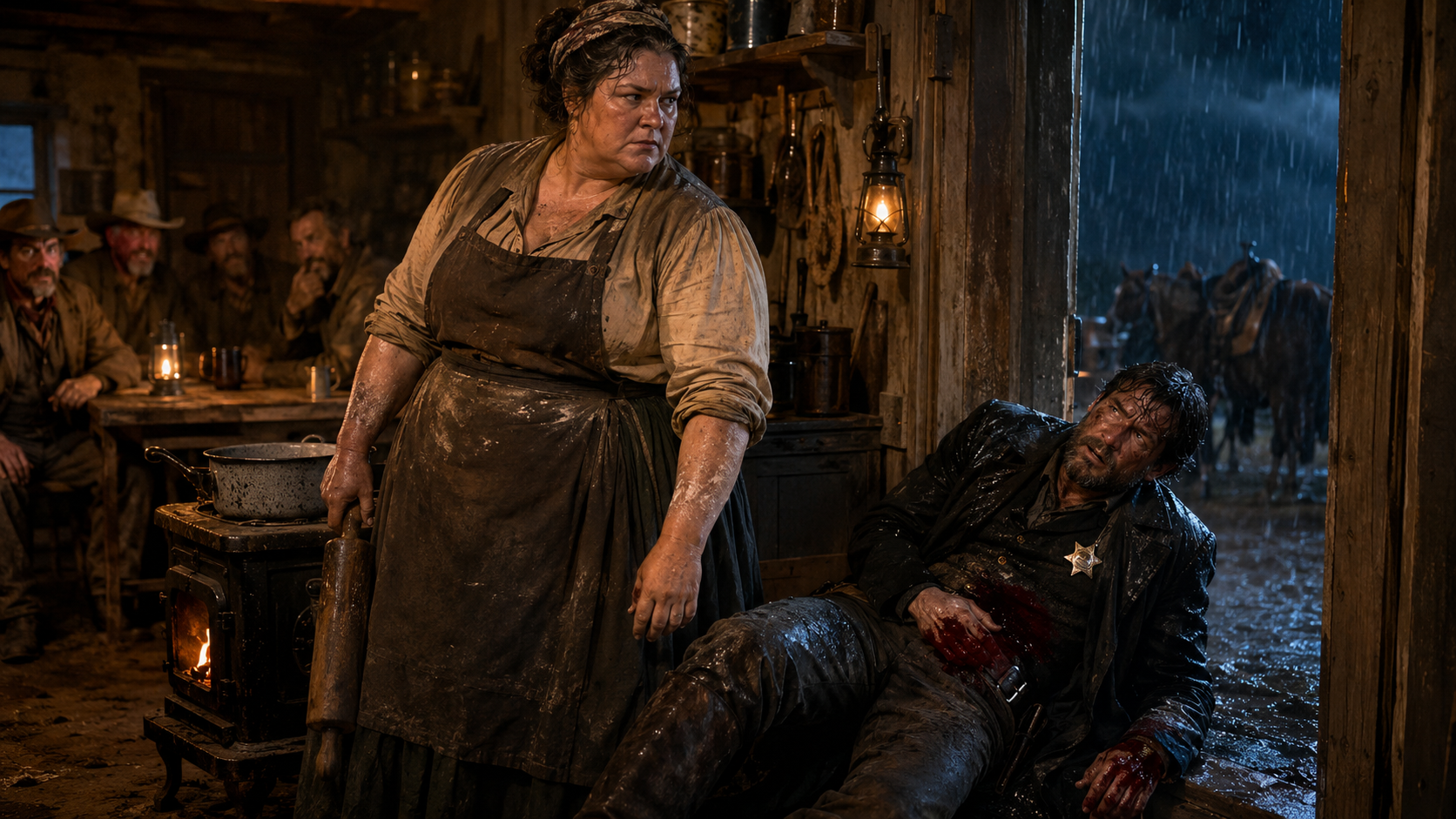
Wycliff looked at Rowan. “And your companion?”
“Deputy U.S. Marshal Rowan Vale,” Rowan said.
Sneed, standing behind them, went pale for half a second.
Beatrice saw it.
So did Rowan.
Wycliff folded his hands.
“The trial meal will be served at four. You will prepare three courses. You may use the kitchen, though my staff will observe. We value refinement here.”
Beatrice looked at the white tablecloths, the crystal glasses, the hungry judgment in every face.
“I value flavor,” she said. “Refinement can come along if it behaves.”
The kitchen staff laughed before they could stop themselves.
At four o’clock, Beatrice cooked.
Not the way she cooked at the Broken Spur, with one eye on the stove and one hand near the shotgun. Not campfire food. Not survival food.
This was the food her father had taught her to taste with memory. The food her mother had stretched from nothing during lean winters. The food Beatrice had built from every insult, every closed door, every lonely mile of road, every night she had fed people who mocked her and watched them go silent over their bowls.
She made roasted onion soup with bone broth, thyme, black pepper, and a splash of sherry.
She made beef rubbed with coffee and salt, seared hard in iron, then finished with a dark sauce of molasses, vinegar, and pan smoke.
She made cornmeal pudding with peaches, cream, and burnt sugar that cracked under the spoon.
The kitchen changed while she worked.
At first, the hotel cooks watched with suspicion. Then curiosity. Then hunger.
A young scullery girl whispered, “How do you know when the sauce is ready?”
Beatrice handed her a spoon.
“Taste.”
The girl tasted and closed her eyes.
“When it tells the truth,” Beatrice said.
Outside in the dining room, the laughter stopped first.
Then the conversation stopped.
Then came the sound every cook in the world understands: spoons returning too quickly to bowls.
When the final plate went out, Beatrice stood alone in the kitchen, her hands braced on the table.
Rowan came near.
“You did it,” he said.
She shook her head. “They haven’t said anything.”
“They don’t need to.”
“Yes, they do. Men like that always need words to convince themselves their own mouths aren’t smarter than they are.”
The kitchen door opened.
Ambrose Wycliff entered.
His expression gave away nothing.
Beatrice straightened.
Wycliff looked at her for a long moment.
Then he said, “Miss Callow, I have eaten in St. Louis, New Orleans, San Francisco, and once in Paris.”
Beatrice lifted her chin.
“Good for you.”
A cough of laughter escaped someone near the stove.
Wycliff’s mouth twitched.
“And yet,” he continued, “I believe the finest meal I have been served in ten years was cooked in my kitchen today by a woman I nearly underestimated before she lifted a knife.”
Beatrice’s breath caught.
“I would like you to run the Grand Heron kitchen,” he said. “If you are willing.”
For one terrifying second, she could not speak.
Then she said, “I want my own staff.”
“Reasonable.”
“I choose suppliers.”
“Within budget.”
“I decide the menu.”
“With discussion.”
“No.”
Wycliff studied her.
Then he laughed once, not mockingly, but with surrender.
“Very well. You decide the menu.”
Beatrice nodded.
Only after he left did she sit down.
Rowan knelt in front of her.
“Bea?”
She covered her face.
“I thought I would feel proud,” she whispered.
“You don’t?”
“I feel tired.”
He smiled gently. “Pride can arrive after a nap.”
She laughed into her hands, then cried before she could stop herself. Rowan did not tell her not to. He simply sat beside her on the kitchen floor until the storm inside her passed.
That night, while the hotel celebrated its new cook, Rowan searched for Percival Sneed.
The clerk had vanished.
So had a guest ledger, two envelopes from the telegraph desk, and the old stable key.
Rowan found Beatrice in the pantry, labeling jars.
“Sneed ran,” he said.
She did not look surprised.
“He knew your name,” Rowan added. “Not from the register. From somewhere else.”
Beatrice slowly set down the jar.
“My father kept a tin box,” she said. “Red lid. Brass clasp. My mother saved it after he died. I keep it in my wagon with spices.”
Rowan’s eyes sharpened.
“What is inside?”
“Cinnamon sticks. Dried orange peel. Old recipe cards. Nothing important.”
“Show me.”
They went to the stable with a lantern and Wycliff’s master key.
The wagon stood where Beatrice had left it, but the canvas flap had been cut.
Her crates had been opened. Flour spilled across the floorboards like pale dust. A sack of beans had been stabbed and left bleeding into the straw.
Beatrice climbed inside without a word.
The red tin was still there, tucked beneath a loose board near the stove box.
Her hands shook as she opened it.