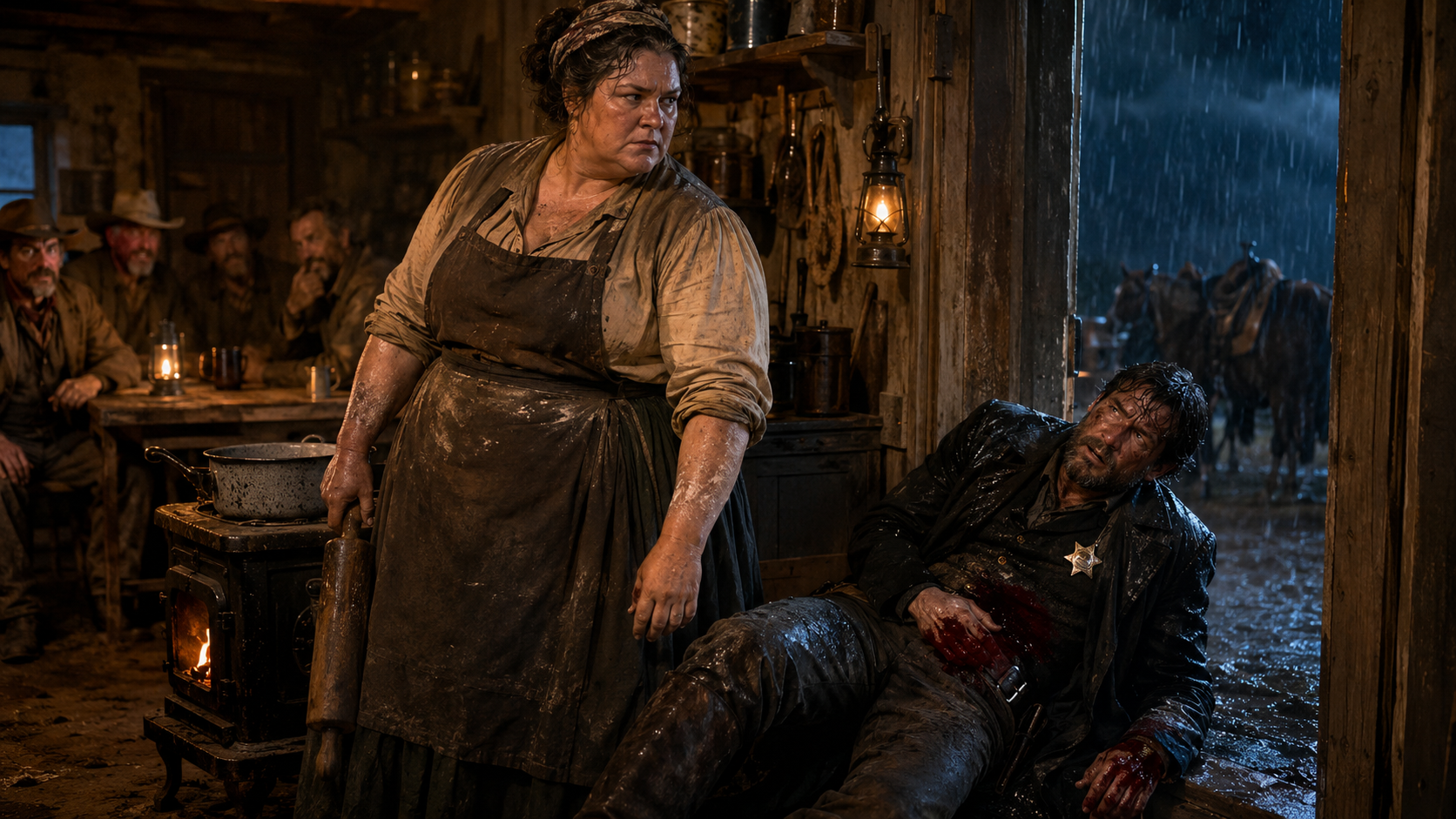
“They took a witness.”
“And you’ll rescue him by fainting off your horse?”
Rowan tried to sit. She pushed him down with one hand.
His eyes flashed.
Hers did not move.
For a moment, marshal and cook measured each other in the dim lamplight.
Then Rowan sank back onto the cot.
“You always this bossy?”
“You always this foolish?”
“Only when bleeding.”
“Then try bleeding quieter.”
Outside, the cattle drivers had grown louder. One of them started singing. Another knocked over a chair. Beatrice heard the floorboards creak near the pantry door.
“Bea,” called the cruel one, “the dead man done eating yet?”
She took the shotgun from the wall.
The door opened two inches.
Beatrice aimed at it.
The door stopped.
“Go sit down, Mr. Harlan.”
There was a pause.
“You wouldn’t shoot a paying customer.”
“No. But I might shoot a thief, and if your hand is on my pantry latch one more second, I’ll decide that’s what you are.”
The latch released.
Bootsteps retreated.
Rowan watched her with a strange expression.
“What?” she asked.
“I was thinking I picked the right floor to bleed on.”
“You didn’t pick. You fell.”
“Best fall I’ve ever taken.”
She should not have smiled.
She did anyway.
For two days, the storm trapped them at the Broken Spur.
Beatrice fed travelers, mended Rowan’s bandages, boiled coffee black enough to insult the devil, and listened to the wind scrape at the walls like fingernails. Rowan drifted in and out of fever. Sometimes he muttered names. Sometimes he reached for a revolver that was no longer there. Once, in the dark before dawn, he woke with his hand locked around her wrist.
“Don’t move,” he whispered.
Beatrice froze.
His eyes were open, but he was not seeing the pantry.
“They’re above the wash,” he said. “Two rifles. One by the cedar.”
“Marshal.”
“Tell Alden to run.”
“Rowan.”
At the sound of his name, his face changed. He came back from whatever blood-soaked memory had him.
He let go at once.
“I’m sorry.”
She rubbed her wrist. “Who’s Alden?”
His eyes closed.
“My deputy.”
“Dead?”
Rowan turned his face toward the wall.
That was answer enough.
She sat on the stool beside the cot. The little lamp threw gold light over the crates, the hanging herbs, the sacks of beans, the jars of peaches she had put up herself because no one made preserves properly within fifty miles.
“My father used to talk in his sleep,” she said.
Rowan did not look at her, but she knew he was listening.
“He would come home from the mines with coal dust in his ears and fear in his coat. My mother said he carried other men’s ghosts because he was too kind to set them down.”
“What happened to him?”
“Explosion.”
Rowan opened his eyes.
“Mine?”
“Railroad powder house. They said he was careless.”
“You don’t believe that.”
“I was twelve. A child believes what adults tell her until grief gets old enough to start asking questions.”
She stood too quickly, as if the words had embarrassed her.
“Eat.”
He looked at the bowl she set before him.
“What is it?”
“Stew.”
“What kind?”
“The kind that keeps ungrateful marshals alive.”
He ate.
After the first spoonful, he stopped and looked at the bowl.
Beatrice braced for a joke. Men always had a joke ready for a woman shaped like her. Something about how much she must taste while cooking. Something about how no man would go hungry in her bed. Something small and mean and tired.
Instead, Rowan said, “That is the best thing I’ve tasted in three months.”
She stared at him.
He looked embarrassed. “Too much?”
“No,” she said softly. “Just unexpected.”
“Good food shouldn’t be unexpected.”
“Kind words often are.”
Neither of them spoke for a while.
On the third morning, the road cleared enough for wagons.
Rowan could stand, though Beatrice told him he looked like boiled laundry. He insisted on leaving. She insisted he was an idiot. Their argument lasted twenty minutes and ended with him sitting at her kitchen table, pale and furious, while she packed supplies into a canvas bag.
“You cannot ride alone,” she said.
“I can.”
“You nearly fell walking to the water barrel.”
“That barrel moved.”
“It did not.”
“It might have.”
She tied the bag shut with unnecessary force.
“There is a town called Bitter Creek two days west,” she said. “I have an appointment there. The Grand Heron Hotel needs a head cook. I was already leaving this place.”
Rowan frowned. “You’re applying at the Grand Heron?”
“Yes.”
“That’s a fine hotel.”
“I know what it is.”
“I didn’t mean—”
“Yes, you did.”
He fell quiet.
Beatrice looked down at her hands. Strong hands. Scarred hands. Hands that could bone a fish, load a shotgun, knead six loaves of bread, and hold a dying man’s head above water. Still, the world looked at them and saw only what it wanted to mock.
“They’ll laugh when I walk in,” she said.