“Don’t save supper for a dead man.”
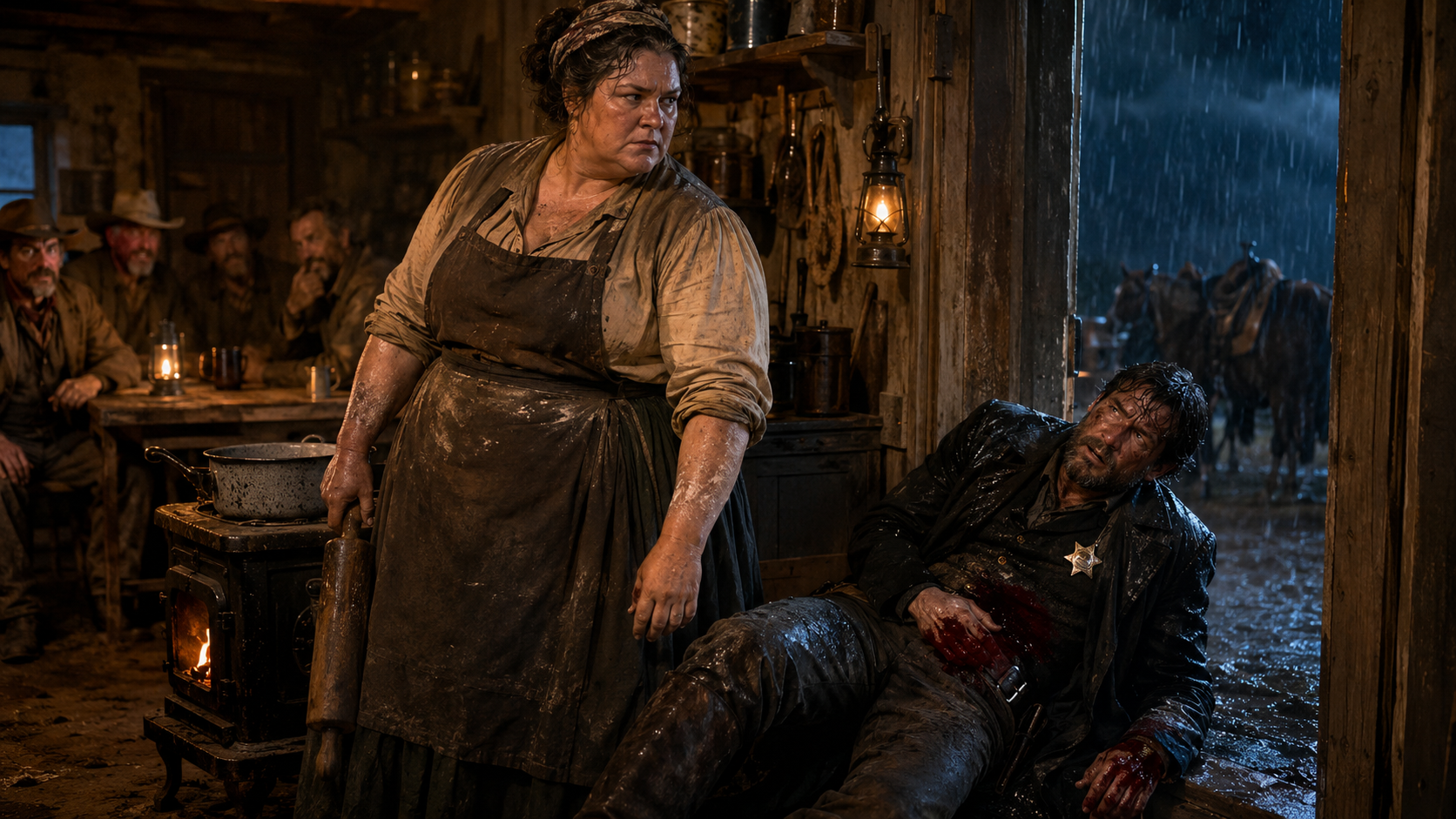
The words came from the far end of the room, where three cattle drivers sat with their boots on the chairs and their cruelty laid out as plainly as their cards. One of them laughed into his tin cup. Another wiped bean gravy from his mustache and glanced toward the door, where a man in a torn black coat lay half across the threshold, leaking blood onto the plank floor.
The storm had carried him in.
Or maybe it had only finished what the bullets started.
Wind screamed outside the Broken Spur way station, rattling the shutters and blowing dust through every crack in the walls. Rain came down hard enough to turn the yard into black soup. The horses in the lean-to stamped and cried, and the old stove glowed red in the middle of the room, fighting the cold with the stubborn pride of a thing too small for the work demanded of it.
Behind the counter stood Beatrice Callow.
Most people called her Bea when they wanted food. They called her Big Bea when they thought she could not hear. They called her worse when they were drunk, and sometimes when they were not.
She was a broad, heavyset woman with powerful arms, dark hair pinned badly under a kerchief, and a face that had learned not to ask the world for softness. Flour dust marked her sleeves. A burn scar crossed the back of one hand. Her apron was patched at the pocket and tied tight around a body men enjoyed judging until they tasted what came from her skillet.
She looked at the bleeding stranger.
He was not dead.
Not yet.
His hat had fallen near the door. Rainwater ran from his hair into his beard. His right hand was clamped around a leather satchel. His left sleeve was dark with blood from shoulder to wrist. A badge glinted beneath his torn coat, dull and muddy, but still visible.
Deputy U.S. Marshal.
The cattle driver laughed again.
“Bea, don’t you dare waste that stew. Man’s already halfway to the grave.”
Beatrice set down the ladle.
The room quieted.
Even cruel men knew when a cook had gone still in a dangerous way.
She came around the counter slowly, wiping her hands on her apron. She stepped over the stranger’s muddy boot, bent with a grunt, and pressed two fingers beneath his jaw.
A pulse.
Weak.
Angry.
Alive.
The stranger’s eyes opened a slit. Gray eyes, sharp even through fever and pain.
“Water,” he rasped.
One of the men at the table snorted. “Hear that? Corpse has manners.”
Beatrice looked over her shoulder.
“You three paid for supper?”
The driver who had spoken lifted his bowl. “Sure did.”
“Then eat it and keep your graveside sermons to yourselves.”
His grin faded.
Beatrice slid her arms under the marshal’s shoulders. He was taller than she expected and heavier than any wounded man had a right to be. Pain cut across his face as she dragged him away from the door. His boots left streaks of blood and mud on the boards.
“Satchel,” he gasped.
“You’re bleeding through your coat.”
“Satchel.”
“Lord save me from stubborn men.”
She reached back, grabbed the leather bag, and shoved it under her arm. Then she hauled him behind the counter and into the little room that served as her pantry, bedroom, and office depending on the hour.
He nearly passed out when she lowered him onto the cot.
“Name,” she said.
His mouth twitched. “You first.”
She narrowed her eyes. “You are not in a position to bargain.”
“Neither are you if those men outside decide to rob you.”
“They know better.”
His gaze dragged to the shotgun hanging above the flour barrel.
“I believe you,” he whispered.
“Name.”
“Rowan Vale.”
“Marshal Vale?”
“Was, last I checked.”
“I’m Beatrice Callow. If you die on my cot, I will be deeply inconvenienced.”
Something like a laugh broke in his chest and turned into a cough.
“Sorry,” he said.
“You’re not sorry yet.”
She cut away his coat.
The bullet had gone through the meat of his upper arm, ugly but clean. Another graze burned across his ribs. His fever worried her more than the wounds. He had ridden too long in the storm. He was shaking under her hands, not from fear, but from the body’s fury at being ignored.
“You were ambushed,” she said.
His jaw tightened.
“Two men. Maybe three.”
“Names?”
“Rusk brothers.”
At that, Beatrice’s hand stopped.
Rowan noticed.
“You know them?”
“I know the name.”
Everybody in that country knew the Rusk brothers. Elias and Boone Rusk had been robbing payroll wagons, burning stage offices, and leaving witnesses face-down in gullies for six years. Some said they had friends in every sheriff’s office from Abilene to Santa Fe. Some said they had never been caught because dead men could not testify.
Beatrice poured whiskey over the wound.
Rowan swore hard enough to make the horses outside answer.
“There,” she said. “Still alive.”
“I need to ride tonight.”
“You need to sleep.”