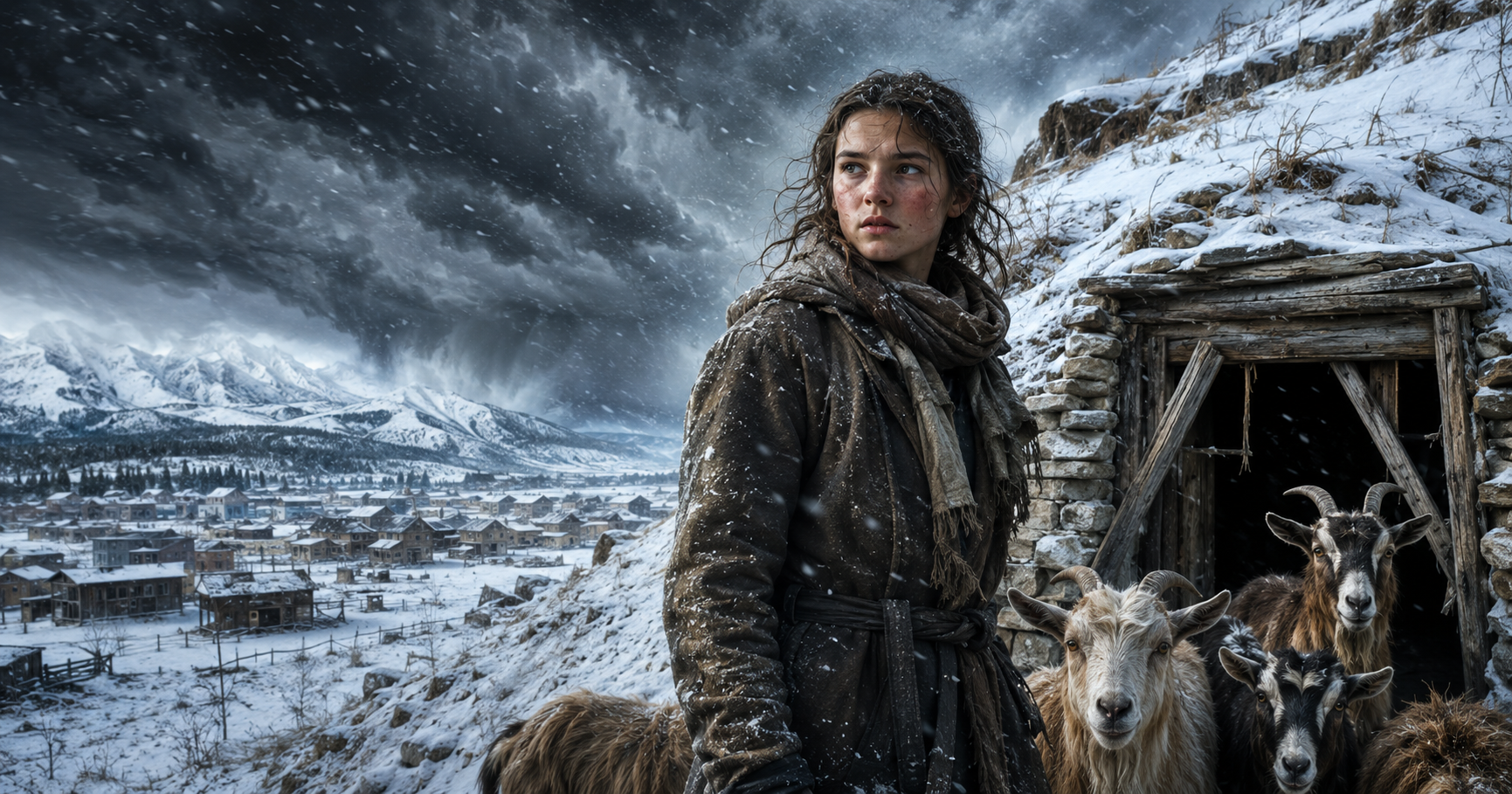
By dusk, the goats were already inside the hill. Clara stood at the entrance and looked down at Alder Creek. Lamps glowed in windows. Smoke rose from chimneys. The church bell rang six times. The hotel windows shone gold. Gideon’s glass barn flashed faintly in the last light.
Everything looked firm.
That was the lie that frightened her most.
Things always looked firm until the moment they failed.
Clara stepped into the shelter. Empress followed. The other goats crowded in behind them, hooves clicking against stone and packed clay.
Clara shut the old door.
She touched the carved words.
HOLD FAST.
Then she dropped the iron bar into place.
At midnight, the temperature fell so fast the creek split with sounds like gunfire.
Before dawn, the world disappeared.
The snow did not fall downward.
It came sideways, upward, in circles, in knives.
Wind tore through Alder Creek with such force that it stripped paint from signs, pushed snow through keyholes, and drove ice beneath roof shingles. Trees cracked. Barn doors slammed until hinges snapped. Water buckets froze solid in kitchens. Chickens died on their roosts. The schoolhouse bell rang once by itself when the steeple shifted, then went silent under the wind.
Inside Larkspur Hill, Clara sat on the sleeping platform with a blanket around her shoulders and a tin cup of warm goat milk in both hands.
The shelter held.
Above her, the storm became a deep trembling in the earth. Around her, the goats shifted, breathed, chewed, and pressed warmth into the chamber. The thermometer climbed to sixty-one degrees.
Every few hours, Clara climbed the ladder and drove a long pole up through the ventilation shaft to break ice from the cap. Each time, the storm screamed down at her for one terrible breath before the baffle settled and the air calmed again.
She marked time with cuts on a cedar post.
One.
Two.
Three.
Five.
Seven.
After that, she stopped knowing whether it was night or day.
Then something struck the door.
At first she thought part of the hill had cracked.
A dull thump.
Then another.
Then scraping.
Empress rose instantly, ears forward, body planted between Clara and the entrance.
Clara took the lantern in one hand and the pry bar in the other.
“Who is there?”
A voice came through the door, broken by wind.
“Clara! Open! Please!”
She knew the voice.
Not Gideon.
Thomas Vale, the schoolmaster.
Clara lifted the bar and shoved the door outward. Snow exploded into the room. A man fell across the threshold dragging two children behind him by a rope tied around their waists. Clara grabbed the smaller child under the arms and pulled with all her strength. The wind tried to take the door from her hands.
A second figure lurched out of the white and slammed shoulder-first into the entrance.
Abel Pike.
His beard was packed with ice. His cane was gone.
Clara threw her weight against the door. Thomas pushed from the floor. Abel cursed through blue lips. Together they forced it shut.
The iron bar dropped.
Silence returned so suddenly that one of the children began to cry.
Thomas lay on the floor, spectacles gone, lips blue. The children were Ruthie and Caleb Dunn from the east road, shaking too hard to speak. Abel sat with his back against the wall, chest heaving.
He looked around the chamber.
“Good hole,” he rasped.
Clara did not waste breath on pride.
“Wet coats off. Hands under arms. Sit near the goats. Thomas, drink slowly.”
She warmed milk over a small lamp and made them sip. She tucked the children between Empress and a patient brown goat named Biscuit. The animals tolerated the arrangement like old nurses who had seen worse.
“What happened?” Clara asked when Thomas could answer.
“The school roof lifted. I found them in the cloakroom.” He swallowed. “Their parents tried to reach town yesterday. I don’t know if they made it.”
Abel closed his eyes.
“The hotel?” Clara asked.
“Still standing when we passed.”
“The store?”
“Roof damaged.”
Clara looked toward the door.
She knew more would come.
Gideon Rusk arrived without his hat.
That was how Clara knew the storm had humbled him.
Gideon had never appeared in public less than properly dressed. Now his hair was frozen flat to his skull. Blood streaked one side of his face where flying glass had cut him. Two ranch hands staggered behind him, one barely conscious.
Clara opened the door only wide enough to drag them through.
When it shut again, Gideon stood in the lantern glow and stared.
He looked at the cedar braces, the shelves, the hay, the goats, the steady lamp flame, the children breathing against warm fur, the thermometer above sixty degrees.
He looked like a rich man discovering a currency no one accepted.
“My barn,” he said.
Clara handed him a cup.
“Drink.”
“The windows blew inward. The herd panicked. The north gate broke. I heard them…” His voice failed. “I heard them dying.”