“Drink.”
His hand shook.
“You warned me.”
“I did.”
“I laughed.”
“Yes.”
The word was not cruel.
That made it worse.
In the hill, there was no room for reputation. Everyone sat low. Everyone smelled of fear, sweat, wet wool, and survival. Pride required space to stand tall. The shelter did not offer it.
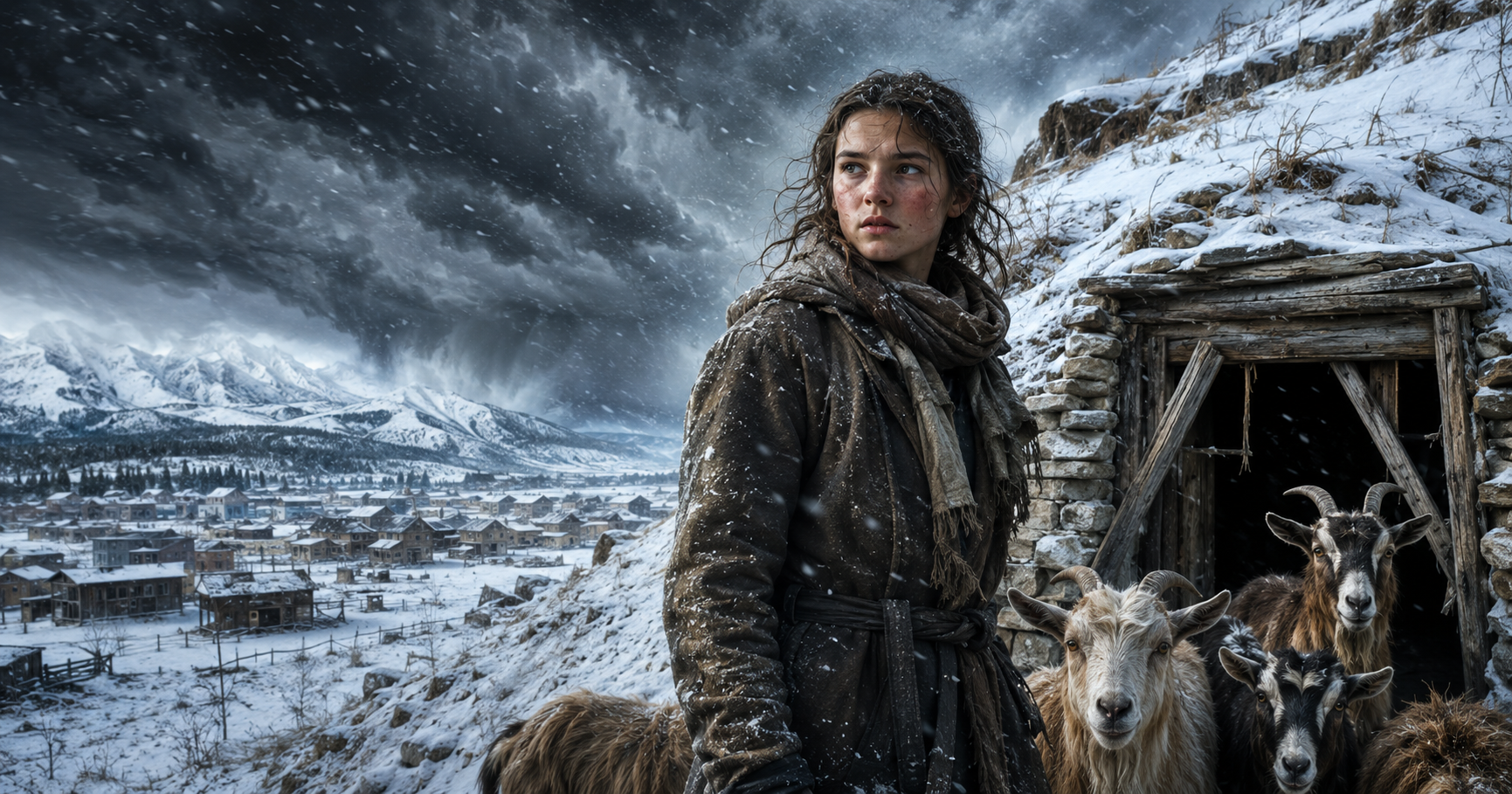
By the second day, there were thirteen people and fourteen goats inside Larkspur Hill.
The air grew heavy. The smell became fierce. Children slept in shifts against the animals. Thomas’s feet turned purple but not black. Abel ruled the ventilation schedule like a general commanding a siege.
Gideon said little.
On the third night, the vent froze solid.
Clara climbed the ladder and drove the pole upward.
Nothing moved.
The lamp flame bent low.
A child coughed.
Abel struggled to stand.
“No,” Clara snapped. “Stay down.”
Gideon rose instead.
“My hands still work.”
“They are frostbitten.”
“They are not dead.”
He climbed behind her and braced both palms beneath the pole.
“Push when I push,” Clara said.
They shoved.
The ice held.
The lantern flame shrank.
The chamber seemed to lean inward.
Again.
Nothing.
Gideon made a sound then—not a word, not a prayer, but the raw noise of a man using the last strength shame had left him.
Ice cracked above.
Air knifed down the shaft.
Everyone gasped as if the hill itself had breathed for them.
Clara climbed down shaking.
Gideon followed. His palms had split open and bled through the frostbite.
He looked at her.
All the storekeeper polish had gone out of his face.
“I was wrong,” he said.
“Yes.”
“I don’t know what to do with that.”
“Take the next watch.”
He nodded.
No forgiveness.
No speech.
No grand change of heart.
Only work.
For that hour, work was enough.
The storm ended not with kindness but with absence.
Clara woke because the floor had stopped trembling.
A blade of sunlight pierced the ventilation shaft and struck the wall. Dust turned gold inside it.
No one moved at first.
Then Abel whispered, “Well. That’s irritating.”
Thomas lifted his head. “What is?”
“Still being alive. Means I owe somebody thanks.”
The children laughed weakly.
The door would not open. Snow had packed outside it like stone.
“We dig up,” Clara said.
Gideon took the shovel first. Clara followed with boards to brace the tunnel. Abel watched the lantern flame and barked orders whenever their breathing became too fast.
It took more than an hour to break through.
When Clara climbed out, the brightness hurt her eyes.
Alder Creek had been erased.
Only chimney tops, broken trees, and the torn point of the church roof showed above the drifts. Fences were gone. Roads were gone. Gideon’s fine glass barn stood split open in the distance, its empty window frames dark as missing teeth.
Gideon came up beside her.
For a long moment he said nothing.
Then he sank to his knees in the snow.
“My God.”
Clara looked toward town.
“The hotel cellar,” she said. “Maren.”
Gideon staggered up.
They moved quickly because daylight would not last.
Abel stayed at the shelter with Thomas and the children. Clara and Gideon dug a path wide enough for the goats. The animals came out one by one, blinking, stamping, then following Empress across the drifted slope as if walking over buried fences and roofs were ordinary business.
At the Rusk Hotel, half the town was alive in the cellar.
Barely.
Maren had brought people there when the hotel windows blew out. She had rationed candles, blankets, water, and flour with calm severity. But the coal was gone. The pantry had flooded. The smallest children had stopped shivering, and Clara knew that was worse than shivering.
When Clara descended the cellar steps leading Empress by a rope, every face turned.
No one laughed.
No one complained about goats in a hotel.
Clara sat on an overturned crate and milked Empress into a tin pail.
The sound filled the cellar.
Steady.
Plain.
Miraculous.
“Children first,” Clara said. “Then the old. Gideon, bring the rest of the goats down. Put them along the walls. Their bodies will warm the room faster than that dead stove.”
Gideon Rusk, who had once owned half the town’s debt and all of its confidence, obeyed like a hired man.
Maren watched him.
Then she looked at Clara.
“I saved candles,” Maren said quietly.
“I brought milk,” Clara answered.
For the first time Clara could remember, another woman smiled at her without pity.
Through that night, the goats kept Alder Creek alive.
Children pressed numb hands into coarse fur. Old men leaned against warm flanks and cried without sound. Maren organized cups. Thomas counted heads despite the pain in his feet. Abel sat against the cellar wall with his unlit pipe and warned everyone not to waste breath arguing with him.
Gideon moved from person to person carrying milk, blankets, and shame.