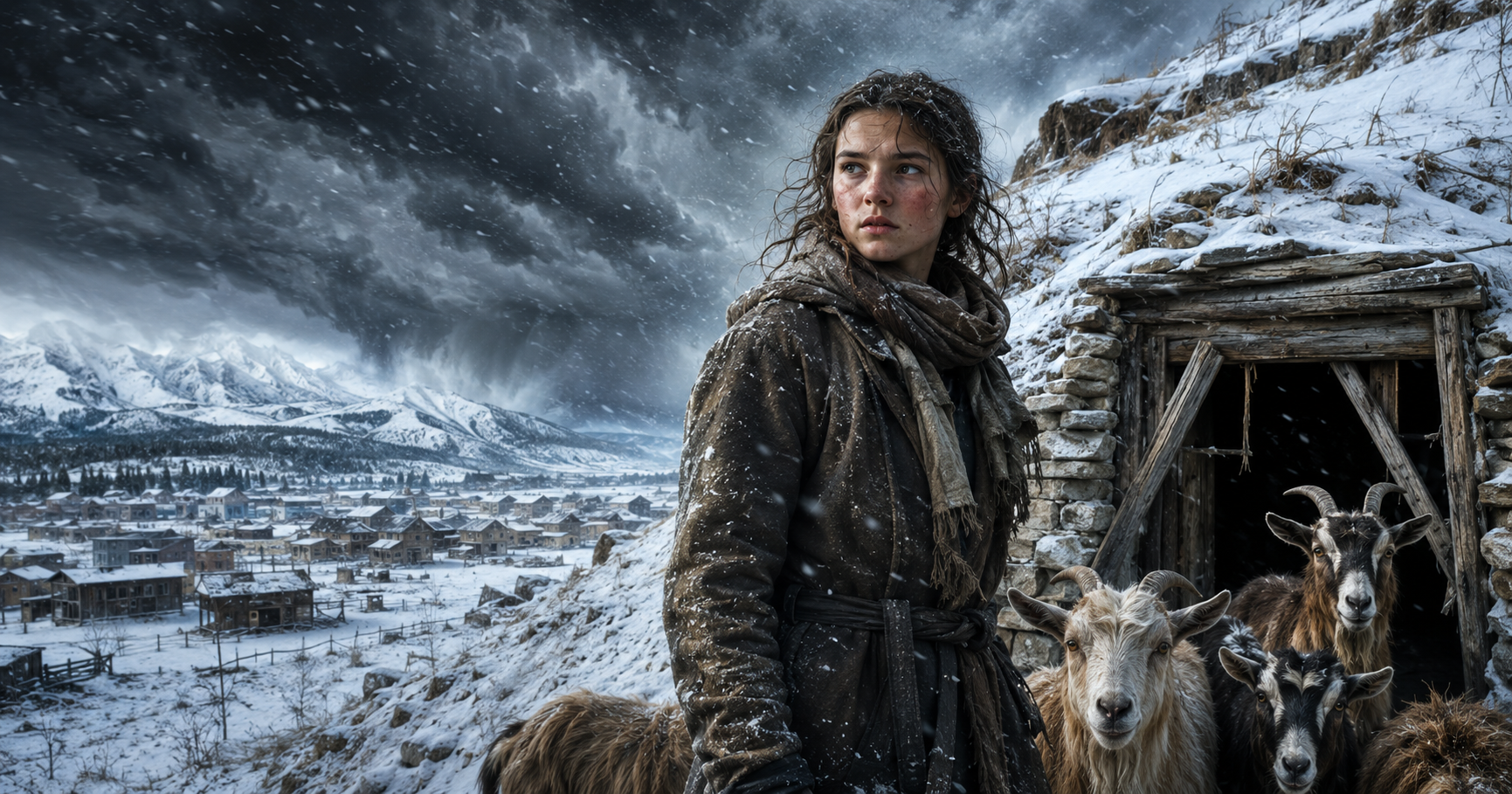
“Fourteen goats weigh more than seven hundred pounds together. They eat brush cattle ignore. They give milk when roads close. They sleep close. Their bodies warm a room. They climb where horses break legs. And they know enough to get out of the wind.”
Gideon’s smile faded.
A few men glanced at the northern sky.
But Gideon spat into the dirt.
“Next she’ll tell us the goats can read scripture.”
More laughter.
Clara gathered the ropes and led her strange herd up the road.
Gideon’s wife watched from beside the auction fence.
Her name was Maren Rusk. She was thirty-eight, quiet, pale, and graceful in the way women became graceful when they had spent years not flinching in public. She said nothing as Clara passed, but her eyes moved from the goats to the mountains, then to her husband.
That evening, Maren put extra candles, flour, blankets, a medicine box, and two barrels of water in the hotel cellar.
She told no one.
Alder Creek entered November with the confidence of people who had survived ordinary winters and mistaken them for proof.
Men repaired barn roofs. Women sealed jars. Children chased each other through frost-stiff yards. Gideon boasted that his new cattle barn, with long glass windows on the south wall, would be the finest winter structure in the county. He said the light would keep the herd calm.
Maren knew that was not the reason.
Gideon liked things that could be admired from the road.
Clara worked without admiring anything.
She stacked hay until the hill chamber smelled like summer trapped underground. She dried moss for bedding. She tested the vent shaft with smoke. She covered cracks with clay and straw. She trained the goats to enter the shelter at dusk. She learned which one kicked, which one bit, which one gave milk easily, and which one would only behave if Clara sang under her breath.
The first night she slept inside with all fourteen goats, she woke before midnight sweating.
She sat up in the dark.
The lantern was low. The wind whispered somewhere beyond the door, but inside the chamber the air was thick with warmth and animal breath.
The thermometer Abel had given her read fifty-nine degrees.
Empress lifted her head and stared at Clara as if asking why humans were always surprised by sensible things.
Clara laughed.
It startled her so much that she covered her mouth.
She had not laughed like that since she was seven years old.
Then the laugh broke apart and became a sob.
She pressed her forehead to her knees and cried while the goats chewed hay around her, unimpressed and alive.
“It works,” she whispered.
Empress blinked slowly.
Outside, the first hard frost silvered the grass.
The storm gave warning in small ways first.
The creek froze at the edges, not with the usual thin lace of ice, but with a cloudy white hardness that looked sick. Birds left the cottonwoods two days before they should have. Horses stamped in their stalls. The goats refused the upper slope and pushed toward the shelter door before sunset.
On December 17, Clara walked into town for lamp oil, salt, and a packet of coffee she could not afford but bought anyway because fear makes people crave proof they are still living.
The sky was low and bruised. The mountains had vanished behind a gray wall. The air smelled metallic, like a wet nail held between teeth.
Inside the general store, Gideon Rusk stood by the stove telling three ranchers that the weather bureau had predicted “a respectable storm.”
“Two feet,” he said. “Maybe three. Nothing to frighten grown men.”
Clara placed her coins on the counter.
“Bring your cattle off the north range.”
The store went quiet.
Gideon turned slowly.
“Excuse me?”
“Bring them in before dark.”
One rancher laughed into his glove.
Gideon leaned one elbow on the counter.
“Miss Whitcomb, grief and loneliness can make a person see omens in every cloud.”
“This is not grief.”
“No?”
“It’s pressure. Wind. The animals felt it before dawn. Your horses felt it too, if anyone bothered to look.”
Gideon’s eyes cooled.
“I was keeping cattle alive before you were old enough to tie your shoes.”
“And you put glass in a winter barn.”
The ranchers stopped smiling.
Gideon straightened.
“What did you say?”
“Glass is only ice waiting for permission to break.”
Clara took her parcel.
“Bring them in.”
She left before he could answer.
Outside, Abel Pike stood in the street staring north. His pipe was in his mouth, unlit.
That frightened Clara more than the sky.
“You smell it?” he asked.
“Yes.”
“Dakota,” he muttered. “Seventy-nine. Same iron stink. Men died within sight of their own lanterns.”
Clara looked at him.
“Come to the hill tonight.”
His eyes shifted toward her.
“I might.”
“I am not being polite.”
“I know.”
“I mean it.”
“So do I.”