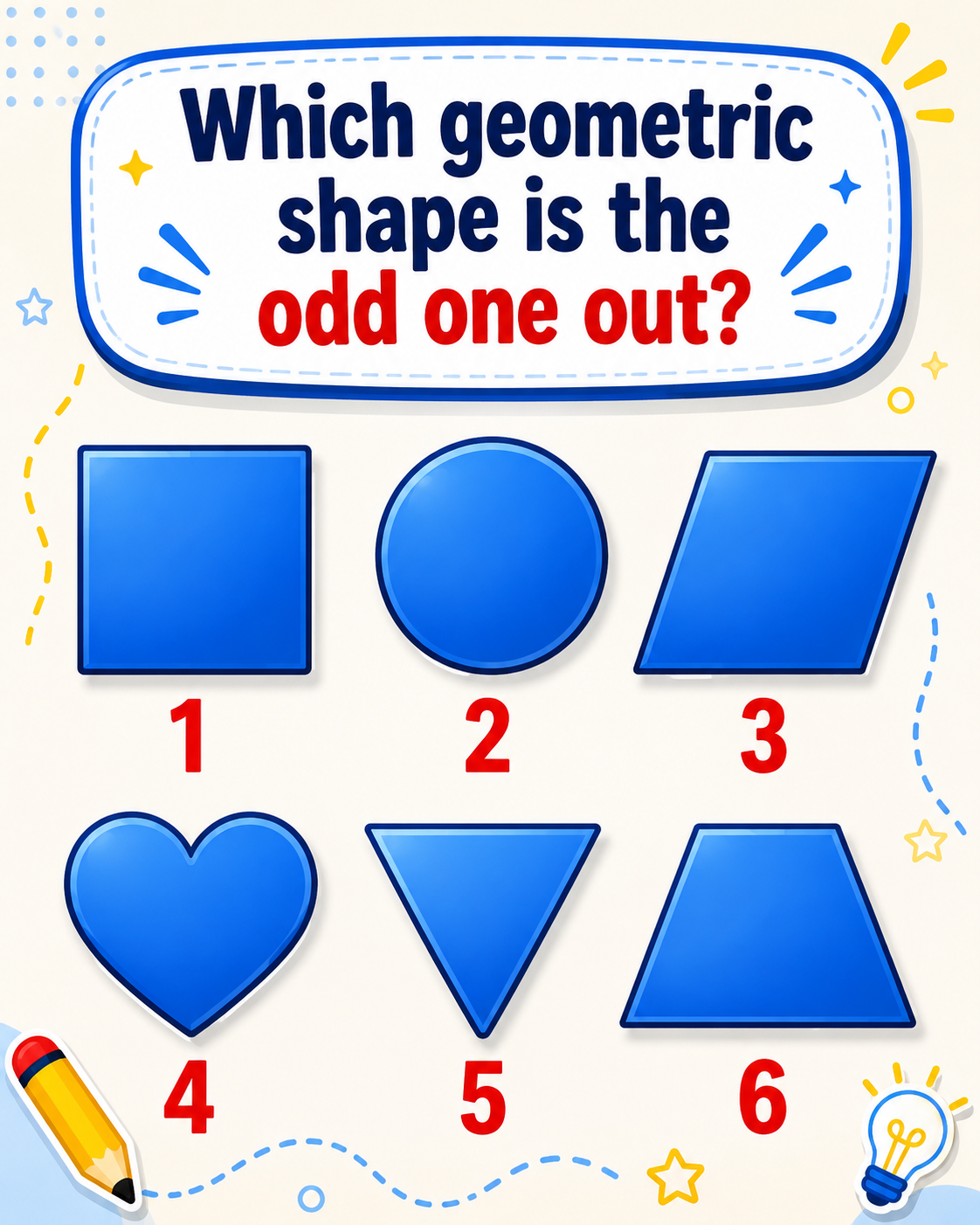
Can you spot the odd one out…? This tricky geometric puzzle stumps most people
Do you think you have a keen eye and a keen eye for detail?
Here’s a quick brainteaser that has already baffled puzzle enthusiasts and those well-versed in geometry. At first glance, it seems extremely simple. What’s more, many people confidently give the answer in just a few seconds.
But here’s the interesting bit.
Most of them are wrong.
Ready to test your powers of observation?
The task
Take a close look at the six blue shapes shown in the image.
Each shape is numbered from 1 to 6:
- Square
- Circle
- Parallelogram
- Heart
- Triangle
- Trapezium
Your task is simple:
Find the one shape that is different from the rest.
Sounds easy, doesn’t it?
But don’t rush.
In this puzzle, you need to choose neither the prettiest nor the most unusual shape. The key here is to think mathematically and not to trust your first impression.
Don’t rush your answer
Many people immediately focus on the obvious differences.
Some choose the heart because it isn’t a classic geometric shape.
Others point to the circle, as it has no corners.
Some even choose the triangle because it has fewer sides than other polygons.
But the key to solving this problem lies in a feature that all five shapes share — and which is missing from just one of them.
Take another look before reading on.
Which shape is the odd one out?
Shape 1
Shape 2
Shape 3
Shape 4
Shape 5
Shape 6
Have you made your choice yet?
Scroll down to find out the correct answer.
Answer
The odd one out is No. 3
If you chose shape 3, well done!
You spotted the key mathematical feature that sets it apart from all the others.
Why is shape 3 different?
It’s all down to vertical symmetry.
A shape has vertical symmetry if a straight line can be drawn through its centre from top to bottom, and both halves are mirror images of each other.
Let’s look at the shapes:
Shape 1 (square): has vertical symmetry ✔️
Shape 2 (circle): has vertical symmetry ✔️
Shape 4 (heart): has vertical symmetry ✔️
Shape 5 (triangle): has vertical symmetry ✔️
Shape 6 (trapezium): has vertical symmetry ✔️
But…
Shape 3 (parallelogram): does not have vertical symmetry ❌
If you draw a vertical line through the centre of the parallelogram, its two halves will not be mirror images of each other.
This is precisely why shape 3 is the only one that lacks vertical symmetry, and therefore this is the correct answer.
Why this puzzle is so often misleading
The puzzle works because it forces people to focus on superficial differences rather than on a deeper geometric characteristic.
Many participants are distracted by:
- Curved and straight lines
- The number of sides
- Familiar and unusual shapes
But those who successfully solve such puzzles look for a rule that consistently applies to the whole group.
In this case, the hidden clue is symmetry.
Did you get it right?
If you spotted figure 3 straight away, you can give yourself a pat on the back: your visual perception, logic and ability to spot patterns are excellent.
If not, don’t worry. Puzzles like this are designed precisely to challenge your usual assumptions and force you to look at the situation from a different angle.
Sometimes the correct solution only becomes apparent when you stop looking for what’s different and start looking for what they have in common.
Test your friends
Share this puzzle with your friends and family and see who can spot the odd one out the quickest.
Will they spot the symmetry clue, or will they fall into one of the common traps?
Let the puzzle battle begin!