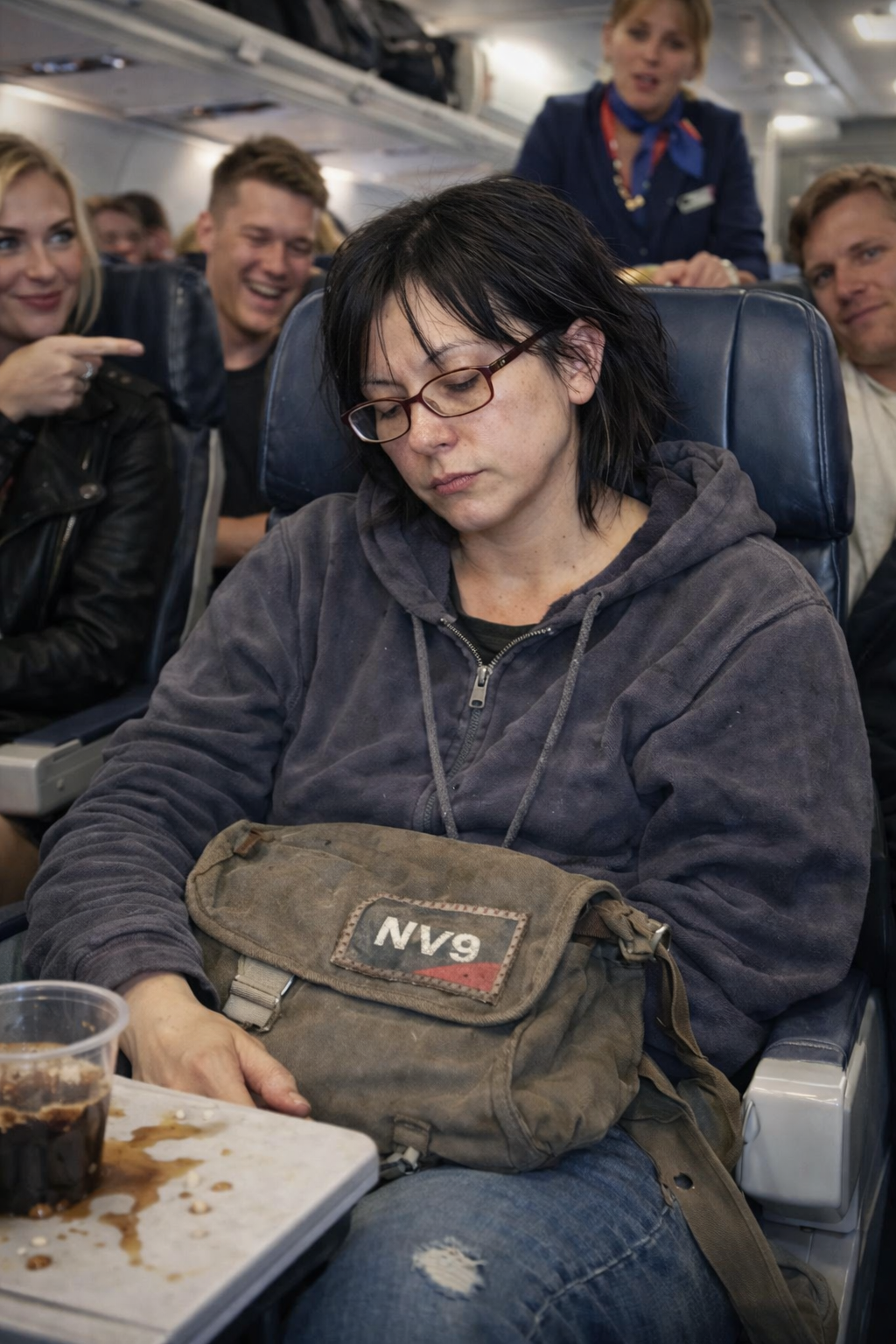
Rachel adjusted the strap of her bag.
“They don’t need my name.”
Nina frowned.
“They should know.”
Rachel looked past her.
Families embracing.
Suitcases rolling over polished floors.
A little boy in dinosaur pajamas wrapping his arms around his grandfather.
“They already know what matters,” she said quietly. “They made it home.”
Nina hesitated.
She wasn’t satisfied—but she was perceptive enough to understand that Rachel wasn’t avoiding attention out of pride.
She was avoiding something older than that.
“Can I at least say thank you?” Nina asked.
Rachel’s expression softened—just a fraction.

“You already did.”
And then she walked away.
Nina stood there, watching until the crowd swallowed her completely.
The airline press conference began before most passengers had even retrieved their luggage.
A spokesperson in a navy suit stood beneath harsh lighting, speaking in the careful, polished language designed less for truth—and more for legal safety.
“We are grateful that Flight 472 landed safely following a systems irregularity. Our trained crew performed admirably under pressure.”
A reporter raised a hand.
“Passengers say a woman from row 9 provided critical navigation support.”
The spokesperson smiled—a thin, practiced expression.
“A passenger assisted under crew supervision.”
“Who was she?”
“We are still confirming identities.”
Another voice cut in.
“Video shows her entering the cockpit while passengers objected. Was she trained?”
The spokesperson adjusted his tie.
“We do not comment on personal backgrounds.”
From the back of the room, Nina almost laughed.
Because what she had lived through was already being flattened into something safer.
Something smaller.
Beside her stood the older man in the worn brown jacket.
Rachel’s notebook rested carefully under his arm, as if it were fragile.
“They’re shrinking her,” he said.
Nina turned.
“You knew what that notebook was.”
He nodded.
“Forty-two years as an aircraft mechanic,” he said. “Not military—crop dusters, charters, rescue planes when they could afford me. I know what real notes look like.”
“What’s your name?”
“Walter.”
Nina gestured toward the stage.
“They’re making her sound like she just got lucky.”
Walter’s jaw tightened.
“Luck doesn’t write wind speeds in pencil because ink runs when your hands shake.”
Nina stared at him—then at the notebook.
“Can I see it?”
Walter opened it carefully.
Page after page of precise handwriting.
Adjustments.
Margins.
Cross-checks.
Hand-drawn approach lines.
At the back—the photograph.
Nina read the words twice.
For the girl who reads storms before they speak.
Something caught in her throat.
“This should be public.”
Walter closed the notebook gently.
“Maybe,” he said. “But not in the wrong hands.”
Within hours, blurry passenger videos began spreading online.
Not through official channels.
Through awe. Through fear. Through people needing to share what they had survived.
A clip of Rachel standing in the aisle in her worn hoodie while others protested.
A clip of the co-pilot saying, “Come with me.”
A shaky recording of the landing—full of crying, applause, and disbelief.
A fragment from near the wing where a child’s voice rang out:
“She did it!”
No clear image of Rachel’s face existed.
And somehow—that made the story grow larger.

Who was the woman in 9A?
Was “Night Viper Nine” a real call sign?
Why had the cockpit recognized her?
What did she mean when she said the instruments were lying?
The internet responded the way it always does—
With brilliance and nonsense tangled together.
Some called her a myth.
Some claimed she was a former government pilot.
Others insisted it was all staged.
Some obsessed over her clothing, as if a hoodie itself required explanation.
But one kind of comment rose above everything else:
Stories.
People describing how they had been dismissed.
Ignored.
Underestimated.
Talked over—because they looked too young, too old, too poor, too plain, too quiet.
The story stopped being about one flight.
That’s when it truly spread.
Three days later, Nina found the first real lead.
Not through leaks.
Not through secrets.
Through an old article buried deep in a local Oregon archive.
Ten years old.
Small regional newspaper.
The headline:
Local Pilot Assists Emergency Ridge Approach After Navigation Failure.
No photo.
Just a short column and a quote from a county official mentioning “a contract pilot who requested privacy.”
The location matched.
The situation felt familiar.
And in one paragraph—almost overlooked—the article referenced a pilot known by a call sign:
Night Viper Nine.
Nina read it three times.
Then she called Walter.
He picked up on the second ring.
“I found something.”
He listened.
Then said simply,