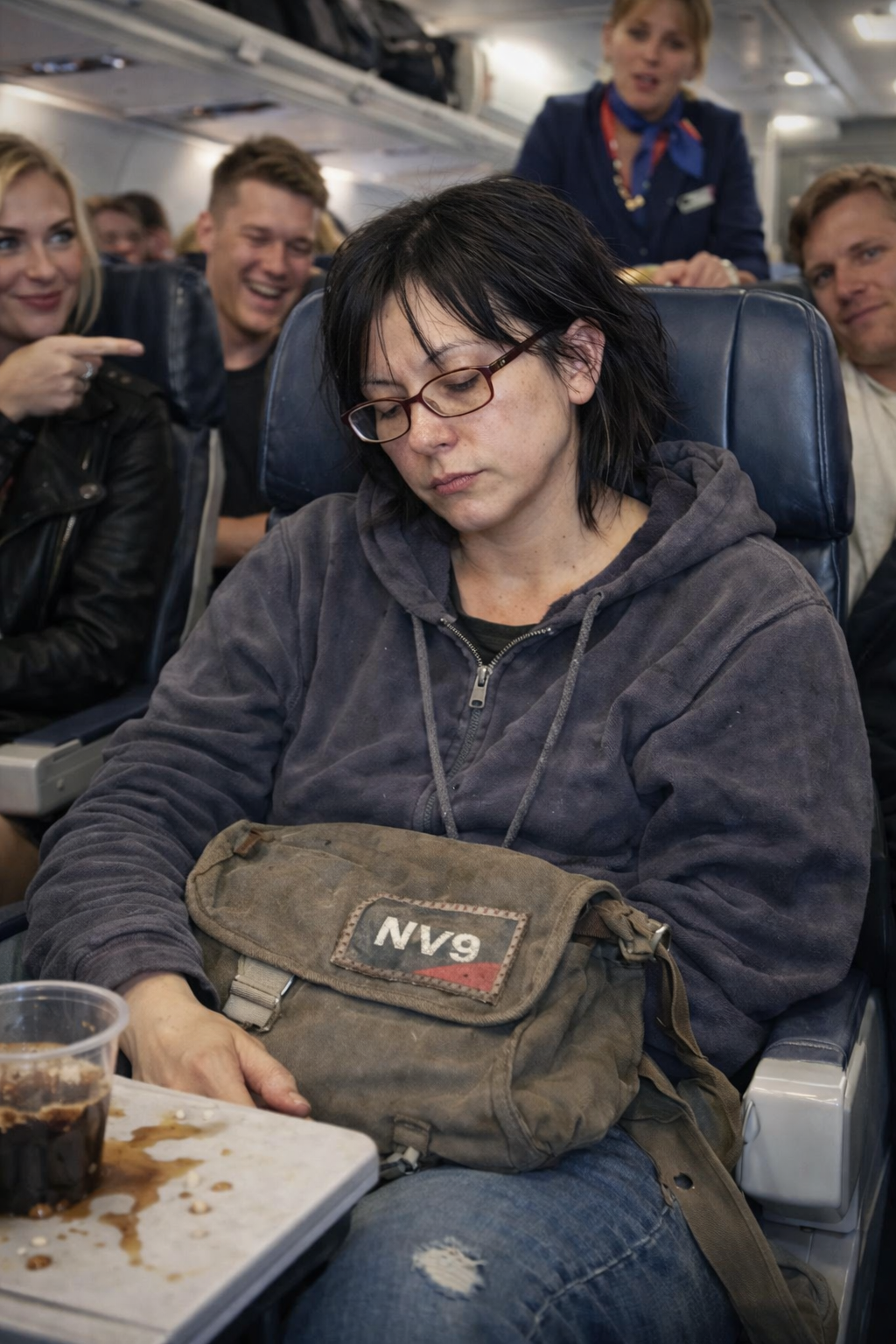
Not trying.
Not hoping.
Bringing.
It sounded like certainty.
That was what people remembered later.
Not just that she saved them—
But how she spoke while doing it.
The wheels hit the runway.
Firm enough to jolt.
Controlled enough to prove skill.
A collective gasp filled the cabin.
Then another bounce—
Then the long, powerful roar of deceleration.
No spin.
No skid.
No chaos.
Just speed bleeding away beneath them.
The aircraft held steady.
And suddenly—
The cabin erupted.
Crying.
Applause.
Laughter tangled with relief and disbelief.
Hands over faces.
Heads pressed into shoulders.
A woman near the back began praying again—this time in gratitude.
The little girl shouted,
“We landed!”
Her mother broke down in tears, kissing her hair.
The tracksuit guy sat frozen for a moment, then looked at Rachel’s empty seat and exhaled like the air had been knocked out of him.
The businessman covered his face.
Only briefly.
But long enough.
In the cockpit, the captain’s hands began to shake after the plane had fully slowed.
That surprised him.
He was used to holding himself together in the moment.
It was afterward that the body collected its due.
He turned to Rachel.
For a second, it looked like he might salute her.
Instead, he said simply,
“Thank you.”
Rachel removed the headset and placed it down with care.
“You had the skill to do the rest,” she said. “You just needed better truth.”
The co-pilot stared at her.
“You talk like this happens often.”

Rachel stood.
“No,” she said. “I talk like panic likes costumes—and truth usually doesn’t wear one.”
She picked up her bag.
The captain glanced again at the faded patch.
NV9.
“What should we tell them?” he asked.
Rachel paused, her hand resting on the cockpit door.
“That they’re home.”
He opened it.
The moment she stepped back into the cabin—
Silence fell.
Because no one prepares for what comes after judgment.
There is no script for sudden shame.
The applause began with the little girl.
Just her.
Small hands clapping with everything she had.
Then her mother joined.
Then the older man.
Then the co-pilot behind Rachel.
And then—
Everyone.
Not neat.
Not synchronized.
Raw. Emotional. Grateful.
Rachel stood there in her worn hoodie, faded sneakers, and old canvas bag—
And every person who had measured her by the wrong things now had to face her.
The businessman rose halfway.
He seemed ready to speak.
Then sat back down.
The woman in the cream blazer stared at her lap.
The woman in pink dabbed at her eyes, suddenly trying to look like she had never judged at all.
The tracksuit guy leaned into the aisle as Rachel passed.
His confidence was gone.
“I’m sorry,” he said.
Rachel stopped.
Looked at him.
His ears flushed red.
“For earlier,” he added. “All of it.”
Rachel gave a small nod.
Then moved on.
She didn’t make him carry it longer than necessary.
That somehow made it heavier.
Near the exit, Cindy stepped into her path.
The cabin quieted again.
Her eyes were wet, her voice unsteady.
“I judged you,” she said. “I was wrong.”
Rachel studied her for a moment.
Cindy looked like she was bracing for something harder.
Rachel’s voice softened.
“You were afraid.”
Cindy swallowed.
“That doesn’t make it right.”
“No,” Rachel said. “But it is a reason. Learn to tell the difference.”
Cindy nodded slowly, as if she understood that those words would stay with her far longer than the flight itself.
At the aircraft door, the captain’s voice came over the cabin speaker.
It was steadier now—but still edged with emotion.
“This is Captain Ellis speaking. Today, this aircraft—and every person on board—made it to the ground because a passenger from row 9 stepped forward when we needed her most. She has my respect, the respect of my entire crew, and more gratitude than I can fit into a single announcement.”
Applause rose again, louder this time.
Rachel closed her eyes for just a moment.
Then she stepped into the jet bridge—and disappeared into the flow of people.
By the time airport staff, airline officials, and camera crews began trying to shape the story into something controlled and presentable, Rachel Morgan was already deep in the terminal crowd, moving with the same quiet purpose she had carried down the aisle.
Near a coffee stand, a college student from the flight hurried after her.
Backpack slung over one shoulder. Hair tied in a messy ponytail. Eyes still wide with the kind of shock that comes from seeing the world rearrange itself.
“Wait!” she called.
Rachel stopped.
The girl held up her phone—not to record, but almost out of instinct.
“My name’s Nina,” she said. “I was on that flight. People are already asking who you are. The airline’s putting out some vague statement.”