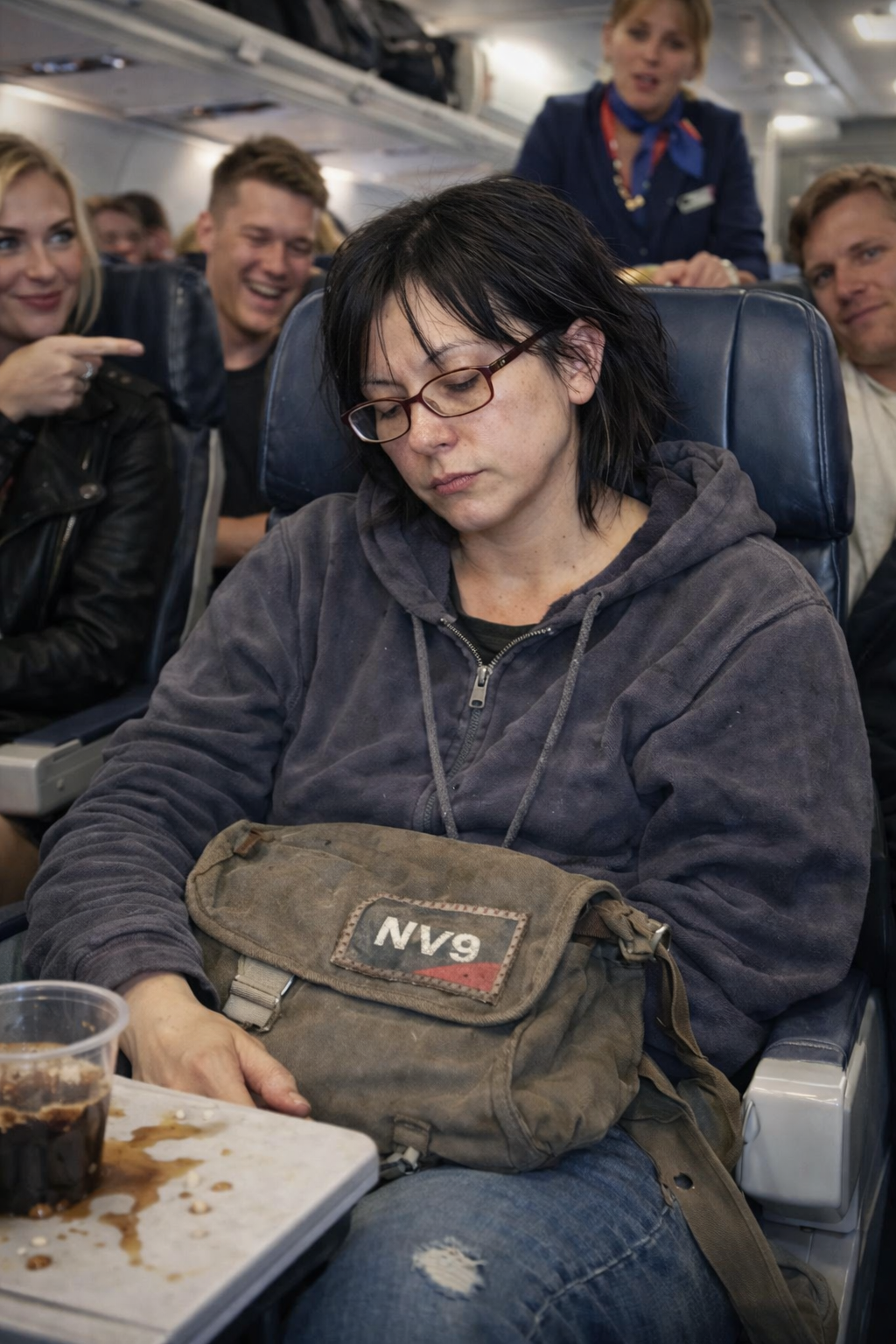
Passengers checked watches, phones, screens—anything to anchor themselves.
The teenager replayed the video he had taken—now muted—watching Rachel walk toward the cockpit again and again.
His friend whispered,
“Delete it if this goes bad.”
He didn’t.
Instead, he lowered the phone—his expression shifting into something closer to guilt.
Near the front, the businessman leaned toward the woman in the cream blazer.
“This airline will never recover from this,” he muttered.
She nodded stiffly.
Neither of them mentioned how they had treated Rachel.
Not yet.
People rarely confront themselves that quickly.
The older man opened the notebook again—more carefully this time.
Inside the back cover was a photograph.
Faded.
Three figures standing beside a small propeller plane.
A man in a worn cap.
A younger Rachel—thin, sharp-eyed, all focus.
And an older woman, smiling into sunlight, her hand resting on Rachel’s shoulder.
On the back, written in ink:
For the girl who reads storms before they speak.
The man swallowed and closed the notebook.
The mother in denim noticed.
“What is it?” she asked quietly.
He shook his head.
“Proof she mattered long before any of us decided she didn’t.”
The mother looked toward the cockpit again.
“Maybe that’s the problem,” she said.
He turned to her.
She glanced around the cabin.
“We expect people to look expensive before we believe they’re capable.”
The words settled heavily over the row.
No one argued.
Too many of them knew exactly who she meant.
Back in the cockpit, Denver was no longer a possibility—
It was becoming reality.
Rachel adjusted the descent carefully.
Not smooth in a showy way.
Smooth in a disciplined, deliberate way.
The kind that respected how easily overconfidence could kill.
The captain watched as the mountain line began to appear through breaks in the cloud.
“If I had followed the primary reading…” he said slowly, “we would have descended earlier.”
Rachel nodded.
“Too early.”
The co-pilot’s face tightened.
“How close would we have been?”
Rachel looked out into the gray horizon.
“Close enough to make headlines—for all the wrong reasons.”
Silence followed.
Then the captain asked quietly,
“Why did you disappear?”
The question lingered.
Not necessary.
Not helpful for the landing.
But human.
Rachel’s mouth pressed into a thin line.
“I didn’t disappear,” Rachel said quietly. “People sitting in offices simply lost interest in a woman who refused to sign off on a prettier version of an ugly truth.”
The captain’s brow furrowed.
“The Oregon incident.”
Rachel didn’t respond.
The co-pilot glanced between them.
“What happened in Oregon?”
Rachel adjusted the trim slightly.
“Faulty instrument readings. Weather boxed us in. Someone higher up wanted the report cleaned up—to protect a contract.”
The captain understood immediately.
“And you refused.”
“Yes.”
“And after that?”
Rachel’s eyes stayed on the terrain display.
“I learned how quickly the truth becomes inconvenient when money gets involved.”
The co-pilot stared at her.
“They erased your record?”
“They… simplified it.”
The captain’s jaw tightened.
He’d been in aviation long enough to know exactly what that meant.
“Procedural disagreement,” Rachel continued. “Difficult personality. Not aligned with the program anymore. That’s the official version.”
The co-pilot’s hands clenched.
“And the real one?”
Rachel looked at him.
“I brought people home,” she said. “Then I made the wrong people uncomfortable.”
The cockpit fell silent.
Because some sentences don’t need explaining—they land on their own.
Outside, the runway approach began to form through thinning storm clouds.
The turbulence eased.
The wind did not.
Rachel guided the captain through the final corrections.
Not because he lacked skill—
But because his nerves were frayed, and hers, somehow, were not.
“Stay with the feel—not the fear,” she said.
The captain let out a short, incredulous laugh.
“That sounds like advice for a horse.”
“My father told me that once, over a field in eastern Oregon,” Rachel replied. “Turns out it works for both.”
The co-pilot actually smiled.
It vanished when the aircraft trembled again.
The landing gear deployed with a heavy mechanical thud.
A wave of breath moved through the cabin.
The little girl hugged her bear tighter.
“Please,” she whispered.
Her mother closed her eyes.
The businessman lowered his head—for the first time without pretense.
The woman with the diamonds stopped trying to look composed.
Cindy braced herself near the jump seat, staring toward the cockpit like she wished she could rewind everything she had said.
Rachel’s voice came over the intercom one last time before touchdown.
“We are aligned. Remain seated. We are bringing you in.”