“That report should have stayed buried.”
The co-pilot stared at her.
“So… you’re real?”
Rachel put on the headset.
“Would you prefer to discuss archived paperwork,” she said calmly, “or would you prefer to land this aircraft?”
That ended it.
The captain stepped aside.
For the next several minutes, no one wasted breath on unnecessary words.
Rachel’s movements weren’t dramatic.
That was the first thing the captain noticed.
No sudden gestures.
No cinematic urgency.
Just precision.
Controlled, efficient actions.
A finger adjusting a dial.
A thumb initiating a test sequence.
A quiet instruction given without hesitation.
“Cross-check the left backup.”
“With what?” the co-pilot asked.
“With the one you stopped trusting ten minutes ago.”
He followed her instruction.
Then froze.
“It matches your estimate.”
Rachel pointed at the terrain display.
“Keep that. Ignore the polished interface trying to reassure you.”
The co-pilot nodded tightly.
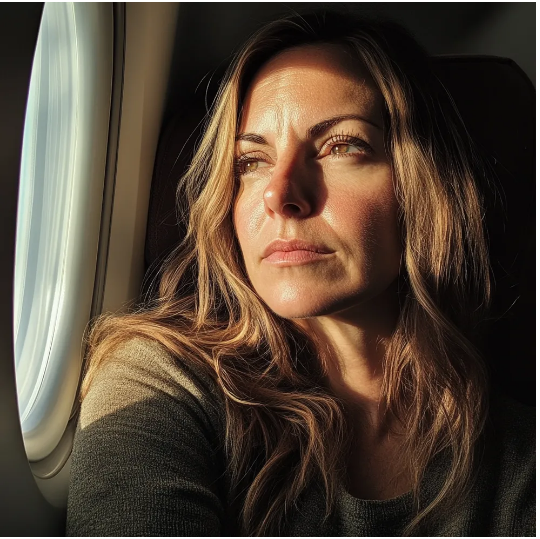
The captain studied her profile as the instrument lights carved sharp shadows across her face.
She looked tired.
Not weak.
Not afraid.
Just tired in a way that suggested she had carried far too much, for far too long—and learned to endure it without asking anyone for help.
The intercom clicked.
Cindy’s voice came through, strained and thin.
“Captain, the passengers are—”
Rachel reached for the microphone before he could respond.
“This is passenger 9A,” she said, her voice calm and steady. “Everyone remain seated. Fasten belts securely. Lock service carts. We are correcting course.”
In the cabin, the effect was immediate.
Her calm achieved what authority could not.
Some passengers resented it.
Others clung to it.
Most simply didn’t know what to think.
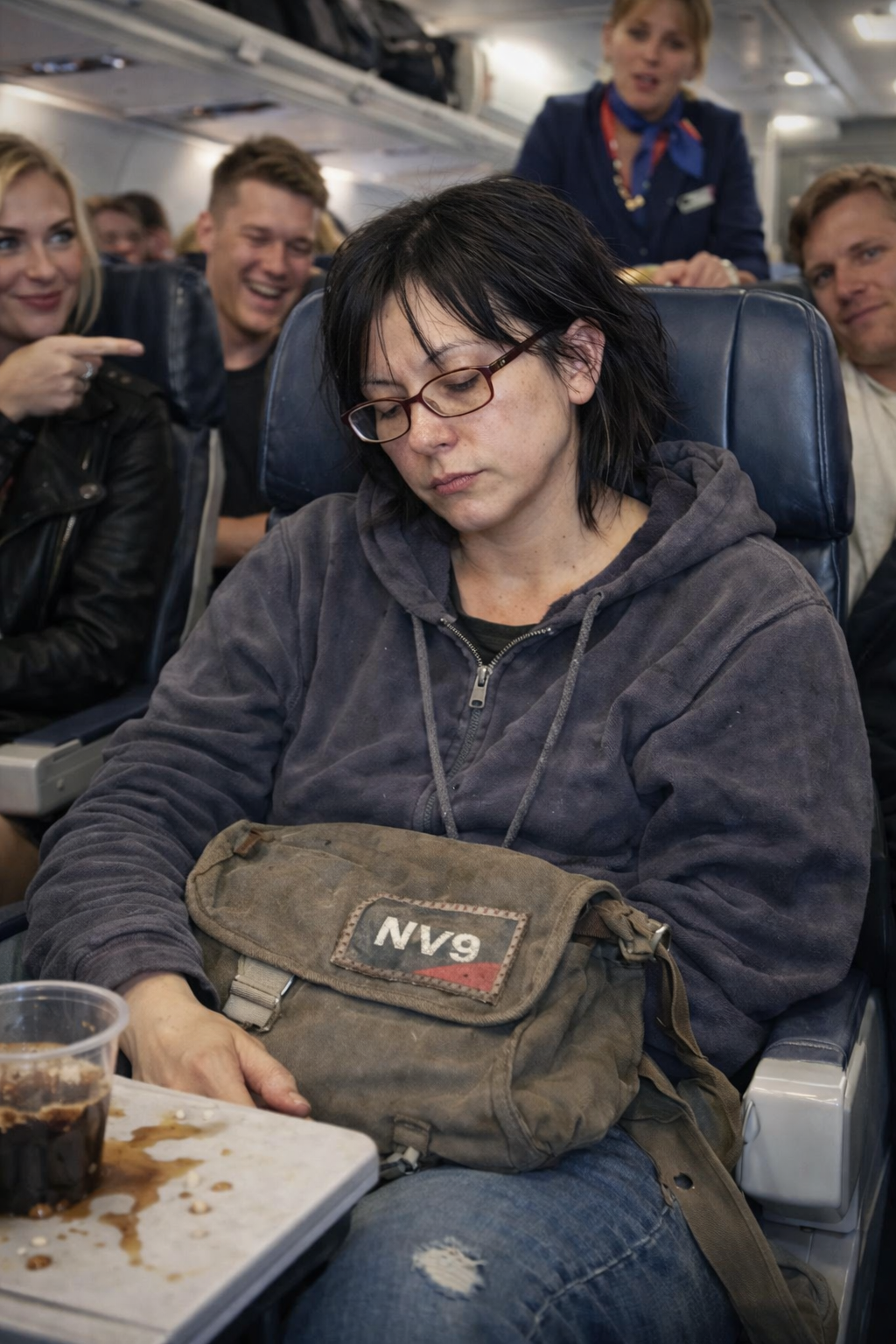
Back at seat 9A, Rachel’s bag rested beneath the window.
A little girl with pigtails, seated two rows behind, stared at it as though it held answers.
Her mother—a weary woman in a denim jacket, dark circles under her eyes—held her hand and whispered softly,
“It’s okay… it’s okay…”
But the girl kept watching the cockpit door.
“Is she a pilot?” she asked.
Her mother glanced around.
At the same people who had mocked Rachel minutes earlier.
The man in the tracksuit had gone pale.
The woman in the cream blazer held her arms so tightly they trembled.
The businessman who had blocked the aisle now stared straight ahead, silent.
“I don’t know,” the mother admitted quietly. “But she sounds like someone who does.”
Across the aisle, an older man in a worn brown jacket leaned down and carefully picked up the notebook Rachel had taken from her bag earlier.
He looked to be around seventy.
His hands were rough, steady—the hands of someone who spent a lifetime repairing things instead of discarding them.
He opened the notebook.
The pages were filled with small, precise handwriting.
Not thoughts.
Not stories.
Coordinates.
Weather logs.
Altitude notes.
Landing markers.
Instrument tolerances.
He turned another page.
In the corner, neatly written—
R.M.
He stared at it for a long moment.
Then slowly closed the notebook, his expression no longer curious—
But certain.
Beneath it, barely visible with age, were the faded letters: NV9.
He closed the notebook at once.
Not out of fear.
Out of respect.
“This woman isn’t pretending,” he said quietly.
The woman in the pink cardigan turned toward him.
“And how exactly would you know that?”
He lifted the notebook slightly.
“Because this isn’t a diary,” he replied. “It’s a lifetime.”
No one responded.
Even the loudest voices had begun to fade.
The teenager who had been filming lowered his phone just a little.
His friend leaned in and whispered,
“Dude… I think this is actually serious.”
From the cockpit, Rachel’s voice came again—this time calm, focused, meant only for the pilots.
“Your correction lag is making the tail feel heavier than it actually is. Don’t fight that. Use manual trim—trust it.”
The captain followed her direction.
The aircraft responded.
Not perfectly—
But noticeably better.
One warning tone cut off.
Then another.
The co-pilot exhaled deeply, as if releasing breath he’d been holding far too long.
“How did you even catch that?” he asked.
Rachel didn’t stop working.
“Because the plane isn’t panicking,” she said quietly. “The people inside it are.”
That line stayed with him.
Years later, he would still remember it.
The captain switched frequencies.
A controller’s voice broke through—distorted by distance and storm interference.
Rachel listened carefully.
Then she asked for the last stable terrain reference, runway alignment options, and updated wind data—with a clipped precision that made the captain look at her again, this time with unmistakable disbelief.
She wasn’t guessing.
She was fluent in this.