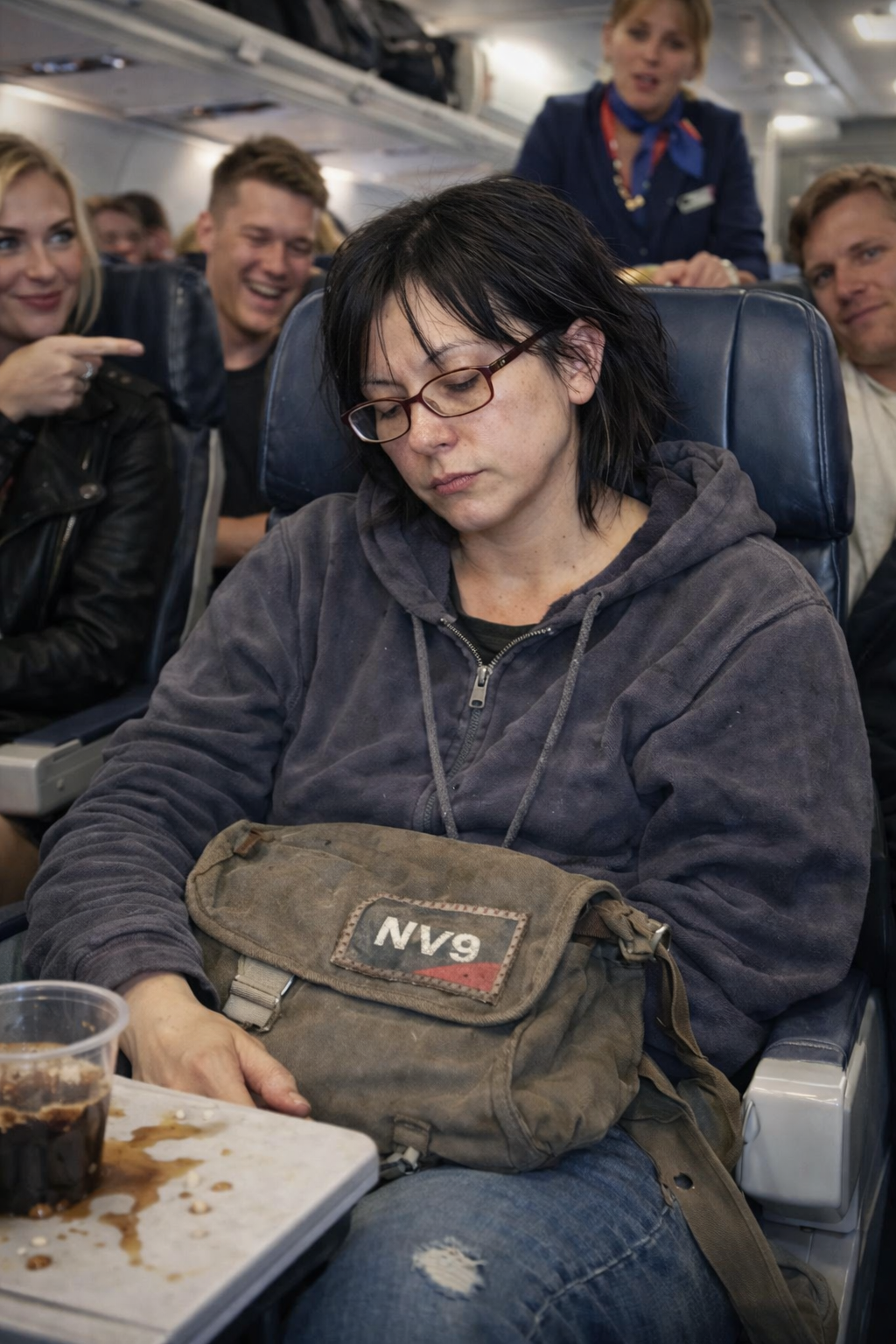
Halfway down the cabin, a teenager pulled out his phone and began recording.
“Yo,” he whispered, equal parts fear and excitement, “this is insane.”
Rachel walked toward the cockpit without rushing.
That calm—more than anything—silenced the cabin.
Not because they trusted her.

Because they couldn’t understand her.
At the cockpit door, the co-pilot lowered his voice.
“Before I let you in, answer one thing.”
Rachel turned slightly.
“Go ahead.”
“What made you ask about the pressure?”
“The reaction in row twelve—ears before masks. The change in the sound under the floor. And the roll is compensating too late.”
He studied her for a moment.
The plane shuddered again.
Then he opened the door.
“Get in.”
Inside, the captain was hunched over the controls, jaw clenched tight, sweat soaking into the collar of his white shirt.
The cockpit wasn’t chaos in the way movies depicted.
It was worse.
Not a single overwhelming alarm—
But scattered warnings.
Intermittent tones.
Numbers shifting in ways that didn’t belong together.
The kind of problem that demanded precision, not panic.
The captain looked up sharply.
When he saw Rachel, his expression hardened.
“No.”
The co-pilot shut the door behind them.
“She called the pressure issue before anyone else. She knows analog systems.”
The captain’s eyes moved over Rachel—
Her worn hoodie.
Her glasses.
The old fabric bag slung over her shoulder.
Then something about the bag caught his attention.
A faded stitched patch on the side.
Two letters and a number—almost completely worn away.
For just a moment, something shifted in his expression.
It was brief—but unmistakable.
Then he looked at her again, this time with far more attention.
Rachel stepped closer to the control panel.
“Your primary instrument feed isn’t failing all at once,” she said. “It’s drifting—layer by layer.”
The captain stiffened slightly.
“We’re aware of that.”
Rachel shook her head faintly.
“No. You know something’s wrong. You don’t yet understand how wrong it is.”
He held her gaze.
“Who exactly are you?”
Rachel’s eyes moved quickly—from the altitude panel to the backup display, then to pitch, then the weather overlay.
“Who I am isn’t the urgent question.”
The co-pilot reached over and handed her the spare headset.
“Can you interpret this?”
Rachel leaned forward.
Her eyes scanned the instruments.
Her right hand lifted, resting lightly against the edge of a display—not pressing, just feeling—like a pianist searching for the correct key in total darkness.
“The left altimeter is feeding clean noise,” she said. “It’s not random interference. It’s being stabilized against a faulty reference.”
The captain frowned.
“That doesn’t make sense.”
“It does,” Rachel replied, “if the pressure sensor started lagging and the system is compensating by smoothing the error.”
The captain stared at her.
The co-pilot remained silent.
Rachel shifted her focus to the right display.
“That one isn’t consistent with your climb rate,” she added. “And the storm layer is distorting your horizon cues.”
The captain swallowed.
“How can you tell?”
Rachel finally turned to him.
“Because if you trust what that panel is telling you… you’ll begin your descent too early.”
A heavy silence settled over the cockpit.
Outside the windshield, dense storm clouds pressed in so tightly they looked almost solid.
Inside, the captain’s breathing had grown shallow.
“Say it plainly,” he said.
Rachel did.
“You’re higher than one system says, lower than another, and the software is averaging the lie between them.”
The co-pilot’s face drained of color.
The captain whispered,
“That would explain the delayed corrections…”
Rachel gave a single nod.
“Show me your terrain backup.”
The captain hesitated.
“It’s outdated.”
“Perfect,” Rachel replied. “Older systems don’t pretend to be smarter than they are.”
That caught his attention.
He switched the display.
A rough, grainy terrain map appeared—basic, unattractive… and honest.
Rachel lowered herself into the jump seat like it was familiar territory.
Like she had done it many times before.
Maybe she had.
Her bag slipped from her shoulder and rested near her boots.
The worn patch—NV9—faced the captain.
He looked at it.
Then at her.
Something shifted again—deeper this time.
Recognition.
“Wait…” he said quietly. “No.”
Rachel didn’t look up.
“Not now.”
But the captain leaned in, voice low.
“Night Viper Nine?”
The co-pilot glanced between them.
“What does that mean?”
Rachel said nothing.
The captain’s voice changed—less shock now, more memory.
“I read a report during training,” he said. “Mountain reroute. Corrupted data. Zero visibility. The flight still landed safely. The call sign was Night Viper Nine.”
Rachel’s jaw tightened.