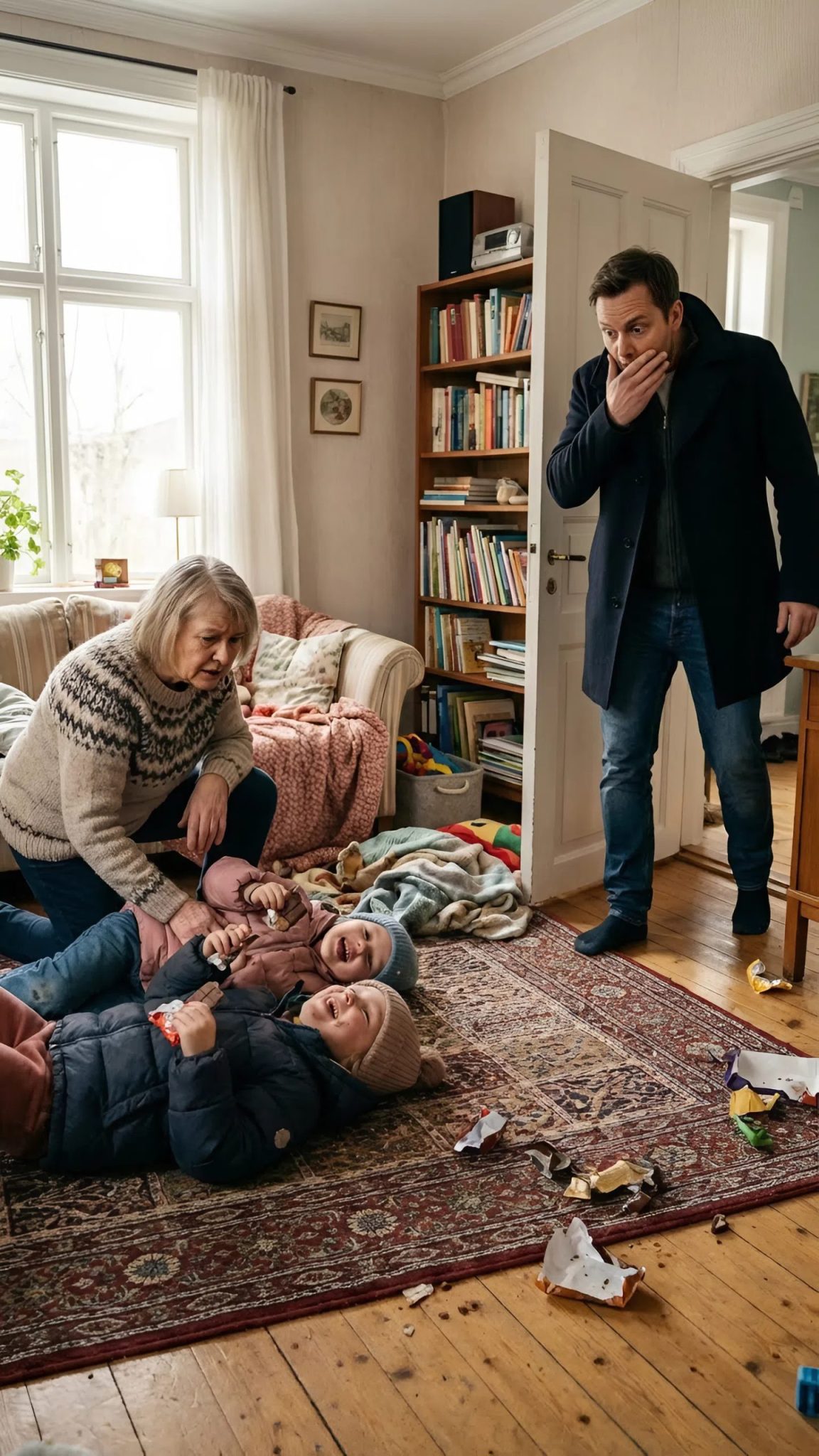
Part 1: The Gilded Box
My own son tried to kill me with a box of artisanal chocolates. I, in a final, unwitting act of maternal sacrifice, saved my own life by making my daughter-in-law and my grandchildren jealous. It is a sentence that, even now, ten years later, tastes like ash in my mouth. A truth so monstrous it still feels like a shard of glass in my memory.
It began on the crisp, deceptively beautiful morning of my sixty-ninth birthday. I remember the way the autumn light filtered through the dusty, lace curtains of my old home in upstate New York, a house that had grown too large and too silent since my husband, Richard, passed away. For forty years, I had sacrificed everything for Thomas. My youth, my dreams, my savings—all of it laid at the altar of his well-being. I had adopted him when he was a terrified, hollow-eyed two-year-old, orphaned by a brutal car accident that had taken his biological parents. I gave him my last name, my unconditional love, my entire life. I had built my world around him, and in doing so, had forgotten to build one for myself.
But on that quiet Tuesday, a courier in a crisp uniform arrived with a package that seemed to promise a long-overdue return on that lifelong investment.
The box was exquisite, a work of art in itself. It was covered in a deep, sapphire-blue velvet, tied with a heavy, cream-colored silk ribbon. Inside, nestled in individual, fluted paper cups, sat twelve pieces of chocolate that looked less like food and more like precious, edible jewelry. They were dusted with a fine, shimmering gold leaf and shaped into delicate, impossible geometric forms. The card, tucked neatly under the ribbon, was written in a familiar, sloping handwriting I knew better than my own: “To the best mother in the world, with all my love, Thomas.”
I was touched, so deeply and profoundly that tears pricked the corners of my eyes. It had been months, perhaps even a full year, since I had received any such affectionate gesture from him. Since he had married Laura—a woman I had initially thought was sweet and unassuming but who had, under Thomas’s subtle influence, grown distant and cold—everything had changed. “Your mother is too nosy, Tom,” she would supposedly say, a complaint he would relay to me with a sigh of weary resignation. “You are a grown man. You are too old to be taking care of her every whim.” Thomas, my Thomas, the boy I had nursed through fevers and teenage heartbreaks, had slowly, methodically drifted away. Visits became scarcer, calls colder, hugs perfunctory and brief.
So, holding that beautiful, unexpected box, I felt a dangerous surge of hope. Perhaps he remembered. Perhaps the bond we once shared wasn’t completely broken, just… strained.

The chocolates looked decadent, almost sinfully delicious. The embossed logo on the inside of the lid read Chocolatier de L’Excellence, the kind of pretentious, high-end brand that charges a week’s wages for a single truffle. But as I lifted one, a delicate, dark chocolate pyramid, to my lips, that old, ingrained, forty-year habit of motherhood kicked in—the instinct to deny oneself for the sake of the children, even when the children are grown. These are far too good for an old woman to eat alone, I thought. Laura and the kids will enjoy them so much more than I would.
My grandchildren, Anne and Charles, were my weakness, the last untainted connection to my son. Despite the ever-present tension with their parents, I adored those children with a fierce, uncomplicated love. They were the living, breathing extension of the Thomas I remembered, the only pure thing left in a relationship that had turned strangely toxic.
I carefully rewrapped the box, tying the silk ribbon back into a perfect bow. My hands, usually clumsy with age, were surprisingly steady. I was on a mission of love. I drove the short, familiar distance to Thomas’s sprawling, ostentatious house, a house far too large for a family of four, a house I knew was a constant financial strain on them.

Laura opened the door. Her smile was a thin, brittle, almost painful-looking thing that didn’t come close to reaching her eyes. It was a mask of strained courtesy stretched taut over a canvas of deep, simmering contempt.
“Hello, Dorothy,” she said, her tone dripping with that specific brand of condescension reserved for unwanted, and in her view, inferior, in-laws. “What brings you by?”
“Thomas sent me these for my birthday,” I said brightly, holding out the offering, a literal olive branch made of chocolate. “But they are far too rich for an old woman like me. I wanted to share them with you and the children. I know how much Charles loves his sweets.”
For a split second, her carefully composed expression faltered. I saw a flicker of something in her eyes—confusion, perhaps even a flash of suspicion—but it vanished as quickly as it came, replaced by her usual practiced indifference. She took the box. “What a nice gesture. I’m sure the kids will be thrilled.”