She didn’t invite me in. She never did anymore. She mumbled a series of familiar excuses about the children sleeping or the house being a mess. I walked back to my car with a slightly heavy heart, the sting of her rejection a familiar ache, yet satisfied that I had, at least, done a good and selfless deed.
Part 2: The Unraveling
The next morning, the phone rang at precisely 7:00 AM, its shrill, old-fashioned ring startling me from a light sleep. It was Thomas.
“Mom,” he said. His voice was tight, vibrating with a strange, high-strung tension I couldn’t immediately place. “How were the chocolates?”
It was an odd, almost jarring question. Thomas was the kind of person who usually forgot about gifts the moment they left his hands. The follow-up felt unnatural, forced.
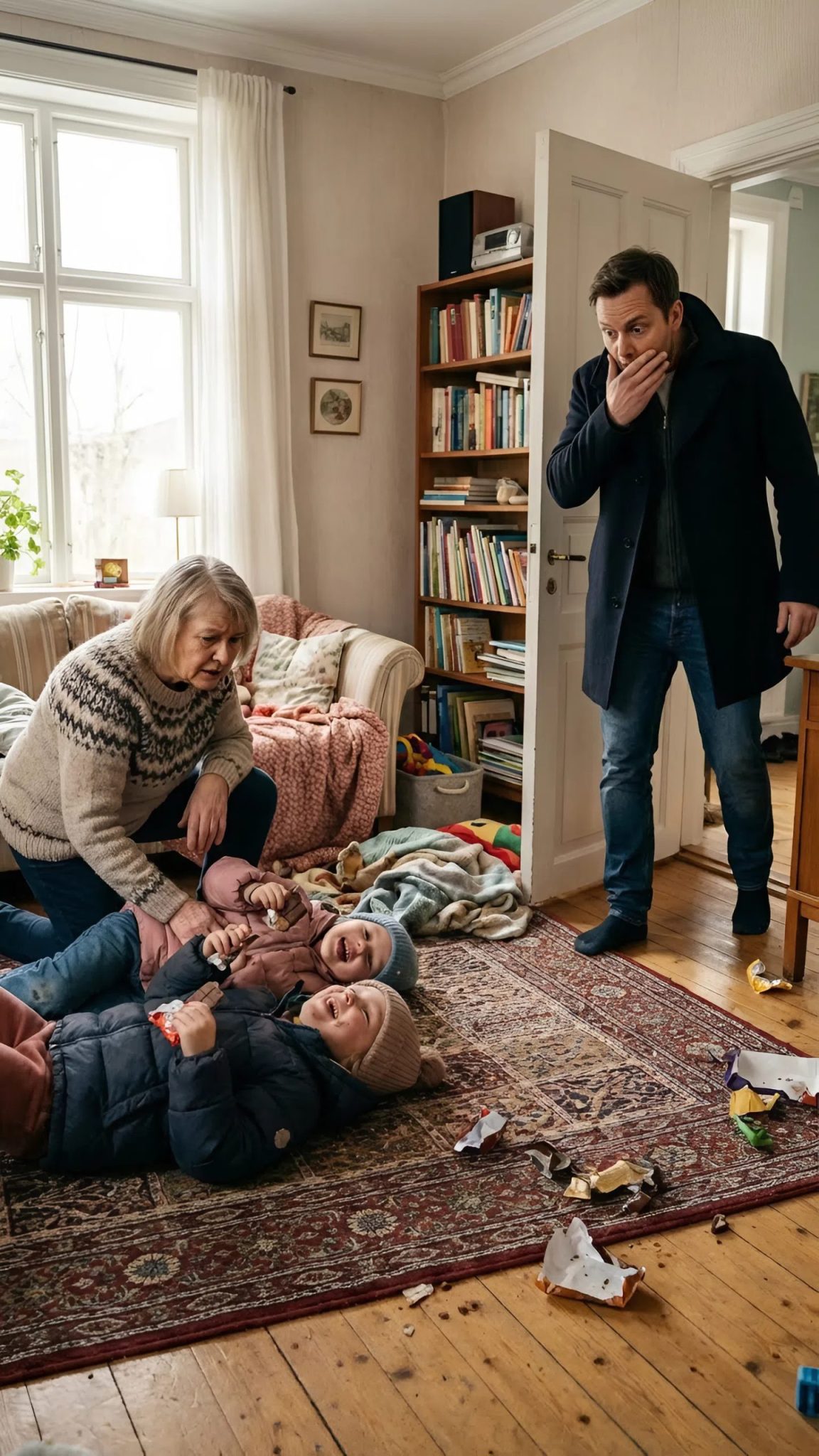
“Oh, Thomas, my dear,” I replied cheerfully, pouring myself a cup of coffee, the morning sun streaming into my kitchen. “They were far too beautiful to eat all by myself. I gave them to Laura and the children. You know how much little Charles loves his sweets.”
The silence that followed was not merely quiet; it was a profound, terrifying void. It was a vacuum, sucking all the air, all the warmth, out of the room. I could hear the faint static on the line, and under it, the sound of a heavy, ragged, almost panicked breathing on the other end.
Then, he exploded.
“YOU DID WHAT?”
The scream was feral, primal. It wasn’t the sound of anger; it was the sound of a man watching his life, his carefully constructed plans, disintegrate in a single, horrifying moment.
“I gave them to Laura and the children,” I repeated, my own voice now trembling with a confusion that was rapidly curdling into fear. “Thomas, are you alright? What’s wrong?”
“You’re crazy! You’re an idiot! A senile old fool!” His voice climbed an octave, cracking with a pure, unadulterated panic. “Did you eat any? Did you even touch them? Did the kids eat them yet? ANSWER ME!”
“No, I didn’t—I just dropped them off.”
“Why can’t you ever just keep things for yourself?” he roared, the question a bizarre, nonsensical accusation. “Why do you always have to be the martyr? The saint?!”
He hung up, the click of the disconnect as loud as a gunshot in my silent kitchen. I stood there, the receiver humming in my hand, my heart hammering a frantic, chaotic rhythm against my ribs. A mother’s instinct is a powerful, ancient, and often illogical thing. It does not require evidence to function. In the profound silence of my kitchen, a terrifying, monstrous realization began to bloom, like a drop of black ink in a glass of clear water.
He didn’t care that I had given away his expensive gift. He was utterly, primally terrified that his own wife and children had eaten it.
Two hours later, Laura called. She was sobbing, her words a hysterical, incoherent jumble.
“Dorothy… the children… we’re at the hospital… Staten Island University Hospital.”
My blood ran cold, turning to ice in my veins. “What happened? Laura, slow down, what happened?”
“The doctors… they say it’s poisoning,” she choked out between sobs. “Severe food poisoning, maybe some kind of chemical. They… they ate the chocolates you brought. Charles said they tasted funny, sort of metallic, but they ate three of them before we could stop them.”
The world tilted on its axis. The pieces of the puzzle, which had been floating disconnected in my mind, slammed together with a brutal, sickening force. The expensive, out-of-the-blue gift. The strange, insistent follow-up call. The deafening silence. The raw, animal panic. The specific, desperate questions about whether I had eaten them.
My son had not sent me a birthday gift. He had sent me an execution order, wrapped in a velvet box and tied with a silk ribbon.
Part 3: The Confession
The next three days were a waking nightmare, a blur of sterile, white hospital corridors, the incessant, rhythmic beep of monitors, and the cloying, antiseptic smell of fear. Thank God, the children survived. They were sick, terribly sick, but the dose of poison in the few chocolates they had managed to share wasn’t enough to kill them. It was, however, enough to leave traces.
Laura came to me in the drab, uncomfortable waiting room on the third day. Her face was pale and drawn, stripped of all her usual pretense and makeup. She looked… broken.

“Dorothy,” she whispered, her voice trembling, her eyes wide with a shared, horrific understanding. “The doctors… the toxicology report came back. They found arsenic. A significant, non-accidental amount of arsenic.”
She looked at me, and for the first time in our long, strained relationship, there was no contempt in her eyes, only a raw, shared horror. “Those chocolates… they weren’t meant to be shared, were they? They were meant for you. All twelve of them.”