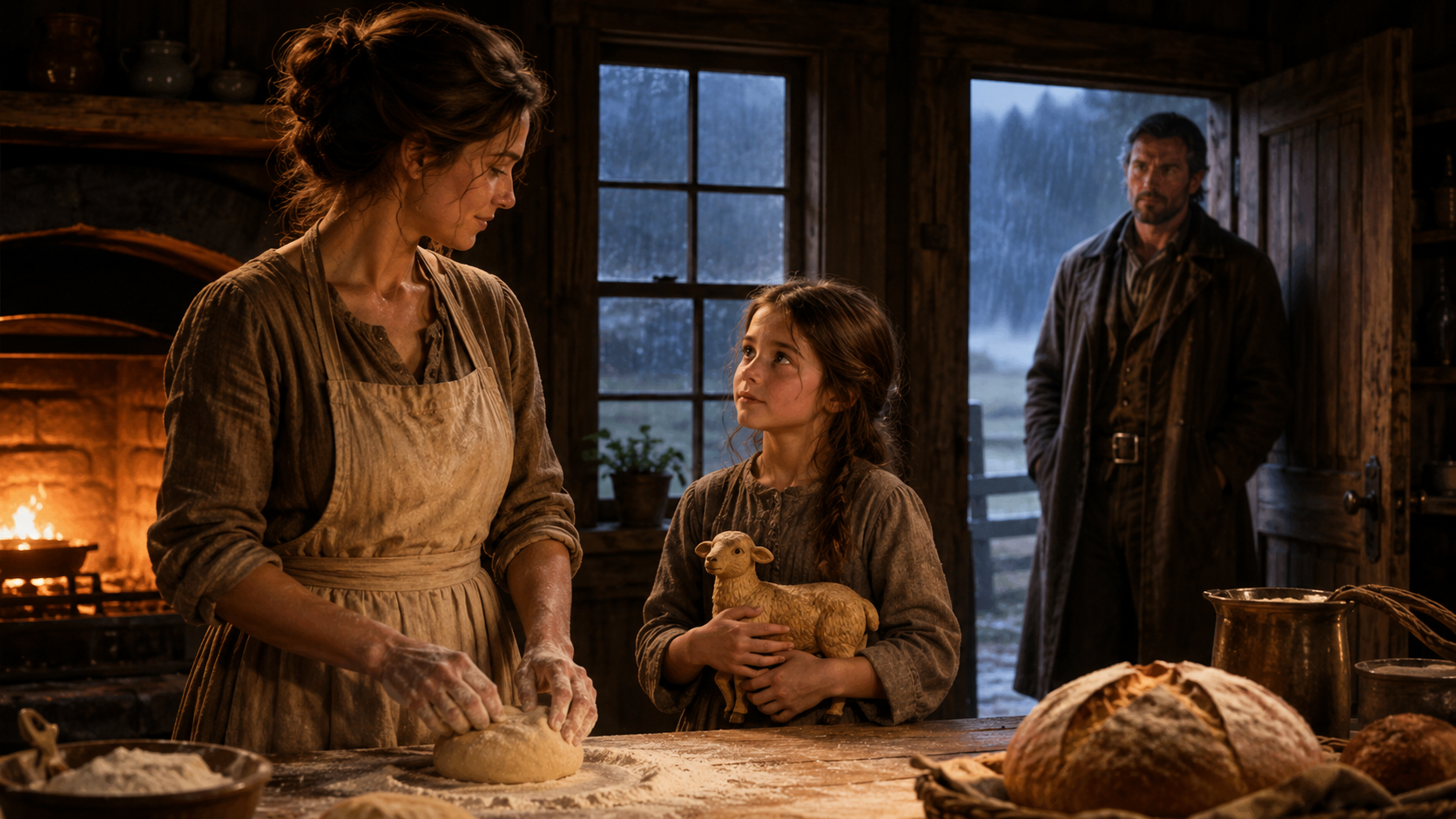
“They are best warm,” she said, facing the counter, “but warmth should never be forced on anyone. A person may wait until the steam stops frightening them.”
Elodie sat.
She broke the bun with both hands. The first bite made her eyes close for one heartbeat.
Then she whispered, “Mama made knots.”
Marion’s whole body went still.
She did not turn quickly. She did not gasp. She did not rush across the room and turn the child’s courage into a spectacle.
She only said, very gently, “Then she had good hands.”
Elodie stared at the bun.
“She sang when she baked.”
“What did she sing?”
The girl’s lips trembled.
“I forgot.”
Marion’s throat tightened. “Forgetting is not betrayal.”
Elodie looked up.
“It feels like it.”
“I know.”
The child studied her as if those two words mattered more than comfort.
Then she slid from the chair and left.
Marion waited until the footsteps faded. Only then did she grip the table with both hands and bow her head.
She did not tell Rowan.
Some first words are not announcements. They are doors opened from the inside.
After that, Elodie returned.
Not every day. Not predictably. She came like a wild bird, always ready to fly. Marion never trapped her with questions. She explained flour, yeast, heat, knives, salt, honey, and patience. She let the kitchen become a place where words could appear without being hunted.
“This is how dough feels when it has rested enough,” Marion said one evening, pressing the child’s palm gently against a smooth round. “It pushes back, but not angrily.”
Elodie touched it with wonder.
“Alive,” she whispered.
“Yes.”
“Like Beatrice?”
“Exactly like Beatrice.”
“Like me?”
Marion swallowed.
“Yes,” she said. “Very much like you.”
The next week, Rowan came in from the cold and found his daughter standing on a stool, flour on her cheek, shaping rolls beside Marion.
He stopped so suddenly the door remained open behind him.
Elodie’s fingers froze.
Marion did not look up sharply. She did not give Rowan the power to frighten the moment.
“Fold the edge under,” she said calmly. “Same as before.”
Elodie obeyed.
Rowan closed the door.
He removed his hat.
For a long time, he said nothing.
Then he sat at the table as if his knees had forgotten their duties.
At supper, Elodie carried her own plate in and sat across from him for the first time in three years. Rowan stared down at his soup like a man afraid direct looking might shatter glass.
“Bread holds together,” he said.
Elodie looked at him.
“You always say that,” she whispered.
The spoon slipped from Rowan’s hand and struck the bowl.
Marion turned toward the stove and busied herself with nothing, because some kinds of mercy require privacy.
Trouble arrived two days before the first snow.
Marion had gone into Ashford Ridge with Gideon Pike, Rowan’s old foreman, to deliver bread to the mercantile. By then half the town had learned that the Hale kitchen produced loaves worth lining up for. Women who once looked past Marion now greeted her by name. Men who had laughed at the idea of paying for bread now bought two loaves and claimed one was for a neighbor.
She was counting coins when a voice behind her said, “Well now. If it isn’t Mrs. Bellamy.”
No one in Ashford Ridge knew that name.
Marion turned.
A man in a velvet-collared coat stood near the barrel of dried apples, smiling with all his teeth and no warmth. Lennox Gray. Victor’s card companion. A man who always smelled faintly of tobacco and other people’s secrets.
“My name is Marion Vale,” she said.
“Not according to your husband.”
The store grew quiet.
Lennox stepped closer. “Victor is worried sick. Says you are confused. Says you stole from him. Says there is a reward for bringing you home before you harm yourself.”
“How generous is his concern?”
“Six hundred dollars.”
Marion’s hands went cold.
Gideon shifted beside her, but Marion touched his sleeve.
Wait.
“I will give you nine hundred,” she said.
Lennox laughed. “You don’t have nine hundred.”
“Not today.”
“Then why would I wait?”
“Because Victor does not reward men who make him look slow,” Marion said. “If you found me and delayed telling him, he will wonder what else you delayed. Victor dislikes wondering.”
The smile weakened.
She had guessed correctly. Men like Victor kept other men on leashes and called it friendship.
“Thirty days,” Lennox said.
“Forty.”
“Thirty-five.”
“Done.”
“If you run?”
“If you speak before then, I write Victor that you tried to sell me twice.”
Lennox’s face hardened.
Marion stepped closer. “And Lennox? I have lived with a cruel man. Do not mistake me for a frightened one simply because I know how fear works.”
On the ride home, she told Gideon enough.
Not everything.
Not the locked bedroom. Not the signed papers. Not the servants paid to hear nothing. Not the doctor who had called bruises “nerves.” But enough.