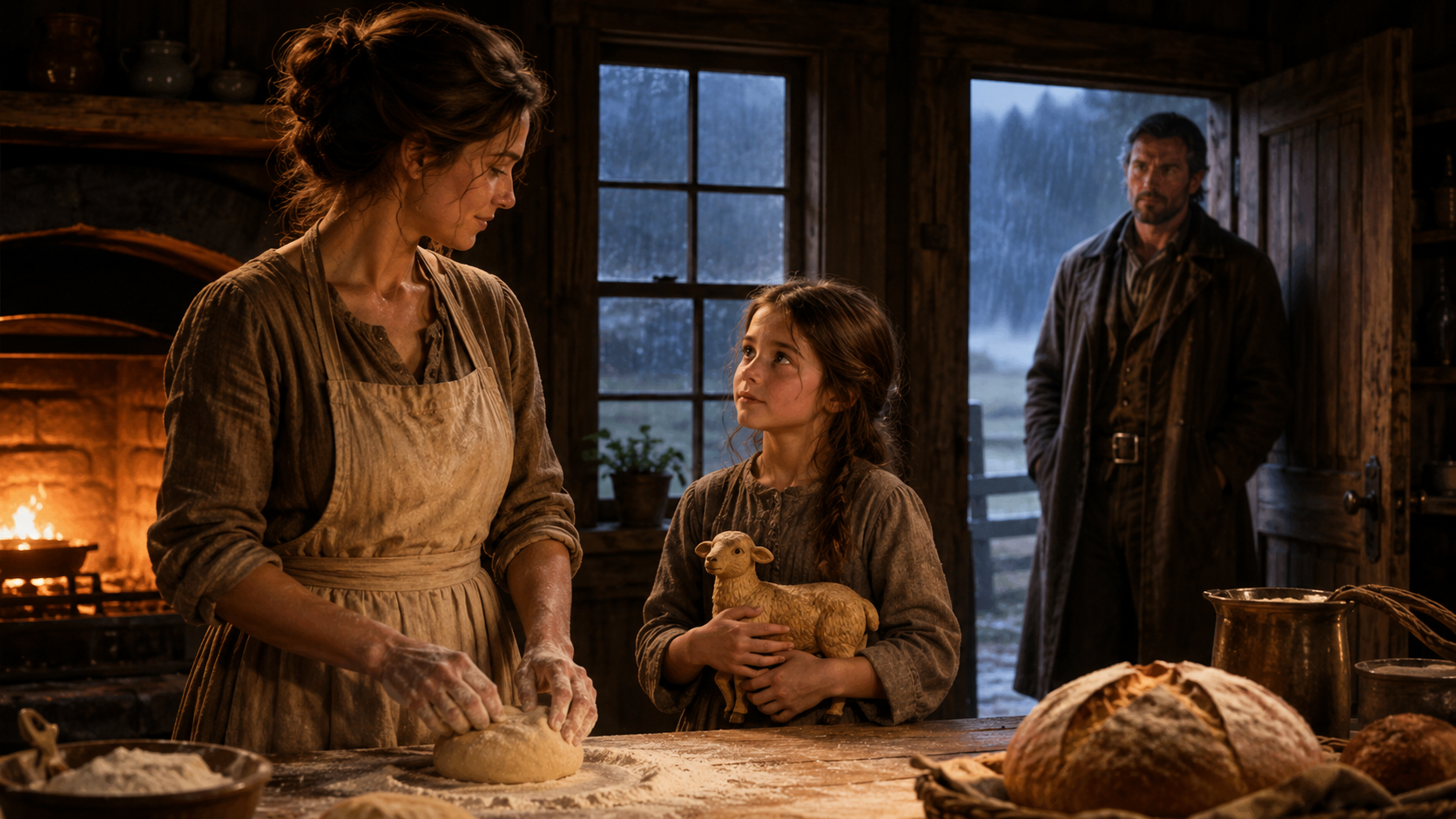
Gideon listened with his jaw clenched.
“You need nine hundred dollars in thirty-five days,” he said.
“Yes.”
“You earn wages, not miracles.”
“I bake bread.”
“That is not a bank.”
“No,” Marion said. “But hunger pays faster than sympathy.”
That night, after Elodie slept, Marion asked Rowan to let her use the kitchen for commercial baking. She offered him half the profits.
“No,” he said.
She had expected it.
It still struck like a door slammed in the face.
“You have not heard the arrangement.”
“I heard trouble breathing.”
“I can bake before breakfast. Gideon can deliver. Your house will not suffer.”
“My house already suffered enough before you came.”
The words silenced them both.
Rowan stood in the small office off the hall, ledger open, lamplight making shadows under his eyes.
“What kind of debt does a woman owe to a man she ran from?” he asked.
“The kind written with her name by someone else’s hand.”
His face changed.
“That is not debt.”
“No,” Marion said. “It is a cage made of paper.”
Rowan looked down at his ledger, then back at her.
“If he comes here?”
“I am trying to prevent that.”
“That is not an answer.”
“It is the only honest one I own.”
The wind pushed against the window.
At last Rowan said, “Half the profits. Your work here comes first. If that man threatens my daughter, I stop being polite.”
Marion believed him.
That frightened her more than the refusal would have.
For the next month, she worked like a woman racing winter.
She rose at three. She baked household bread first, then rye loaves for the mercantile, sweet buns for the hotel, biscuits for the lumber crews, and hand pies for miners headed north. Her knuckles split. Her shoulders ached. Flour lived in her hair and in the seams of her dresses. Elodie worried over every cut with grave authority.
“You are bleeding again.”
“It is only a little.”
“Blood is not seasoning.”
Gideon laughed so hard he had to leave the room.
Even Rowan began watching her too closely. One morning before dawn, he entered the kitchen, took a bowl from her hands, and set it down.
“Sit.”
“I am busy.”
“You are swaying.”
“I am thinking.”
“You are about to think yourself onto the floor.”
She tried to glare, but exhaustion blurred the effort.
“I am short,” she admitted. “Two hundred and ten dollars.”
Rowan left the kitchen.
When he returned, he carried a tin cash box.
“No,” Marion said.
“Yes.”
“Rowan—”
“It is an advance.”
“I do not take charity.”
“Good. I am not offering charity. I am investing in bread.”
He counted the money onto the table.
Then he said, quietly, “My daughter asked me this morning whether we could open her mother’s music room.”
Marion looked up.
“She has not said the word mother to me in three years,” Rowan continued. “You came into a dead kitchen and made it breathe. You made my child feel safe enough to remember aloud. Take the money.”
So she did.
She paid Lennox Gray two days before his deadline in the back room of the mercantile while Mrs. Voss pretended to sort buttons with the attention of a judge.
Lennox pocketed the bills.
“Victor always preferred elegant women,” he said, looking Marion over. “Never understood why he married you.”
The old shame rose.
Then, unexpectedly, it burned itself out.
“No,” Marion said. “He preferred obedient women. He mistook my kindness for obedience. Men do that when they are not as clever as they think.”
Lennox’s smile vanished.
“If Victor hears from you,” she continued, “I will make certain every newspaper between here and the capital learns that you accepted money to hide a battered wife from the husband who forged her name. Imagine your mother reading that.”
Lennox left without another word.
For the first time in years, Marion walked through Ashford Ridge without trying to make herself smaller.
Winter settled in silver and blue. The bread business grew. Elodie laughed sometimes—briefly, fiercely, as if laughter had escaped before she could stop it. Gideon began eating in the kitchen “for quality inspection.” Rowan lingered near the flour bins and asked Marion’s opinion on grain, oven stone, hired hands, fence repairs, and whether the old smokehouse could become a bakehouse.
He did not court like a man in poems.
He courted by listening.
Then Alden Crowe arrived.
He came in a black carriage with brass lamps, wearing city boots too polished for country mud. Alden Crowe owned mines, railroad shares, two banks, and enough lawyers to make truth feel negotiable. He looked at land the way wolves look at lambs.
Marion watched from the kitchen window as he spoke to Rowan near the barn. Crowe pointed toward the creek, then toward the hills, then toward the house.
Rowan went still.
Twenty minutes later, he entered the kitchen and sat down.
“He wants the land,” he said.
Marion poured coffee. “What did he offer?”