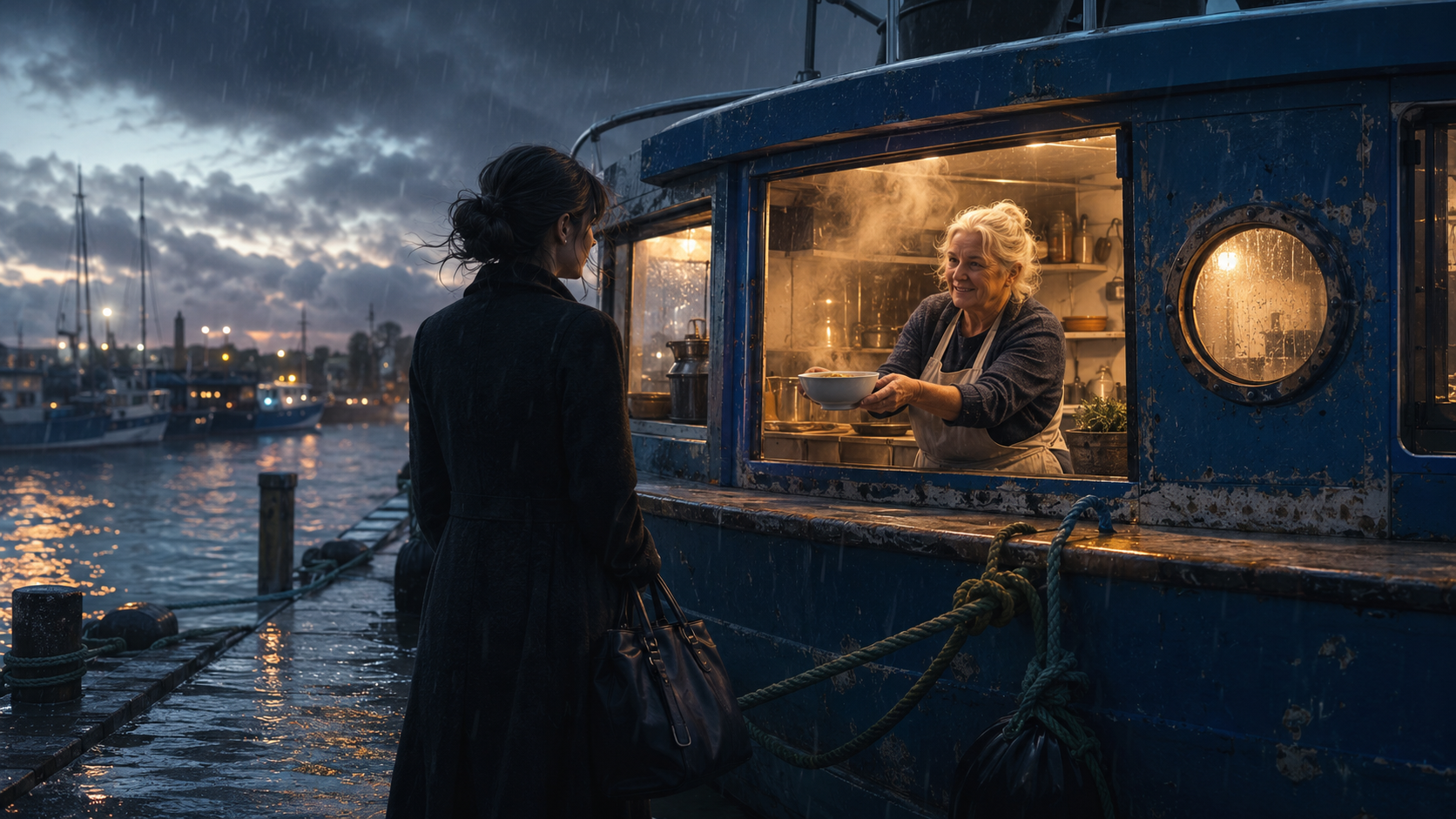
“No demolition will take place tomorrow.”
“You don’t have authority over municipal property decisions.”
“I have authority to suspend every national grant connected to the harbor barrier until the safety review is complete.”
His jaw tightened.
“You would endanger the entire project for this boat?”
“No. I would protect the project from a commissioner willing to hide information.”
Lila looked toward the water.
The tide was unusually high. Waves struck the concrete wall and returned at an angle, colliding near the marina pilings. The pattern was wrong.
She walked to the end of the pier.
“Amos, has the current always turned like this?”
“Not before they drove those new supports into the western channel.”
“How long ago was that?”
“Four months.”
“Any flooding since then?”
“Three times. Even without a major storm.”
Voss gave a dismissive laugh. “An old cook is not a hydrologist.”
“No,” Lila said. “But people who spend their lives beside water often notice what office windows conceal.”
Amos disappeared into the galley.
When he returned, he carried several notebooks tied together with kitchen string.
“I write down the tides,” he said. “Always have.”
Lila opened the first notebook.
Every page contained dates, wind directions, rainfall estimates, tide heights and hand-drawn maps of the current. Some entries went back more than thirty years.
The newer diagrams showed a disturbing change after the marina construction began. Water was being forced toward the oldest residential district, where thousands of low-income families lived below the original sea wall.
Lila studied the pages in silence.
“These readings need to be verified,” she said. “But if they are accurate, the marina is redirecting storm surge toward East Bellhaven.”
“That’s absurd,” Voss snapped.
“Then you have nothing to fear from an investigation.”
The commissioner stepped closer and lowered his voice.
“Think carefully, Dr. Hart. Delays will cost millions. Investors will leave. Jobs will disappear.”
“A flood will cost lives.”
“You cannot place amateur notes above certified models.”
“I don’t. I use them to identify what your models may have ignored.”
Voss looked from Lila to Amos, realizing he had lost control of the conversation.
“This is political theater.”
“No,” Lila said. “This is the moment before the curtain rises.”
She turned to her assistant.
“Cancel the private meeting. Move the review to the public chamber. Invite the press, the independent engineering panel and every resident representative from the eastern district.”
“Today?”
“Today.”
Voss stared at her.
“You are making a serious enemy.”
Lila met his gaze.
“When I was eight years old, I thought hunger was the most frightening thing in the world. Then I learned there was something worse.”
“What?”
“Watching powerful people decide that your life is inconvenient.”
By noon, Bellhaven City Hall was full.
Developers occupied the front rows in tailored suits. Dockworkers stood along the walls. Families from the eastern district crowded the aisles, holding photographs of water entering their homes. Cameras faced the commission table.
Amos sat beside Lila wearing his cleanest sweater. He looked deeply uncomfortable beneath the chamber’s bright lights.
Voss presented first.
He praised economic growth, tourism and modernization. He displayed polished digital images of white yachts, restaurants and apartments glowing at sunset. He described the marina as Bellhaven’s future.
Then Lila stood.
She did not begin with Amos.
She began with water.
She projected tide models across the chamber wall. Independent calculations confirmed what the notebooks had suggested. The new pilings narrowed the western channel and redirected storm energy toward the eastern sea wall.
During a severe storm, the change could raise local flood levels by nearly a meter.
The room became silent.
Voss interrupted.
“These are preliminary projections.”
“Yes,” Lila replied. “Which is why construction should never have proceeded without a complete secondary review.”
She displayed copies of internal messages obtained from the development office that morning. Engineers had raised similar concerns months earlier. Their warnings had been removed from the final report.
Several commissioners turned toward Voss.
He stopped smiling.
Lila then lifted one of Amos’ notebooks.
“The first evidence of the altered current did not come from a laboratory. It came from a man who has watched this harbor every day for thirty-seven years.”
Amos was asked to speak.
He approached the microphone as if it were a dangerous animal.
“I don’t know much about developments,” he began. “I don’t know how to make the pictures they showed you. I cook soup.”
A few people laughed gently.
“But water has a voice. It knocks differently when it has nowhere to go. Four months ago, it started knocking against the eastern wall.”