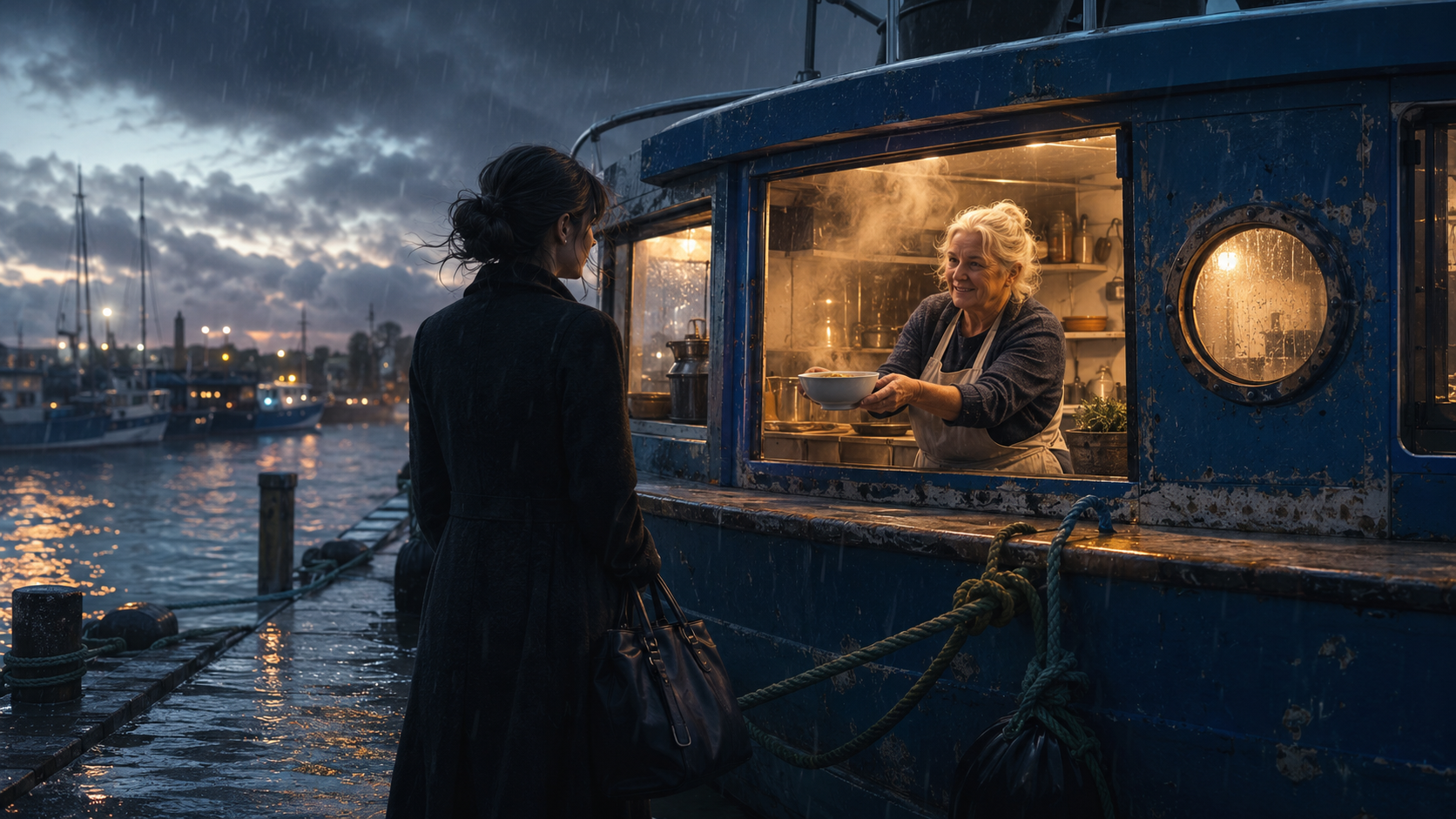
A woman in the audience raised a photograph of her flooded kitchen.
Amos continued.
“I told the harbor office. They said I was old. I wrote letters. They said I was confused. So I kept writing down what I saw.”
He looked toward Voss.
“People like me are easy to ignore. That doesn’t mean the water ignores us too.”
The chamber erupted in applause.
By evening, Commissioner Voss had been suspended pending a corruption investigation. The marina construction was halted, and the eastern barrier redesign was approved unanimously.
The demolition order against the Blue Lantern was revoked.
Outside City Hall, reporters surrounded Lila and Amos.
One asked whether Lila had intervened only because Amos had helped her as a child.
“No,” she answered. “Personal gratitude brought me to his boat. Evidence brought us here.”
Another reporter raised her voice.
“Dr. Hart, is it true that Mr. Reed saved your life?”
Lila looked at Amos.
“He fed my mother and me during the worst night of our lives. But what he gave us was larger than a meal. He treated us as though our future mattered before there was any proof that it would.”
Amos leaned toward the microphones.
“She was a very suspicious child.”
The crowd laughed.
“And the soup was terrible,” Lila added.
“Still is,” he replied.
Six months later, the Blue Lantern no longer stood alone.
The old vessel had been carefully restored and permanently secured beside the rebuilt pier. Behind it rose a storm shelter designed to withstand the strongest surge predicted for the next century.
The building contained emergency beds, a medical room, classrooms and the largest public kitchen in Bellhaven.
Its official name was the Harbor Resilience Center.
Everyone in the neighborhood called it Amos’ Table.
Amos refused the title of director. He accepted “head cook” only after being assured that no one would ask him to wear a tie.
Young apprentices worked beside him, learning to prepare inexpensive meals from local ingredients. No one was turned away for lacking money.
Above the kitchen entrance hung a row of brass ferry tokens.
Any guest could take one.
The token promised a free meal, no questions asked. The only condition was that someday, when life became kinder, its owner should help another person.
On the night the center opened, a storm rolled in from the northern sea.
Families arrived carrying blankets, medicine and frightened children. Wind shook the windows, but the new sea wall held.
Inside, enormous pots steamed beneath bright kitchen lamps.
Lila stood beside Amos, chopping onions badly.
“You hold the knife like a politician,” he complained.
“I’m an engineer.”
“That is worse.”
A little boy approached the counter. His clothes were wet, and he kept one hand protectively around his younger sister.
“We don’t have money,” he said.
Amos placed two bowls in front of them.
“Good,” he replied. “Money ruins the flavor.”
The boy hesitated.
“Do we have to pay later?”
Lila reached into her pocket and placed the old brass token on the counter.
“Not later,” she said. “Forward.”
The children carried their bowls to a table.
Amos looked at the token.
“You kept it all these years.”
“I thought returning it would repay the debt.”
“And did it?”
Lila watched the crowded room. Dockworkers shared bread with tourists stranded by the storm. Nurses checked an elderly woman’s breathing. Teenagers unfolded beds for families they had never met.
“No,” she said. “I finally understand that some debts aren’t meant to be repaid.”
“What are they meant for?”
“To be continued.”
Amos smiled.
Outside, waves struck the harbor wall with enough force to shake the pier. Inside, spoons touched bowls, children talked and the kitchen filled the shelter with the smell of onions, pepper and smoked fish.
A young girl tasted the soup and looked up at Lila.
“Why does it taste different from normal soup?”
Lila glanced at Amos.
He pretended to concentrate on the stove, but she could see the smile hiding beneath his white mustache.
“Because this one remembers,” Lila said.
“Remembers what?”
“Everyone who shared it before you.”
The girl considered that answer, then broke her bread in half and handed one piece to her brother.
The storm continued through the night.
But no one inside Amos’ Table was cold.
And no one was hungry.