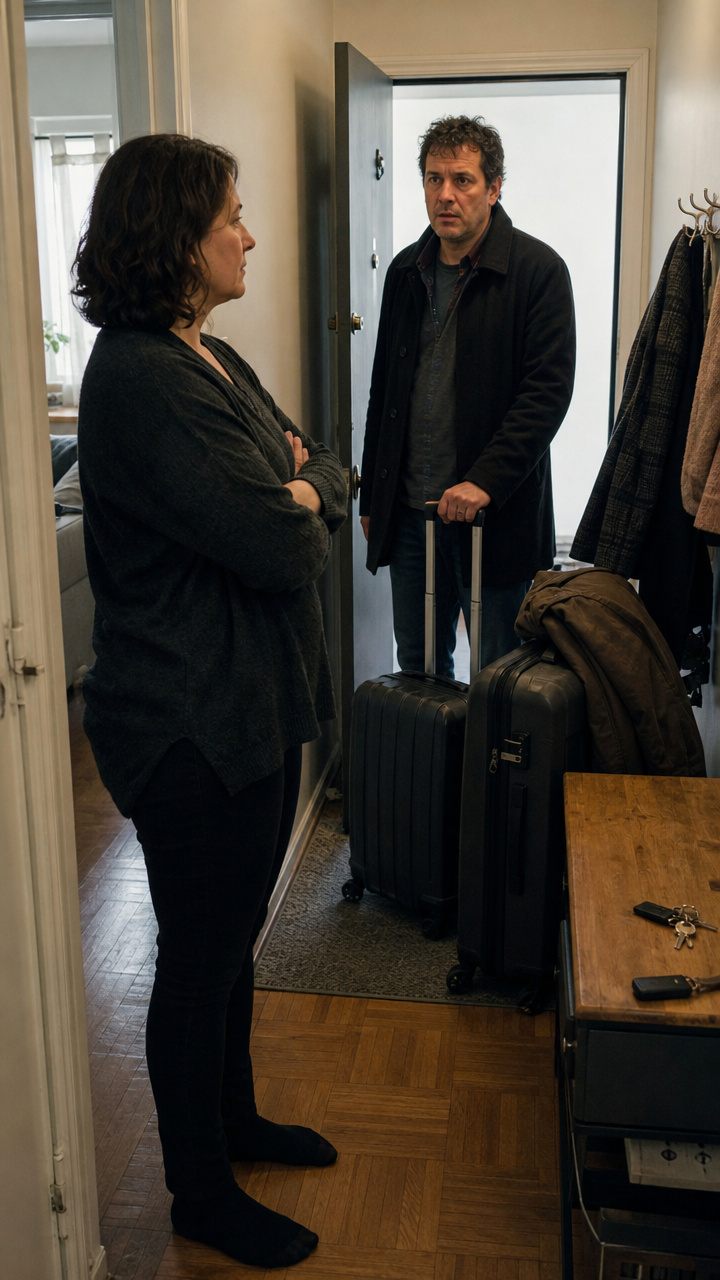
“It isn’t what you think,” my husband tried to explain.
“Of course it isn’t. You were only going to Victoria’s place to play chess,” I replied.
Andrew stopped in the doorway.
Two travel bags stood neatly fastened beside the entrance. His jacket hung over one of the handles, almost like the scene in a hotel when a guest has checked out, cleared the room, and is ready to leave.
His eyes moved from the luggage to me.
I could almost see the different versions of the conversation collapsing inside his mind. The speech he had prepared—the one that began with “We need to talk”—no longer fit the situation.
“Olivia, wait.”
“I’m not going anywhere. Put your keys on the hall table.”
He didn’t move.
Still wearing his shoes, he remained on the mat and stared at me with open confusion. Andrew was accustomed to controlling every conversation. At work, people called it negotiation skill.
At home, he did exactly the same thing.
During our twenty-three years of marriage, I had never once been the one to begin a serious conversation.
But that evening, I was.
“How do you know about Victoria?”
I gave him no answer.
Instead, I walked into the kitchen and switched on the kettle.
I genuinely wanted some tea.
For three weeks, I had prepared myself for that evening. And now that it had finally arrived, there was no panic inside me, no hollow emptiness.
Only calm.
It was the kind of calm that comes after a long period of sleeplessness, when a person finally makes a decision and, for the first time in ages, manages to fall asleep peacefully.
I learned about Victoria by accident.
Andrew had left his phone charging in the bedroom and gone into the bathroom. I had never searched through his messages or gone looking for proof that he was cheating.
But the screen lit up on its own.
A voice message had come through.
A woman’s voice sounded warm and certain:
“I’m waiting for you. Just don’t be late.”
I could have caused a scene that very evening.
I chose not to.
I sat down at the kitchen table, poured myself a glass of water, and began to think.
The apartment had belonged to my father. He had died seven years earlier and left me a three-bedroom home on one of the city’s main avenues.
Andrew had moved in before we were married.
At first, he called it “Olivia’s apartment.”
Later, it became “our apartment.”
A few years after that, he simply called it “the apartment,” as though it had risen from the ground by itself and had always belonged to him.
I had bought the car two years earlier with my own money, after receiving a promotion at work.
Yet Andrew drove it most of the time because he claimed he “needed it for errands.”
I took the subway.
When I told Irene everything, my friend refused to believe me.
“You’re serious? You’re just going to pack his things and put him out?”
“What am I supposed to do instead? Run after him and scream?”
“No. But you could at least cry.”
“Irene, I already cried. On Tuesday. For an hour and a half. That was enough.”
For the next two weeks, I dealt with paperwork.
I checked the property documents and confirmed that my name alone appeared on them.
Then I found the car purchase agreement.
After that, I reread the prenuptial agreement we had signed twenty years earlier at my mother’s insistence.
Back then, Mom had said:
“Sweetheart, documents aren’t about distrust. They’re about making things clear.”
Andrew had laughed and signed without an argument.
He was thirty years old then and considered the agreement a pointless formality.
Years later, that same formality turned out to be extremely useful.
My husband came into the kitchen without taking off his shoes.
It wasn’t the parquet floor that bothered me.
It was the fact that he had always taken his shoes off before.
Now he stood there in outdoor footwear, as if he no longer considered himself part of the home.
“Olivia, let’s talk calmly.”
“All right. Leave the keys to the apartment and the car. Your things are packed. You can check them if you want. I put your winter coat in the left-hand bag.”
He lowered himself onto a stool with the awkward heaviness of a man who had suddenly forgotten what to do with his hands.
“You’re throwing me out?”
“No. You decided to leave. To go to Victoria. I only helped you pack.”
“But how did you—”
“Andrew, this has been going on for three weeks. You came home around eleven every night. Your clothes smelled of unfamiliar perfume, and you deleted messages in the bathroom. I’m not blind, and I’m not deaf. I’m forty-six, not sixteen.”
He covered his face with both hands.
I made tea.
A bag went into the cup, followed by boiling water and a spoonful of honey.
My hands remained perfectly steady.
I was proud of myself.
“It’s much more complicated than that,” he said at last.
“For me, everything is perfectly clear. The apartment is mine, and so is the car. The keys belong on the hall table. Which part is difficult to understand?”
“You know perfectly well how much I invested in this home…”