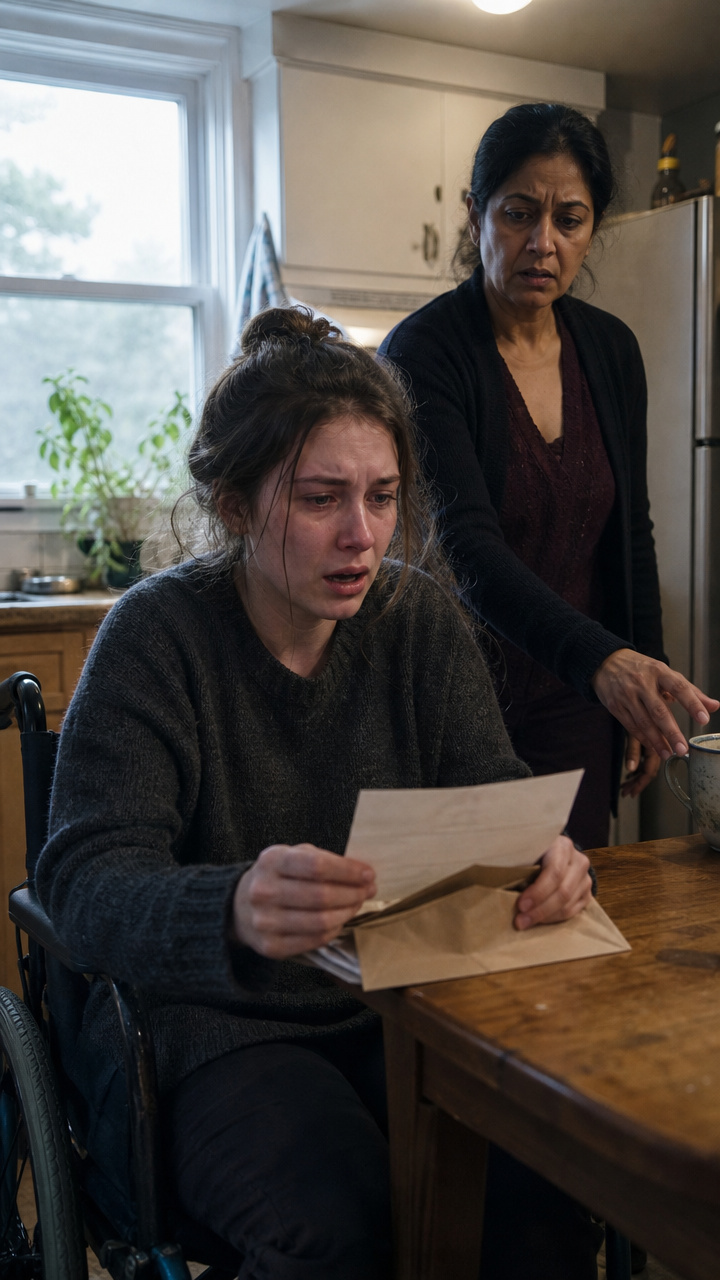
I was twenty-six years old when my uncle died. Four days after his funeral, Mrs. Patel placed an envelope in my hands. The handwriting on the front was unmistakably his.
I opened it with trembling fingers.
The first line read:
“I have lied to you all your life.”
I had not taken a single step since I was four years old.
Whenever people heard that, they usually imagined my life beginning in a hospital bed, surrounded by white walls and machines.
But I had a life before that.
I do not remember the accident itself.
I remember my mother, Laura, singing so loudly in the kitchen that the neighbors could hear her through the open windows. I remember my father, Daniel, smelling of motor oil and peppermint gum.
I remember bright sneakers with glowing soles, a purple cup that belonged only to me, and having far too many opinions for a four-year-old.
Then there was the accident.
For my entire life, I had known only one version of what happened: there had been a car crash, my parents had died, I had survived, and my spine had suffered irreversible damage.
Afterward, the authorities had to decide where I would go.
There were conversations about foster care, suitable families, and homes experienced in caring for children with serious disabilities.
Then my mother’s older brother arrived.
“We’ll find her a loving home,” the social worker, Melissa, said gently. She was standing beside my hospital bed with a stack of papers in her hands.
“We have several families who understand—”
“No,” my uncle interrupted.
His voice was rough enough to stop her.
“Sir, I’m only trying to explain—”
“I’m taking her home. She isn’t going to strangers. She’s family.”
That was how I came to live in his small house, where everything smelled faintly of coffee.
He had no children.
He had no partner.
And, to be honest, he had no idea what he was doing.
Still, he learned.
He watched the nurses carefully and wrote everything down in a battered spiral notebook: how to turn me without hurting my skin, how to check for pressure sores, how to lift me so I felt secure instead of frightened.
On my first night in his house, he set an alarm for every two hours.
Each time it rang, he shuffled into my room with his hair sticking up in every direction.
“Time to turn you, pancake,” he would mumble before carefully rolling me onto my side.
If I cried out because something hurt, he immediately bent over me.
“I know,” he whispered. “I’ve got you. I’m right here.”
He built a wooden ramp so my wheelchair could get over the front step.
It was crooked and looked as though it might collapse in bad weather.
But it worked.
He spent endless hours on the phone with insurance companies.
“No, she cannot manage without a shower chair,” he snapped one afternoon. “Would you like to come here and explain that to her yourself?”
No one ever came.
He took me to the park.
Our neighbor, Mrs. Patel, began bringing food and hovering around us as if she had appointed herself guardian of the entire household.
“She needs friends,” she insisted.
“She also needs not to fall down the stairs,” my uncle grumbled.
Even so, he later wheeled me around the neighborhood and introduced me to every child as though I were the most important person in the world.
At the park, children stared at me.
Their parents looked away.
Then a girl about my age walked straight up to my chair.
“Why can’t you walk?” she asked bluntly.
I froze.
My uncle crouched beside me.
“Her legs don’t listen to her brain,” he explained. “But she can still beat you at cards.”
The girl laughed.
“I don’t believe that.”
Her name was Lily.
She became my first real friend.
My uncle had a gift for standing between me and uncomfortable moments without making me feel protected like a helpless child. He could take an awkward question and turn it into something ordinary. He could make humiliation feel survivable.
When I was ten, I found an old chair in the garage covered in tangled balls of yarn.
“What is this?” I asked.
“Nothing. Leave it alone.”
That evening, he sat on the edge of my bed.
His hands were shaking.
“Don’t move,” he muttered.
He tried to braid my hair.
The result looked disastrous.
One side was too tight, the other was coming loose, and several strands had escaped completely.
But I felt as though my heart might burst with happiness.
When puberty arrived, he entered my room carrying a plastic shopping bag and wearing the expression of a man hoping the floor would open beneath him.
“I bought some things,” he announced.
“What kind of things?”
“The kind you need when… things start happening.”
Inside were sanitary pads, deodorant, and a cheap tube of mascara.
“You watched videos online, didn’t you?” I asked.
He gave me an embarrassed grin.
“Those girls talk very fast.”
We never had much money.
But he never made me feel like a burden.
He washed my hair over the kitchen sink. One hand supported my neck while the other poured warm water slowly over my scalp.
“That’s good,” he would repeat. “You’re all right. I’m here.”