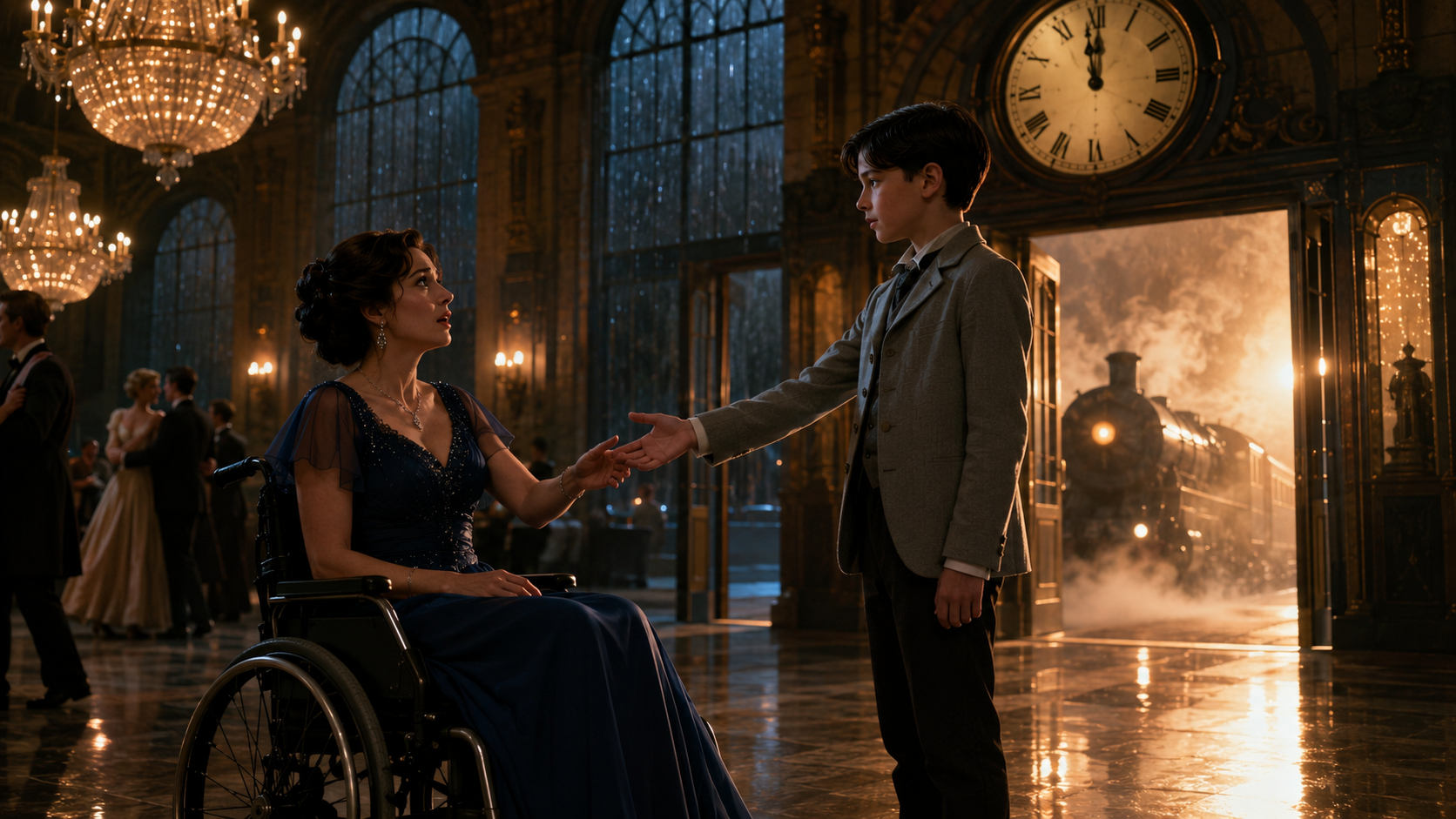
THE LAST WALTZ AT BELLWEATHER STATION

The invitation had been sitting unopened on Claire Ashford’s kitchen table for eleven days.

Heavy cream paper. Silver lettering. A wax seal stamped with the image of an old railway clock.

THE BELLWEATHER RESTORATION GALA

Claire had almost thrown it away.

She had no interest in champagne, orchestras, expensive dresses, or smiling conversations with people who asked how she was doing while carefully avoiding looking at the wheelchair beneath her.

But Bellweather Station was different.

Her father had loved that place.

When Claire was a child, he would bring her there on Sunday mornings, long after passenger trains had stopped using the station. They would stand beneath the enormous iron clock while he told her stories about soldiers returning from war, lovers saying goodbye on the platform, and musicians playing all night in the grand waiting hall.

“Every old building remembers something,” he used to say.

Claire had laughed at him then.

Tonight, twenty-two years later, she found herself remembering those words.

The restored station looked almost unreal.

Hundreds of candles flickered beneath the vaulted glass ceiling. Crystal chandeliers hung between the old steel beams. An orchestra occupied the former ticket balcony, and beneath them, couples moved across the polished floor where generations of travelers had once hurried toward departing trains.

Claire sat near one of the enormous arched windows.

Outside, rain streaked the glass.

Inside, everyone seemed to be dancing.

She adjusted the folds of her dark blue dress over her legs and tried not to notice the empty space people naturally left around her chair.

Three years earlier, Claire had been climbing a mountain road in northern Italy with her younger brother, Daniel, when another vehicle crossed the center line.

She remembered the headlights.

The sound of twisting metal.

Then darkness.

Daniel survived with a broken arm.

Claire woke in a hospital unable to move either leg.

There had been surgeries.

Rehabilitation.

Specialists.

Months of optimism followed by quieter conversations.

Eventually, the doctors stopped talking about recovery and started talking about adaptation.

Claire adapted.

She learned to drive again.

She returned to work.

She moved into an apartment without stairs.

She learned how to smile when strangers called her brave.

But there was one thing she had never learned.

How to stop remembering the person she had been before the crash.

That woman had danced.

Badly, perhaps.

But enthusiastically.

She had danced in kitchens, elevators, parking lots and once on the roof of a hotel during a thunderstorm.

The orchestra began a waltz.

Claire looked away.

“You’re sitting in my mother’s favorite place.”

The voice came from beside her.

Claire turned.

A boy stood near the window.

He looked about eleven or twelve.

He wore dark trousers, polished shoes, and a pale gray jacket that seemed strangely old-fashioned compared with the formal clothes worn by everyone else.

His black hair was neatly combed.

There was something unusual about him.

Not frightening.

Just… misplaced.

As though he belonged in an old photograph.

Claire glanced around for his parents.

“I’m sorry,” she said. “Was someone sitting here?”

The boy shook his head.

“No. A long time ago.”

Claire smiled politely.

“Then I suppose I’m safe.”

The boy studied her chair.

Most children stared.

Claire had become accustomed to it.

But this boy wasn’t staring with curiosity.

He was staring as though he recognized it.

“You don’t like the music,” he said.

“I like the music.”

“You look angry at it.”

Claire gave a small laugh.

“That’s a very strange thing to say to someone you’ve just met.”

“My mother said I said strange things.”

“Your mother sounds perceptive.”

“She was.”

The word made Claire pause.

Was.

Before she could ask what he meant, the boy looked toward the dance floor.

“Do you know this waltz?”

Claire listened.

“Yes.”

“Then dance with me.”

For several seconds, she thought she had misunderstood him.

A nearby couple heard the request and glanced over.

Claire forced another smile.

“I’m afraid you’ve chosen the wrong partner.”

“Why?”

She looked directly at him.

“Because I can’t walk.”

“I didn’t ask you to walk.”

Claire’s smile disappeared.

The boy extended one hand.

“I asked you to dance.”

A few guests were watching now.

Claire felt the familiar heat of embarrassment rise into her face.

“That’s enough.”

The boy did not move.

“You think dancing belongs to your legs.”

“What is your name?”

“Samuel.”

“Samuel, where are your parents?”

Instead of answering, he walked behind her chair.

Claire turned sharply.

“What are you doing?”

“Showing you something.”

His hands settled on the push handles.

Claire immediately locked both wheels.

“Please don’t touch my chair.”

Samuel stepped back.

“I’m sorry.”

His apology sounded sincere.

Claire relaxed slightly.

Then Samuel pointed toward the floor.

“Look.”

Claire followed his finger.

Her chair moved.

Only a fraction of an inch.

She stared.

The brakes were still locked.

The chair moved again.

Backward.

Claire grabbed the wheels.

“What the hell?”

Several people nearby noticed.

A man carrying a champagne glass stepped closer.

“Everything all right?”

Claire looked under the chair.

Nothing.

The floor was level.

No one was touching her.

“I think so.”

Then the chair turned.

Slowly.

Deliberately.

Claire’s hands flew away from the wheels.

The orchestra continued playing.

Around her, conversations faded.

The wheelchair rotated until Claire was facing the center of the ballroom.

Someone laughed nervously.

Someone else whispered, “Is that motorized?”

It wasn’t.

Claire’s chair was lightweight, manual, and completely ordinary.

“Samuel?”

The boy had walked in front of her again.

He extended his hand.

“Now will you dance?”

Claire stared at him.

“No.”

His expression changed.

For the first time, he looked sad.

“Why not?”

“Because chairs don’t move by themselves.”

“This one does tonight.”

“That doesn’t answer my question.”

Samuel glanced upward toward the enormous clock suspended above the former ticket booths.

It was eleven forty-seven.

“We don’t have much time.”

A chill moved across Claire’s shoulders.

“What happens at midnight?”

Samuel didn’t answer.

The music suddenly stopped.

Not because the conductor had finished the piece.

Every musician froze at exactly the same moment.

A violin bow remained suspended over the strings.

The pianist’s hands hovered above the keys.

Silence filled the station.

Then the lights flickered.

Once.

Twice.

Darkness.

Someone screamed.

A second later, the chandeliers returned.

Samuel was gone.

Claire spun her chair around.

“Samuel?”

People were murmuring throughout the hall.

A woman near the orchestra shouted that there had probably been an electrical problem.

The musicians began talking among themselves.

Claire searched the crowd.

No gray jacket.

No black hair.

No boy.

Then she heard the sound.

A child laughing.

It came from behind one of the old wooden doors beside the ticket counter.

Claire rolled toward it.

The sign above the door read:

EMPLOYEES ONLY

She hesitated.

Then opened it.

A narrow corridor stretched into darkness.

“Samuel?”

No answer.

Claire switched on her phone flashlight.

Old photographs covered the walls.

Bellweather Station in 1902.

Bellweather during the war.

Bellweather beneath three feet of snow.

Bellweather crowded with hundreds of travelers.

Claire moved slowly along the corridor.

At the end stood a large framed photograph.

She stopped.

It showed a Christmas dance inside the station.

Dozens of people smiled at the camera.

Women wore long dresses.

Men wore dark suits.

Children stood near the front.

Claire’s light moved across their faces.

Then stopped.

Samuel.

Same hair.

Same pale gray jacket.

Same serious eyes.

Claire’s breathing became shallow.

A brass plaque beneath the photograph read:

BELLWEATHER WINTER BALL — DECEMBER 19, 1936

Behind her, someone spoke.

“You found him.”

Claire nearly dropped her phone.

An elderly woman stood in the doorway.

She wore a black evening gown and held a silver cane.

“You scared me.”

“I’m sorry.”

Claire pointed toward the photograph.

“That boy. Who is he?”

The woman came closer.

For a moment, she simply stared at the picture.

“Samuel Vale.”

Claire felt cold.

“Is he related to someone here?”

The woman looked at her.

“He died that night.”

Claire said nothing.

“There was a fire shortly before midnight,” the woman continued. “Electrical wiring behind the old stage. Most guests escaped.”

“Most?”

The woman nodded.

“Samuel went back inside looking for his mother.”

Claire looked at the photograph again.

“What happened to her?”

“She survived.”

“How?”

The elderly woman’s eyes shifted toward Claire’s wheelchair.

“Samuel found her.”

Claire waited.

“She had been injured years earlier and used a wheelchair. When the smoke filled the hall, people panicked. Someone knocked her chair over. Samuel went back and dragged her toward the platform doors.”

Claire’s heart began pounding.

“Did he get out?”

The woman shook her head.

“His mother did.”

The clock in the ballroom chimed.

Once.

Claire looked at her phone.

11:55.

The woman touched the photograph gently.

“My grandmother used to tell me the story.”

“Your grandmother?”

The woman smiled.

“Samuel’s mother.”

Claire stared at her.

The laughter came again.

Not from the photograph.

From the ballroom.

Claire turned.

Samuel stood at the far end of the corridor.

“Samuel!”

He ran.

Claire pushed her wheels hard.

She reached the ballroom and stopped.

The atmosphere had changed.

The orchestra was playing again, but slower.

Guests stood along the edge of the floor.

And Samuel waited in the center.

Claire felt dozens of eyes following her.

She rolled toward him.

When she reached the dance floor, he smiled.

“You came.”

“I know who you are.”

His smile faded.

“Then you know why I have to leave.”

“What happens at midnight?”

“My train comes.”

Claire swallowed.

“Where does it go?”

Samuel looked toward the old platform doors.

“I don’t know.”

For the first time, he sounded like a frightened child.

Not a ghost.

Not a mystery.

A boy.

Claire moved closer.

“You’ve been waiting here all this time?”

Samuel nodded.

“For what?”

He looked toward the elderly woman standing near the corridor.

“To know she was all right.”

The woman covered her mouth.

Tears filled her eyes.

“She was,” Claire whispered. “Your mother lived.”

“I know now.”

The clock read 11:58.

Samuel looked back at Claire.

“One dance.”

Claire glanced down at her chair.

Then at the polished floor.

“I told you. I can’t.”

Samuel smiled.

“You’re still thinking about your legs.”

He held out his hand.

Claire slowly placed her fingers in his.

The wheelchair moved.

Not forward.

Sideways.

Smoothly.

As though invisible hands had taken hold of it.

Claire gasped.

The chair turned.

Samuel stepped around her.

The wheels followed.

One rotation.

Then another.

Claire laughed.

A real laugh.

A sound she hadn’t heard from herself in years.

The wheelchair glided through the waltz as naturally as any dancing couple.

Samuel bowed dramatically.

Claire spun.

Guests stepped backward, stunned.

Someone began crying.

Someone else whispered a prayer.

But Claire stopped noticing them.

For fifteen extraordinary seconds, the ballroom belonged only to a woman, a boy, and a song that should have ended eighty-nine years earlier.

Samuel laughed.

“See?”

Claire was crying now.

“I see.”

The clock began striking midnight.

Samuel stopped.

The wheelchair stopped with him.

First chime.

The platform doors behind them swung open.

Wind rushed into the ballroom.

Second chime.

Beyond the doors, there was no rain.

No city.

Only fog.

Then a distant light appeared.

Third chime.

A train whistle echoed through the station.

Guests turned toward the doors.

There were no active tracks outside Bellweather anymore.

They had been removed decades ago.

But the sound grew louder.

Fourth chime.

Samuel released Claire’s hand.

“I have to go.”

Claire tightened her fingers around his.

“Are you afraid?”

He looked at her.

“Yes.”

Claire remembered something her father used to say whenever she was frightened as a child.

Courage was not the absence of fear.

It was deciding fear did not get the final word.

She smiled at Samuel.

“Then I’ll wait until your train arrives.”

Fifth chime.

The light in the fog became brighter.

Samuel looked toward the elderly woman.

She was crying openly now.

He lifted his hand.

She lifted hers.

“My grandmother talked about you until the day she died,” the woman whispered.

Samuel smiled.

Sixth chime.

The shape of an old steam locomotive appeared beyond the doors.

Impossible.

Silent except for the slow rhythm of turning wheels.

Seventh chime.

Samuel walked toward it.

Halfway there, he stopped and looked back at Claire.

“You should dance more.”

Claire laughed through her tears.

“In this?”

She touched her wheelchair.

Samuel grinned.

“You’re still asking the wrong question.”

Eighth chime.

He stepped into the fog.

Ninth.

The locomotive doors opened.

Warm golden light spilled onto the abandoned platform.

Tenth.

Samuel climbed aboard.

Eleventh.

He turned once more.

“Goodbye, Claire.”

She froze.

She had never told him her name.

Twelfth chime.

The doors closed.

The train vanished.

The fog disappeared.

Rain crashed against the windows again.

For several seconds, nobody in Bellweather Station moved.

Then the orchestra conductor slowly lowered his baton.

A woman near the dance floor whispered, “What just happened?”

Claire looked down.

Her wheelchair was exactly where Samuel had left it.

Her legs had not miraculously changed.

She had not been cured.

She was still Claire Ashford.

Still disabled.

Still carrying everything the accident had taken from her.

And yet something was different.

For three years, she had believed that dancing belonged to a previous version of herself.

That joy had belonged to that woman too.

Adventure.

Love.

Risk.

Life.

She had been waiting for her old body to return before allowing herself to become alive again.

Samuel had shown her the flaw in that bargain.

Claire placed both hands on her wheels.

The orchestra began another song.

The elderly woman approached.

“Would you like me to take you back to your table?”

Claire looked toward the dancers.

Then shook her head.

“No.”

She pushed herself onto the floor.

A young man stepped aside to give her room.

Claire caught his eye.

“Do you dance?”

He looked at her chair, then quickly back at her face.

“Badly.”

“Perfect.”

She offered him her hand.

“Me too.”

A few minutes later, the ballroom was full again.

People laughed.

Shoes crossed polished wood.

The orchestra played beneath the ancient clock.

And Claire danced.

Not the way she once had.

Not the way she had spent three years wishing she could.

She danced as she was.

Outside, somewhere beyond the rain-covered windows, a train whistle sounded one final time.

Claire heard it.

She smiled.

And this time, she did not look back.

THE LAST WALTZ AT BELLWEATHER STATION
The Little Girl Who Asked Me to End It Quickly