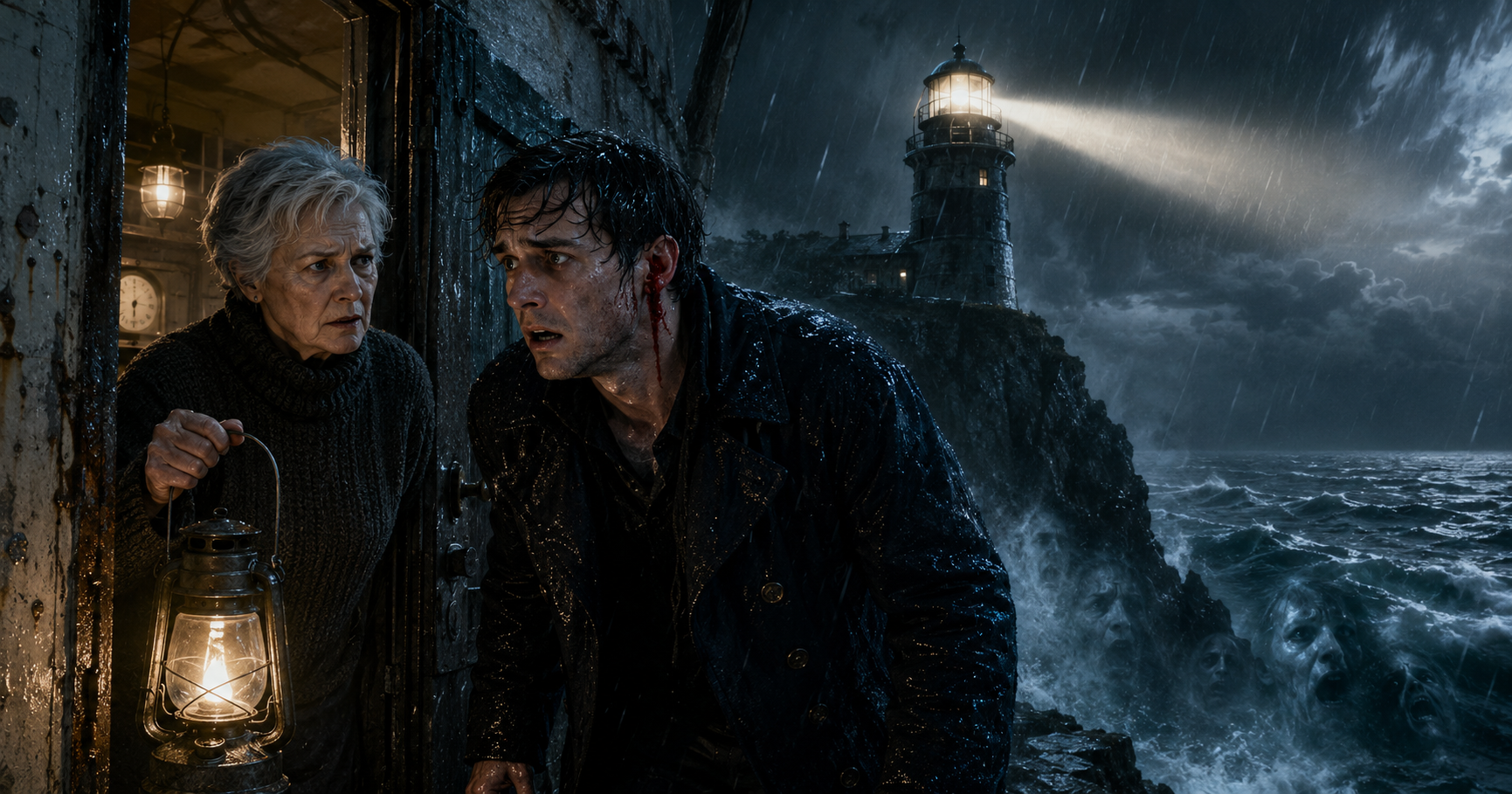
THE VOICE BENEATH THE LIGHTHOUSE

“DON’T LET ME HEAR IT AGAIN!”

The cry rose above the wind and struck the lighthouse door a heartbeat before the man did.

Miriam Voss barely managed to lift the iron latch before Ellis Rook collapsed across the threshold.

Rainwater streamed from his coat. One boot was missing. Blood covered the left side of his neck and disappeared beneath the collar of his sweater. He pressed both hands over his ears as though trying to hold his skull together.

Behind him, the midnight sea battered the cliffs of Griefwater Point.

The old lighthouse trembled with every wave.

Miriam dragged Ellis inside and forced the door shut. Wind screamed through the narrowing gap until the lock caught.

“Ellis, look at me.”

He remained on his knees.

His shoulders shook.

“Please,” he whispered. “Make it stop listening.”

Miriam stared at him.

“Listening to what?”

Ellis slowly raised his head.

He was thirty-two, strong, stubborn and usually incapable of admitting fear. He maintained the hydrophones and navigation buoys along the northern coast. Three weeks earlier, he had repaired the lighthouse generator while joking that the building was old enough to remember the invention of darkness.

Now his face looked gray.

A thin line of blood ran from his left ear.

Miriam reached toward him.

Ellis recoiled so violently that his back struck the door.

“No!”

“I need to examine you.”

“You can’t touch it.”

“Touch what?”

His eyes shifted toward the spiral staircase leading down to the sealed lower chambers.

“The thing that followed me from the listening station.”

The lighthouse lantern rotated overhead.

A blade of white light crossed the windows, swept over the black sea and vanished into the storm.

Miriam had lived at Griefwater Point for twenty-seven years. Before that, she had worked as an emergency surgeon in the naval hospital at Caldrin Bay. She had removed bullets, pieces of machinery, fishhooks and shattered bone from men who had believed themselves impossible to kill.

She did not believe in ghosts.

She did not believe the stories fishermen told about drowned voices beneath the cliffs.

But she believed Ellis was injured.

That was enough.

“Come into the radio room,” she said.

“I can hear them in there.”

“The radio hasn’t worked in twelve years.”

“They don’t need the radio.”

He winced and clutched the side of his head.

Something moved beneath the skin below his ear.

Miriam saw it clearly.

A narrow ripple traveled down his jaw, paused near his throat and then slid upward again.

It was not a vein.

It was not a muscle spasm.

It moved with purpose.

Ellis saw the change in her expression.

“You believe me now.”

“I believe something is inside you.”

“That isn’t the worst part.”

Miriam placed his arm over her shoulder and helped him stand.

“What is the worst part?”

Ellis leaned close enough that she smelled saltwater and blood on his breath.

“It knows which voices you’ll answer.”

The radio room occupied the eastern side of the lighthouse. Its walls were crowded with rusted instruments, dead monitors and emergency maps whose coastlines had faded to pale blue veins. A heavy wooden desk stood beneath the window.

Miriam pushed the maps aside and made Ellis sit beneath the brightest lamp.

“Hands on your knees,” she instructed.

“I might hit you.”

“Then I’ll hit you back.”

“I’m serious.”

“So am I.”

She opened the medical cabinet mounted beside the radio equipment. Most of its contents were old but usable: gauze, antiseptic, surgical scissors, a battery-powered examination lamp and a collection of instruments left from her hospital years.

Ellis watched her select a narrow otoscope.

“What are you doing?”

“Looking.”

“It doesn’t like light.”

“That gives us something in common.”

Lightning flashed beyond the window.

For an instant, the ocean became a field of white teeth.

Miriam tilted Ellis’s head and directed the examination light into his ear.

The outer canal was swollen. Blood coated the skin. Deeper inside, beyond the reach of her smallest forceps, something pale opened and closed.

At first she mistook it for torn tissue.

Then it unfolded.

Four translucent structures pressed against the walls of the ear canal. They resembled the wings of an insect formed from wet glass. At their center was a dark bead no larger than a pepper seed.

The bead rotated toward the light.

Miriam drew back.

The object had no visible eye.

Nevertheless, she felt it looking at her.

“What did you see?” Ellis asked.

“Something attached near the eardrum.”

“Attached?”

“Possibly embedded.”

“Get it out.”

“You just told me not to touch it.”

“I changed my mind.”

“You’re in shock. You don’t get to change your mind every ten seconds.”

A deep note rolled through the lighthouse.

It was lower than thunder.

The glass in the windows vibrated.

Miriam looked toward the ceiling.

Ellis closed his eyes.

“No,” he whispered.

The note sounded again.

This time it came from beneath them.

From the abandoned foghorn chamber at the base of the lighthouse.

“That system has no power,” Miriam said.

“It isn’t the horn.”

“Then what is it?”

Ellis looked at her with an expression of absolute exhaustion.

“It’s the mouth underneath it.”

Miriam cleaned the blood from his neck while he told her what had happened.

At sunset, Ellis and another technician, Naomi Kells, had sailed to Platform Nine, a concrete listening station built into the reefs three miles north of Griefwater Point. The navy had abandoned it after the northern sonar program ended.

A recent undersea landslide had exposed a maintenance entrance beneath the platform. Ellis and Naomi had been ordered to inspect the damage before the next tide.

They entered through a corroded steel hatch.

The corridor beyond it should have ended after twenty meters.

Instead, it descended.

The station plans showed no lower level, but the stairs continued beneath the waterline. Every landing was dry. The air grew warmer as they went down.

At the bottom, they discovered a circular chamber lined with hundreds of brass listening tubes.

Each tube entered the wall.

Each tube was shaped like a human ear.

“There was a chair in the center,” Ellis said. “Leather straps on the arms. A metal hood above it.”

Miriam stopped cleaning his wound.

“A restraint chair?”

“I don’t know.”

“You know exactly what a restraint chair looks like.”

Ellis said nothing.

“What did Naomi do?”

“She heard her father.”

“Her father lives in Bellstrand.”

“He died last winter.”

The lighthouse groaned.

Ellis continued in a quieter voice.

“Naomi heard him inside one of the tubes. He said he was cold. He asked her to come closer.”

“And she did.”

“I tried to stop her.”

“But she did.”

Ellis nodded.

“She put her ear against the tube. At first she smiled. Then she started crying. She said he had forgiven her.”

“For what?”

“She never told me.”

“What happened next?”

“She answered him.”

Miriam waited.

Ellis’s fingers tightened around his knees.

“The moment she spoke, every tube in the chamber answered.”

The lamp above them flickered.

“Hundreds of voices,” Ellis said. “Men, women, children. Some were begging. Some were laughing. Some were praying. They all spoke at once, but I understood every word.”

Miriam felt a pressure building behind her eyes.

“What did they say?”

“My name.”

The pale thing inside Ellis’s ear shifted.

He gasped and gripped the desk.

Miriam steadied him.

“Where is Naomi?”

“I don’t know.”

“You left her?”

“The lights went out. Something opened beneath the chair. I heard water, but none came into the room. Naomi began singing.”

“Singing what?”

“A lullaby.”

Ellis looked toward the dead radio.

“My mother used to sing the same one.”

Static burst from the radio speaker.

Both of them froze.

The equipment was disconnected from the power supply.

Miriam knew because she had cut the cables herself years ago.

The static thickened.

A woman’s voice emerged from it.

Soft.

Distant.

Almost buried beneath the hiss.

“Miri?”

Miriam’s breath stopped.

No one had called her that for twenty-seven years.

Ellis turned toward her.

“You know the voice.”

The speaker crackled.

“Miri, are you there?”

Miriam remembered a red scarf blowing along a harbor wall.

Two girls running through summer rain.

A hand squeezing hers beneath a hospital blanket.

Celia.

Her younger sister.

Lost during the Griefwater evacuation.

No body had ever been recovered.

“Miri,” the radio whispered. “I waited for you.”

Miriam moved toward the desk.

Ellis caught her wrist.

“Don’t answer.”

“That recording can’t exist.”

“It isn’t a recording.”

“My sister disappeared before this equipment was installed.”

“Miriam.”

Celia’s voice came from the speaker again, clearer now.

“You promised you would come back.”

Miriam’s eyes filled with tears.

She remembered the promise.

She had never spoken of it to anyone.

On the night of the evacuation, Miriam had been ordered to treat the injured aboard a rescue vessel. Celia had remained in the lighthouse with six communications officers.

Miriam had promised to return before the last boat left.

She had not returned.

The storm had swallowed the lighthouse road, the communications room and everyone inside it.

Only the upper tower survived.

“Miriam,” Ellis said firmly. “Look at me.”

She forced herself to turn away from the radio.

The voice continued.

“You left me here.”

Miriam pulled the radio cable from the wall.

The speaker kept talking.

“You heard me calling.”

She seized a brass lamp and smashed it into the radio.

The casing split.

Vacuum tubes shattered.

The voice stopped.

Silence filled the room.

Ellis released her wrist.

“You did hear her that night,” he said.

Miriam stared at the broken radio.

“I heard many people.”

“You heard her.”

“I was on a rescue ship half a mile offshore.”

“But you heard her.”

Miriam remembered standing on the deck while the sea rose around the cliffs.

She had heard Celia’s voice through the storm.

Not over the ship’s radio.

Inside her own head.

She had spent twenty-seven years convincing herself it had been grief.

“Why did you come here?” she asked.

Ellis swallowed.

“Naomi told me to.”

“You said she disappeared.”

“She did.”

“Then how did she tell you anything?”

“After I escaped the chamber, I reached the boat. I thought I was alone.”

His voice began to shake.

“Then Naomi spoke from inside my ear.”

The skin beneath his jaw moved again.

This time the ripple traveled lower, approaching the pulse in his neck.

Miriam opened a drawer and removed a small steel case.

Inside lay a set of magnetized surgical probes used for extracting metal fragments.

“What are those?”

“Our best chance.”

“The thing isn’t metal.”

“Its center reacted to the examination light. It may react to a magnetic field.”

“And if it doesn’t?”

“Then this will hurt for no useful reason.”

Ellis almost laughed.

The attempt died in his throat.

Miriam sterilized the narrowest probe and positioned the lamp.

“I need you to remain completely still.”

“Tie me down.”

“That won’t be necessary.”

“It will.”

He looked directly at her.

“When the voices start, I won’t know which thoughts are mine.”

Miriam found two canvas safety straps in a storage cabinet. She secured Ellis’s wrists to the chair and fastened another strap across his chest.

“Too tight?” she asked.

“Not tight enough.”

The foghorn sounded beneath the lighthouse.

The whole tower vibrated.

Dust fell from the ceiling.

Miriam activated the magnetic probe.

A faint hum filled the room.

The pale structures inside Ellis’s ear unfolded at once.

He screamed.

Miriam inserted the probe.

“Hold still.”

“It’s cutting me!”

“It’s moving away from the magnet.”

“Then stop!”

“You asked me to remove it.”

“I was wrong!”

The object retreated deeper into the canal.

Miriam changed the polarity.

The dark center snapped toward the probe.

Ellis’s body arched against the straps.

A voice burst from his mouth.

It was not Naomi’s.

It was Celia’s.

“Miri, please don’t leave me again.”

Miriam’s hand trembled.

Ellis’s eyes rolled toward her.

His lips continued moving in her sister’s voice.

“I was alive when the water came.”

“You are not Celia.”

“You could have saved me.”

“You are not Celia.”

“I held the railing until my fingers broke.”

Miriam pushed the probe deeper.

Ellis screamed in his own voice.

The magnet caught something.

Resistance traveled up the handle.

She began to pull.

A transparent filament emerged from the ear canal, thin as fishing line. It stretched without breaking.

The foghorn below released another impossible note.

The lighthouse windows bowed inward.

“Miriam!” Ellis shouted. “Wait!”

“I have it.”

“Look at the monitor!”

One of the dead sonar displays had illuminated.

A green line moved across the black screen.

With every sweep, it revealed a circular shape beneath the lighthouse.

Not rock.

Not a cave.

A vast chamber.

At its center lay something resembling a coiled body.

The display marked it at nearly four hundred meters long.

“That wasn’t there before,” Miriam whispered.

“It was always there.”

The line swept again.

The coiled shape shifted.

The movement was slow but unmistakable.

The lighthouse floor tilted.

Somewhere below them, stone cracked.

The filament in Ellis’s ear tightened around the magnetic probe.

Miriam pulled harder.

The pale object screamed.

The sound did not travel through the air.

It appeared directly inside her bones.

Not words.

A warning.

Images flooded her mind.

Engineers lowering brass tubes into the cliffs.

Military doctors strapping volunteers beneath a metal hood.

Men destroying their own eardrums to escape voices no one else could hear.

Small pale organisms being placed inside the survivors’ ears.

Not parasites.

Barriers.

Living plugs engineered to absorb the signal rising from beneath the sea.

Miriam released the probe.

Ellis collapsed against the chair, panting.

“What did you see?” he asked.

“That thing is protecting you.”

“Protecting me from what?”

The sonar line swept across the screen again.

The shape beneath the lighthouse had begun to uncurl.

“From that.”

The broken radio came alive.

Dozens of voices poured from its ruined speaker.

Naomi.

Celia.

Unknown sailors.

Crying children.

Men shouting coordinates from vessels lost decades ago.

Each voice called for someone who was no longer alive.

The walls answered with faint whispers.

Ellis looked toward the spiral staircase.

“It followed me here because of you.”

“Why me?”

“Platform Nine was only a receiver. This lighthouse was the transmitter.”

Miriam shook her head.

“The old foghorn?”

“Not a foghorn. A signal generator.”

Another deep vibration rose from below.

The dead instruments flickered awake one after another.

Needles swung across gauges.

Warning lamps glowed red.

On the wall, an ancient reel-to-reel machine began turning.

There was no tape mounted on it.

Still, Celia’s voice came from the empty mechanism.

“Miri, open the lower door.”

Miriam backed away.

The sealed lower chambers had remained locked since the evacuation. She possessed the only key.

For twenty-seven years, she had worn it on a chain beneath her clothes.

Now the key felt warm against her chest.

Ellis stared at it.

“It knows you have it.”

“Everyone knew I had it.”

“No. It knows now.”

A metallic knock echoed from the staircase door.

Once.

Then twice.

Then three times.

The same emergency signal used by lighthouse crews when the electrical systems failed.

Miriam’s hand moved toward the key.

Ellis strained against the straps.

“Don’t.”

“Someone may be below.”

“There is no one below.”

The knock came again.

Celia began to cry behind the door.

“Miri, the water is rising.”

Miriam closed her eyes.

She saw her sister as she had been at nineteen: laughing with paint on her hands, angry at the world, brave only when someone else needed her.

“Miri, please.”

Miriam reached for the key.

Ellis tore one hand free of the canvas restraint.

He struck the metal tray beside him.

The crash snapped Miriam back to the room.

“That voice wants you to remember her frightened,” he said. “Was she?”

Miriam looked at him.

“What?”

“Your sister. Was she the kind of person who begged?”

Celia had been many things.

Reckless.

Impatient.

Infuriating.

But when the evacuation sirens sounded, she had helped carry injured officers into the upper tower. The final transmission from the lighthouse had been calm.

Celia had never begged.

Miriam took the key from her neck.

The voice behind the door became hopeful.

“Yes, Miri. Open it.”

Miriam walked to the emergency furnace.

She placed the key inside.

Then she shut the iron grate.

The voice stopped crying.

Its next words came in a deep chorus.

“You were given one purpose.”

The lighthouse shook.

The lower staircase door bulged inward.

Ellis freed his other hand and pulled the remaining straps loose.

“What purpose?” he asked.

Miriam watched the key begin to glow inside the furnace.

“I don’t know.”

“Yes, you do.”

A memory surfaced.

Not from the evacuation.

From three days afterward.

Miriam standing inside this same radio room with blood dried beneath her nose.

A naval officer asking what she had heard during the storm.

Doctors measuring her hearing.

Engineers playing tones through headphones.

Celia’s voice emerging from a test speaker.

Miriam screaming until she lost consciousness.

Then a needle.

A white room.

A signature at the bottom of a document she had never remembered signing.

“They erased something,” Miriam said.

Ellis touched the blood beneath his ear.

“What?”

“My reason for coming back here.”

The reel-to-reel machine accelerated.

A second sonar monitor illuminated.

It displayed a waveform.

Miriam recognized the pattern.

“It’s waiting for a response.”

“What kind?”

“A cancellation frequency. The transmitter was designed to produce an opposing signal.”

“Can you activate it?”

“The controls are in the foghorn chamber.”

“The chamber behind the locked door?”

Miriam looked at the furnace.

The key had begun to melt.

The lower door bent inward again.

Its hinges screamed.

“We don’t need the key anymore.”

The door exploded from its frame.

Beyond it, the spiral staircase descended into red emergency light.

Wet footprints marked the steps.

They began at the bottom and ended at the threshold.

Miriam and Ellis stared into the opening.

From far below, Naomi called his name.

“Ellis?”

He stepped toward the stairs.

Miriam caught his arm.

“That isn’t her.”

“I know.”

“Do you?”

He looked at her.

Tears stood in his eyes.

“No.”

They descended together.

The lower lighthouse smelled of hot metal and seawater. Pipes ran along the stone walls like arteries. With every note from below, they expanded and contracted.

Halfway down, Miriam noticed faces beneath the moisture covering the walls.

Not actual faces.

Impressions.

Foreheads, mouths and closed eyes pressing outward from inside the stone.

Ellis avoided looking at them.

“Keep talking,” he said.

“About what?”

“Anything real.”

Miriam searched for something ordinary.

“The kitchen roof leaks near the western beam.”

“Good.”

“The generator consumes twice as much fuel as the manual claims.”

“Keep going.”

“You still owe me for the replacement window you broke in March.”

“I told you a gull did that.”

“The gull did not leave a wrench on my floor.”

A small laugh escaped him.

The faces in the wall opened their mouths.

Each one laughed with him.

Ellis stopped.

“Don’t react,” Miriam said.

They continued downward.

At the base of the stairs stood the foghorn chamber.

The room was far larger than the lighthouse above it.

A copper mechanism filled the center, shaped like an enormous gramophone horn directed into a shaft in the floor. Thick cables disappeared into the stone. Banks of control wheels lined a circular platform.

Beyond the platform, the shaft descended into darkness.

Warm air rose from it in slow breaths.

Naomi stood beside the main console.

Her yellow diving coat dripped onto the floor.

Ellis rushed toward her.

Miriam seized him by the collar.

Naomi turned.

Her skin was colorless.

Both ears were missing.

Smooth skin covered the sides of her head where they should have been.

“Ellis,” she said. “You brought the listener.”

Miriam felt the room contract around her.

Ellis whispered Naomi’s name.

Naomi smiled.

Then every mouth in the stone walls spoke through her.

“Begin the final transmission.”

The copper horn lowered toward the shaft.

The machine activated.

A sound beyond hearing rolled through the chamber.

Miriam felt her teeth vibrate.

The pale guardian inside Ellis’s ear unfolded, trying to block the signal. Blood streamed down his neck.

He dropped to one knee.

“I can’t hold it out.”

“You don’t have to.”

Miriam dragged him toward the console.

The controls carried no labels, only symbols: waves meeting, waves separating, a closed eye and an open mouth.

The memories returned more quickly now.

She had operated this machine before.

The night Celia died, the signal beneath the sea had awakened. Miriam had been the only technician capable of distinguishing its frequency from the storm.

She had entered the chamber.

She had generated the cancellation tone.

And she had failed to maintain it.

The signal had taken Celia’s voice because Celia had been the last person Miriam desperately wanted to hear.

Afterward, the navy had suppressed Miriam’s memories and left her at Griefwater Point as an unwitting guardian. Her presence completed part of the circuit.

She had not chosen to live beside the lighthouse.

She had been placed there.

“Miriam!” Ellis shouted.

Naomi crossed the platform toward them.

Her jaw opened wider with every step.

Miriam turned the first control wheel.

The horn changed position.

She adjusted a second wheel, watching the waveform on the monitor.

Two patterns appeared.

One belonged to the thing below.

The other had to be created manually.

“I need a stable tone,” she said.

“What tone?”

“The last clear sound I remember before the original transmission.”

“Celia’s voice?”

“No.”

Miriam remembered the rescue ship.

Rain striking the steel deck.

Warning bells.

The captain shouting orders.

And beneath it all, Celia singing through the lighthouse transmitter to keep the frightened survivors calm.

Not a lullaby.

An old workers’ song their mother had taught them.

Miriam began to sing.

Her voice cracked on the first line.

The waveform barely moved.

Naomi lunged.

Ellis intercepted her.

They struck the floor together.

Naomi moved with impossible strength, her fingers closing around his throat.

“Louder!” Ellis gasped.

Miriam sang again.

The copper horn rotated toward her.

The chamber repeated the melody in Celia’s voice.

Miriam nearly lost the rhythm.

The imitation was perfect.

Then it made a mistake.

Celia had always paused before the final note.

The voice from the horn did not.

Miriam understood.

The thing could reproduce sound.

It could reproduce words and memories.

But it could not understand hesitation.

It did not know why a human voice sometimes broke.

It did not know why grief changed the spaces between notes.

Miriam sang the line once more.

This time she included the pause.

The second waveform aligned with the first.

“Ellis, now!”

He kicked Naomi away and slammed his hand onto the symbol of two colliding waves.

The chamber erupted.

The cancellation frequency passed through Miriam without sound.

Every light shattered.

The stone faces screamed.

Naomi fell beside the shaft, clawing at the smooth skin where her ears had been.

The pale guardian inside Ellis’s ear released its grip.

For one moment it emerged into view, its translucent wings spread across the side of his face.

Then it dissolved into clear liquid.

The enormous shape beneath the lighthouse struck the shaft.

The platform jumped.

Miriam was thrown against the console.

The copper horn split along its length.

Black seawater surged upward.

Within it moved countless pale mouths.

They opened together.

Celia’s voice filled the chamber.

“Miri.”

Miriam looked into the rising water.

For one final moment, she allowed herself to imagine that her sister truly waited below.

Then she pulled the emergency overload lever.

Ellis saw what she was doing.

“What will that do?”

“Destroy the transmitter.”

“And us?”

Miriam gave him a tired smile.

“I haven’t read the manual.”

He crawled toward her.

Naomi rose behind him.

Her empty face turned toward the shaft.

“Don’t silence us,” she said in a thousand voices.

Miriam pushed the lever down.

The copper coils ignited.

White light consumed the chamber.

The last thing Miriam felt was Ellis covering her head with his body.

Then the world became perfectly silent.

Dawn arrived over Griefwater Point beneath a clear sky.

A fishing crew found Miriam and Ellis on the rocks below the lighthouse. The upper tower had split from top to bottom. Everything beneath the ground-level entrance had collapsed into the sea.

No trace of Platform Nine remained.

No trace of Naomi Kells was ever recovered.

Miriam woke in the hospital three days later.

Ellis sat beside her bed with bandages wrapped around his head.

He noticed her eyes opening and smiled.

His lips moved.

She heard nothing.

Miriam touched her ears.

Ellis handed her a notebook.

Both of us, he had written. Permanent, according to the doctors.

Miriam read the sentence twice.

Then she wrote beneath it.

The signal?

Ellis shook his head.

Gone.

She closed her eyes.

For the first time in twenty-seven years, there were no radios, no foghorns, no waves and no voices of the dead.

Only silence.

It felt clean.

It felt merciful.

Ellis stood and walked to the window.

Outside, sunlight covered the harbor. Fishing boats moved across the water. Gulls circled above them with open beaks, crying into a world Miriam could no longer hear.

She began to believe they had survived.

Then someone whispered her name.

Not through her ears.

The voice rose from deep inside her chest.

“Miri.”

Her eyes opened.

Across the room, Ellis had gone completely still.

He slowly turned toward her.

Miriam knew from his face that he had heard it too.

The voice beneath the lighthouse had lost its transmitter.

It had lost its horn.

It had lost the sea route through which it had called for generations.

But as Miriam felt the next whisper travel through her bones, she finally understood the mistake they had made.

The thing had never needed human ears.

It had only needed human beings to believe that it did.

THE VOICE BENEATH THE LIGHTHOUSE
9 good reasons to love a cat