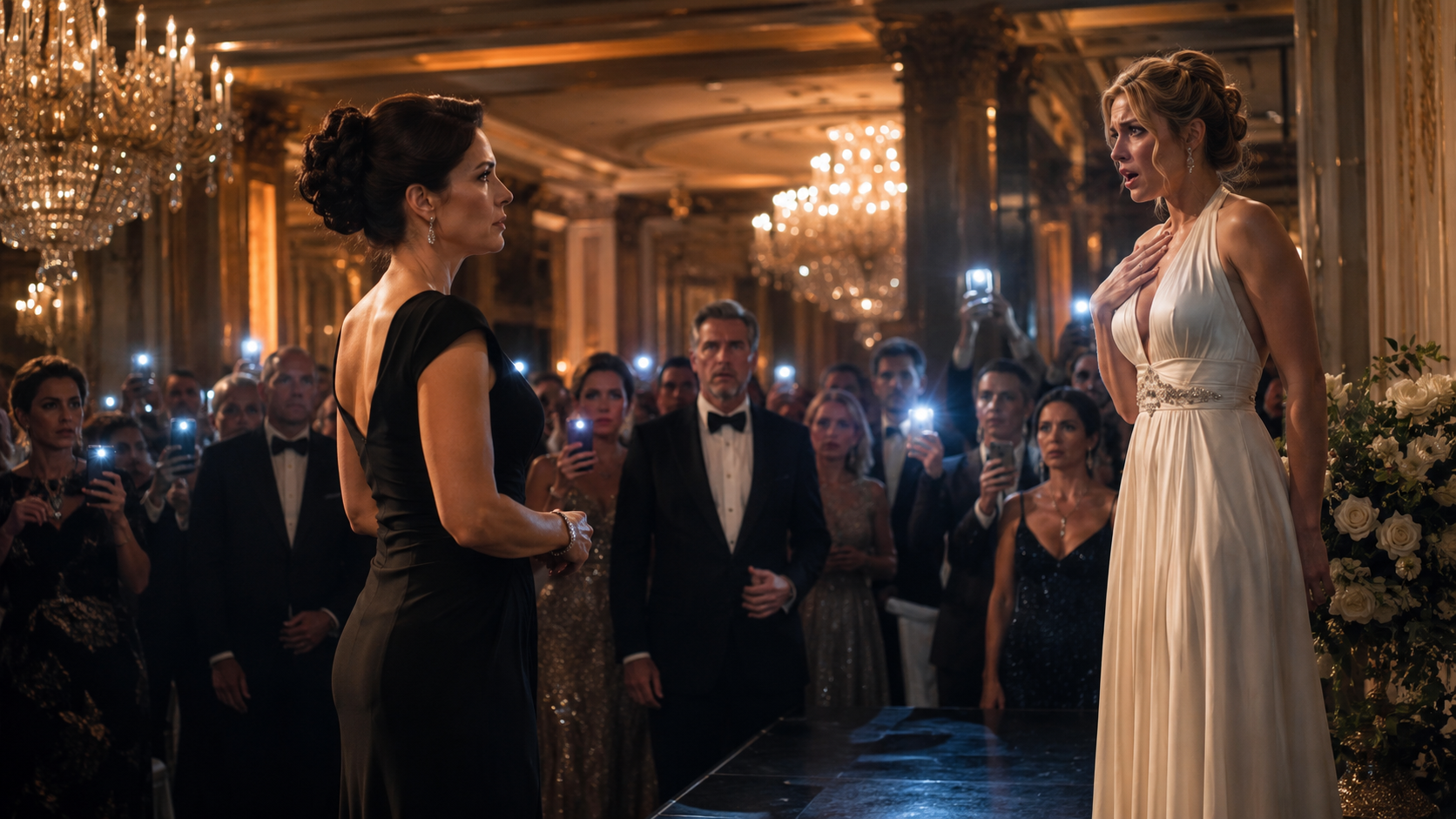
The applause began before my sister reached the stage.
It rolled across the ballroom in polished waves, rising above the music of the twelve-piece orchestra and the soft collision of crystal glasses. Nearly three hundred investors, executives, journalists, and carefully selected family friends stood beneath a ceiling painted with silver constellations.
They were celebrating the beginning of a new era for Marlowe Dynamics.
More precisely, they were celebrating my replacement.
My younger sister, Vivienne Marlowe, crossed the stage in a white evening gown and accepted the company’s ceremonial gold key from our father. Cameras flashed as she lifted it above her head.
“Tonight,” my father announced, “our family’s legacy passes into capable new hands.”
I remained seated near the rear of the ballroom.
My invitation identified me as Elena Marlowe, Strategic Consultant.
Not founder.
Not chief engineer.
Not the woman who had designed the first prototype in a rented garage while Vivienne was still posting photographs from beach resorts.
Strategic Consultant.
The title was intended to make my disappearance look voluntary.
Fourteen years earlier, I had created a system that allowed hospitals, factories, and entire municipal districts to predict energy failures before they happened. Investors had called it unrealistic. Competitors had called it impossible.
I had called it Atlas.
Atlas became the foundation of Marlowe Dynamics.
The company grew from four exhausted engineers sharing two computers into an international infrastructure firm with offices in eleven countries. Our software managed power networks, emergency systems, and transportation hubs used by millions of people.
My father supplied the family name and early introductions.
I supplied everything that made the company valuable.
For years, that distinction did not seem important.
Then our profits crossed a billion dollars.
After that, everyone suddenly became interested in deciding who deserved the credit.
Vivienne reached the microphone and smiled at the crowd.
She was excellent in front of cameras. Every movement appeared spontaneous, though I had watched her rehearse that smile in the mirrored elevator twenty minutes earlier.
“When my father asked me to lead this company,” she began, “I understood that leadership would require courage.”
Applause followed immediately.
At the table beside me, Daniel Cho, the company’s former legal counsel, shifted uncomfortably in his chair.
“Courage is a dangerous word tonight,” he whispered.
I kept my eyes on the stage.
“She hasn’t signed it yet,” I said.
“She will.”
“Yes.”
“And you’re going to let her?”
“I’m not holding the pen.”
Vivienne continued speaking about modernization, accountability, and the need to leave outdated thinking behind. She never said my name, but everyone in the room understood who represented the past.
For the previous six months, she had slowly isolated me from the company I had built.
My research division had been reassigned.
My security access had been restricted.
Senior engineers were ordered to report to executives who had never written a line of code.
Meetings were moved without telling me. Decisions were made in private. Rumors appeared in financial magazines suggesting that I was brilliant but unstable, visionary but impossible to manage.
Vivienne had learned that the cleanest way to remove someone was to convince the world that removing them had been necessary.
When she finished her speech, my father returned to the microphone.
“We have one final piece of business,” he said.
Daniel stopped breathing for a moment.
An assistant carried a black folder onto the stage.
Vivienne opened it.
“Elena,” she said.
The room became silent.
She looked directly at me for the first time that evening.
“Would you please stand?”
I rose slowly.
Every camera turned in my direction.
Vivienne waited until she was certain she had the attention of the entire ballroom.
“Marlowe Dynamics cannot move forward while certain individuals continue resisting necessary change,” she said. “Effective immediately, your consulting agreement, executive privileges, and relationship with this company are terminated.”
Several people gasped.
Most remained silent.
A few members of Vivienne’s new leadership team began to applaud. The sound was weak at first, then spread as frightened people realized they were expected to join.
My mother stared at the tablecloth.
My father stood beside Vivienne with his hands folded in front of him.
He did not look surprised.
That hurt more than the dismissal.
Vivienne lifted the termination document.
“The board has authorized me to sign this in front of our shareholders and partners,” she said. “Transparency matters.”
Daniel leaned closer to me.
“Elena.”
“It’s all right.”
“It is very much not all right.”
Onstage, Vivienne signed the document with an exaggerated flourish.
She placed the pen beside the folder and looked toward me, waiting for anger, tears, or a desperate attempt to defend myself.
I gave her none of those things.
Instead, I asked, “Did you read the original incorporation agreement?”
Her smile tightened.
“I have reviewed every relevant company document.”
“That wasn’t my question.”
A murmur moved through the ballroom.
Vivienne placed both hands on the podium.
“This is neither the time nor the place for another one of your technical lectures.”
“It isn’t technical.”
My father finally looked at me.
There was a warning in his expression.
I ignored it.
“Did you read Section Twelve?” I asked.
Vivienne laughed, encouraging the audience to laugh with her.
A few people did.
“Our attorneys have confirmed that the board has full authority to remove you.”
“Your attorneys reviewed my employment contract,” I said. “Section Twelve isn’t in my employment contract.”
The confidence in her face flickered.
Only briefly.
Then she recovered.
“Security will escort you out.”
Two security officers approached my table. I recognized both men. I had approved the medical assistance fund that paid for one officer’s daughter’s surgery.
Neither wanted to touch me.
I picked up my coat.
As I walked toward the exit, Vivienne spoke again.
“Elena.”
I turned.
She wanted the final image to belong to her.
She wanted the cameras to record me leaving while she remained beneath the lights.
“I hope,” she said, “that one day you understand this was necessary.”
I studied her for several seconds.
Then I looked at the signed folder.
“So do I,” I replied.
Outside the ballroom, Daniel followed me into the marble corridor.
“You could have stopped her,” he said.
“She was warned.”
“Not clearly.”
“I sent her three letters.”
“Letters she probably gave to her assistants.”
“She received them personally.”
Daniel glanced back toward the closed ballroom doors.
“How long until the clause activates?”
“It already has.”
His phone vibrated.
Then mine did.
Daniel looked at the screen.
“Emergency review initiated,” he read. “Founder-control audit pending.”
“That’s the first notice.”
He looked at me with a mixture of admiration and horror.
“What comes next?”
“The patent licenses freeze.”
“All of them?”
“All core systems developed before the restructuring.”
“That’s nearly the entire company.”
“Yes.”
“Elena, the market will panic.”
“The market was always going to panic. The only question was whether it happened before or after Vivienne sold Atlas to Calder Vale.”
Daniel’s expression changed.
“You know about the sale?”
“I wrote Atlas. Did they believe they could duplicate the architecture without leaving fingerprints?”
For three months, Vivienne had been secretly negotiating with Calder Vale, a private infrastructure conglomerate known for acquiring technology firms, stripping their assets, and eliminating their research teams.
The proposed sale would have made my sister extraordinarily wealthy.
It also would have placed the emergency systems of forty-seven cities under the control of a company with a record of ignoring safety failures.
I had confronted her privately.
She denied everything.
Two days later, my access to the executive network was revoked.
Vivienne believed she was removing an inconvenient sister.
In reality, she had transformed a private concern into a mandatory legal investigation.
Section Twelve had been written during the company’s earliest days, when our first investors demanded control over my inventions. I agreed to accept outside funding on one condition: Atlas and every system derived from it would remain licensed to the company only while the founder retained independent oversight.
If I resigned voluntarily, the licenses would continue.
If I died, they would transfer to a public-benefit trust.
But if I were removed without the approval of every independent director, the licenses would automatically suspend and trigger a forensic audit of all pending transactions.
My father had called the clause paranoid.
That night, it became the only thing standing between the company and a silent takeover.
Daniel’s phone vibrated again.
“Second notice,” he said.
Behind the ballroom doors, the orchestra was still playing.
“They haven’t noticed yet,” he added.
“They will.”
We entered the hotel’s quiet library and waited.
At 10:41 p.m., the first independent director called me.
At 10:48, the chair of the audit committee requested access to my evidence.
At 11:03, the company’s outside counsel confirmed that Vivienne had never requested unanimous authorization for my dismissal.
At 11:17, Calder Vale attempted to withdraw its acquisition proposal.
The withdrawal came too late.
Section Twelve required the proposal, the internal correspondence, and every related payment to be preserved.
At 11:26, Daniel placed his phone on the table.
“Your sister approved consulting fees to three shell companies.”
“I know.”
“One of them is controlled by her fiancé.”
“I know that too.”
“How long have you known?”
“Long enough to hope I was wrong.”
At 11:39, the hotel manager knocked on the library door.
“Ms. Marlowe,” he said, “there appears to be a situation in the ballroom.”
The situation was visible before we entered.
Almost every guest was holding a phone.
The music had stopped. Conversations overlapped in frightened whispers. Investors clustered around board members. Journalists stood near the stage, speaking rapidly into recording devices.
A synchronized alert had reached the company’s directors, senior employees, shareholders, and business-news subscribers.
The screens displayed my photograph.
Above it was an announcement identifying me as the temporary custodian of Marlowe Dynamics’ intellectual property during an emergency governance review.
No one applauded when I entered.
They simply moved aside.
Vivienne remained onstage, but the lights no longer made her look powerful. They made her look trapped.
My father was reading something on his phone. His face had lost all color.
Vivienne saw me and descended the stairs.
“What did you do?” she demanded.
The ballroom quieted around us.
“I didn’t sign the termination order,” I said.
“You sabotaged the company.”
“I protected the technology.”
“From me?”
“From anyone who tried to sell it in secret.”
Her eyes moved toward Daniel.
“You have no proof.”
Daniel answered calmly.
“The audit servers have already preserved the transaction records.”
Vivienne turned back to me.
“You planned this.”
“I prepared for it.”
“That is the same thing.”
“No. Planning this would mean I wanted you to sign.”
“You did want me to sign. You sat there like you knew exactly what would happen.”
“I knew what could happen. I still hoped you would stop.”
Vivienne lowered her voice.
“You could have warned me.”
“I did.”
“You sent legal threats.”
“I sent questions. You answered them by firing the person asking.”
My father approached us.
“Elena, whatever disagreements exist inside this family, we cannot allow them to destroy the business.”
I looked at the man whose approval I had chased for most of my life.
“This business was placed in danger when you supported a secret sale.”
His jaw hardened.
“I supported stability.”
“You supported the highest bidder.”
“I did what was necessary for the family.”
“The engineers losing their jobs are part of families. The cities depending on our systems are filled with families. Why does that word only matter when you need an excuse?”
My mother had joined us, though she remained several steps away.
She looked smaller than I remembered.
“Please,” she said. “Not in front of everyone.”
Vivienne gave a bitter laugh.
“She wants an audience. That is why she did this tonight.”
I shook my head.
“You chose the audience.”
A group of independent directors entered the ballroom with the company’s outside counsel.
The chair of the board, Miriam Holt, approached Vivienne.
“Ms. Marlowe, you are suspended from executive authority during the investigation.”
Vivienne stared at her.
“You can’t suspend me. I’m the chief executive.”
“Not as of eleven forty-two.”
“My father controls the family shares.”
“Family voting rights are temporarily restricted under the conflict provisions.”
Vivienne looked from Miriam to our father and then back to me.
For the first time that evening, her expression contained no performance.
Only fear.
“What happens now?” she asked.
“The audit begins,” Miriam replied.
“And Elena?”
“Dr. Marlowe will oversee the technology trust until the board determines whether the company has violated its licensing obligations.”
Vivienne stepped close enough that only I could hear her next words.
“You always hated me.”
I felt the accusation land between us.
Perhaps it was easier for her to believe that hatred had caused everything. Hatred would make the story simple. It would allow her to remain the victim of an older sister who could never accept sharing the spotlight.
But the truth was more painful.
“I didn’t hate you,” I said. “I kept making excuses for you.”
Her eyes shone with angry tears.
“You never believed I could lead.”
“I believed you could. That is why I didn’t fight your appointment.”
“You embarrassed me in front of everyone.”
“You dismissed me on a stage.”
“Because you wouldn’t step aside.”
“I stepped aside six months ago. What I would not do was remain silent while you sold the company’s safety systems to people who intended to dismantle them.”
She looked toward the ballroom.
Guests who had praised her an hour earlier were now avoiding her eyes.
“This was supposed to be my night,” she whispered.
“It was.”
Vivienne looked at me, confused.
“You showed everyone exactly what kind of leader you intended to become.”
The investigation lasted eleven weeks.
Calder Vale denied wrongdoing until the audit committee released records showing that its executives had helped prepare false financial projections for the board. Vivienne’s fiancé admitted that his consulting company had received payments connected to the proposed sale.
My father resigned from the board.
My mother withdrew from public life.
Vivienne was not sent to prison, but she lost her position, her reputation, and most of the wealth she expected to gain from the acquisition.
People called it my victory.
It never felt like one.
There is no victory in discovering that the people closest to you considered your life’s work an inheritance they could divide before you were gone.
The board offered to make me chief executive again.
I refused.
Instead, I became chair of the independent technology trust and appointed an experienced operator named Priya Raman to run the company. She had spent twenty years managing infrastructure systems and had no interest in family mythology.
Together, we broke Marlowe Dynamics into two organizations.
The commercial division continued serving private clients.
Atlas became part of a protected public-benefit corporation that could never be sold without approval from engineers, municipal partners, and an independent safety council.
Six months after the gala, I returned to the same hotel.
The ballroom was empty.
Workers were preparing it for a medical conference. The silver constellations still covered the ceiling, but without the lights and cameras, the room looked ordinary.
I stood near the place where my table had been.
Daniel entered carrying two cups of coffee.
“Sentimental visit?” he asked.
“Inspection.”
“Of the carpet?”
“Of my memory.”
He handed me a cup.
“Any conclusions?”
I looked toward the stage.
For years, I thought power meant being the person standing under the brightest light. My father believed power came from ownership. Vivienne believed it came from making other people afraid to challenge her.
They were both wrong.
Real power was quieter.
It lived in the conditions you refused to compromise, the work you protected when no one was applauding, and the door you were willing to walk through without knowing whether you would ever be invited back.
“I should thank her,” I said.
Daniel nearly dropped his coffee.
“Vivienne?”
“She forced the company to become what it should have been from the beginning.”
“That is an unusually generous interpretation.”
“It isn’t generosity.”
“What is it?”
I looked one final time at the stage where my sister had tried to erase me.
“Closure.”
My phone vibrated.
For a moment, I remembered hundreds of screens illuminating the ballroom at once, each one carrying the name Vivienne had tried to remove.
This notification was different.
Atlas had successfully prevented a cascading power failure at a children’s hospital in northern Finland. Backup systems had activated seventeen seconds before the main grid collapsed.
No cameras recorded the moment.
No audience applauded.
Somewhere, doctors continued working without interruption, and patients never learned how close the darkness had come.
That was the legacy I wanted.
I finished my coffee and walked out of the ballroom without looking back.

