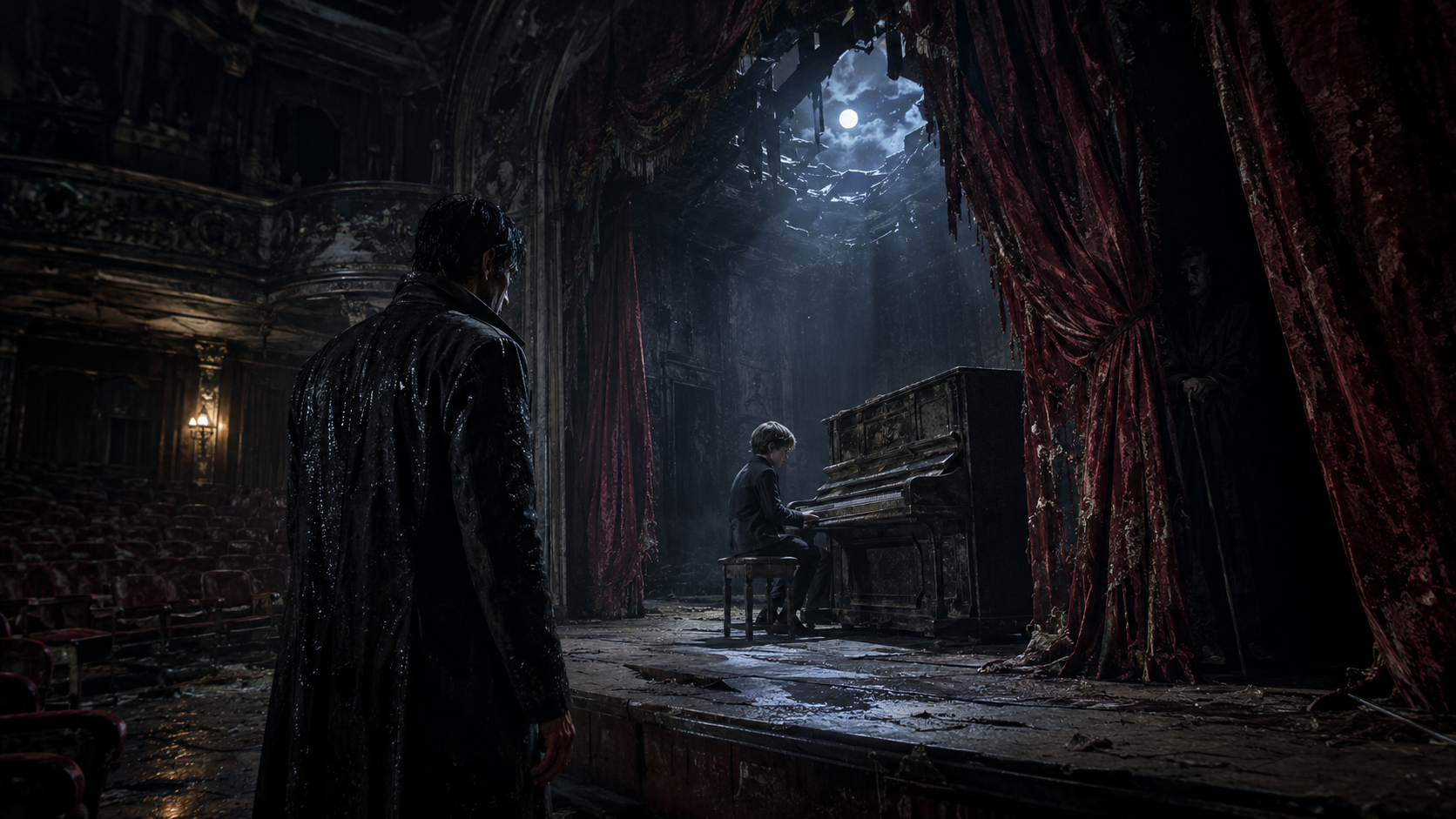
The Boy Who Knew What Lived Behind the Curtain

The Orpheum Theatre had been empty for ten years, yet someone was playing its piano.

The notes drifted through the ruined auditorium one by one—seven soft tones, a pause, and then the same seven tones played backward.

Elian Marr stopped beneath the balcony.

Rainwater slipped from his coat and gathered around his shoes. Above him, torn velvet curtains hung like dried blood. Rows of dusty seats disappeared into darkness, and pale moonlight entered through a hole in the ceiling.

The melody came again.

Seven notes.

A pause.

Seven notes in reverse.

Elian had not heard that sequence since the night his brother died.

“Theo?” he called.

The piano stopped.

His voice traveled across the empty theatre and returned as a whisper.

Elian moved toward the stage. At thirty-eight, he no longer looked like the celebrated illusionist whose face had once appeared outside theatres from Paris to Prague. His dark hair had begun to turn silver near the temples. A thin scar crossed his left palm, and exhaustion had settled permanently beneath his eyes.

Ten years earlier, the Orpheum had burned during the final performance of his career.

Elian had escaped.

His younger brother, Theo, had not.

At least, that was what everyone believed.

Elian climbed the steps beside the orchestra pit.

A small figure sat at the piano.

It was a boy, perhaps eleven or twelve years old, wearing a brown coat several sizes too large. His black hair had been cut unevenly, as though he had done it himself with a pair of kitchen scissors. Mud covered his boots.

He did not turn around.

“Who taught you that melody?” Elian asked.

The boy pressed one key with his index finger.

A low note trembled through the theatre.

“The man who lives behind the curtain.”

Elian looked toward the decaying red curtain at the back of the stage.

“There is no one behind it.”

The boy finally faced him.

His eyes were an unusual shade of gray, almost silver in the moonlight.

“He said you would say that.”

Elian’s stomach tightened.

“Who are you?”

“My name is Jun.”

“How did you get inside?”

Jun ignored the question.

Instead, he removed a copper ring from a cord around his neck and placed it on the piano.

Elian recognized it immediately.

A tiny eight-pointed star had been carved into the metal.

He had made that ring for Theo when they were teenagers. It had been part of their first professional illusion, a trick involving two identical rings that appeared to pass through solid glass.

Theo had been wearing it on the night of the fire.

Elian picked it up.

The copper felt warm.

“Where did you find this?”

“I didn’t find it.”

“Then who gave it to you?”

“The man behind the curtain.”

Elian closed his hand around the ring.

“My brother died here.”

Jun looked past him into the darkness of the auditorium.

“No,” he said quietly. “Your brother learned how to disappear.”

A metallic sound echoed somewhere above them.

Elian turned.

One of the theatre’s side doors had opened.

A narrow beam of white light moved across the seats.

Then a second light appeared.

Jun jumped down from the piano bench.

“We have to go.”

“Who is that?”

“They followed me.”

Two men entered the auditorium. Both wore dark coats and featureless white masks.

One of them raised a flashlight toward the stage.

“There!” he shouted.

Jun ran toward the rear curtain.

Elian grabbed his shoulder.

“That leads to a wall.”

Jun twisted free.

“Only when the theatre wants it to.”

He pulled a brass lever hidden beneath the stage floor.

A section of scenery shifted with a deep wooden groan, revealing a narrow opening behind the curtain.

Jun disappeared through it.

The masked men were already climbing onto the stage.

Elian followed the boy.

The opening closed behind them just as something heavy struck the other side.

They entered a passageway barely wide enough for one person. Its walls were lined with ropes, counterweights, broken pulleys and rusted machinery left from another century.

Jun moved confidently through the darkness.

Elian struggled to keep up.

“How do you know this place?”

“I lived underneath it.”

“That’s impossible.”

Jun stopped.

“You use that word too often.”

A door slammed somewhere behind them.

The masked men had found another entrance.

Jun hurried onward.

The passage descended beneath the stage and opened into a maze of brick tunnels. Faded symbols had been painted on the walls: circles, stars, arrows and human eyes with black lines drawn through them.

Elian touched one of the markings.

“What is this?”

“A route.”

“To where?”

“Everywhere.”

Jun led him through three intersections before entering a chamber filled with old theatre props. There were cracked mirrors, empty cages, artificial trees and wooden boxes once used to make assistants vanish.

Jun closed the door.

For several seconds, neither of them spoke.

Then Elian knelt in front of him.

“You are going to tell me the truth.”

Jun folded his arms.

“You won’t believe me.”

“Try.”

The boy glanced at the copper ring in Elian’s hand.

“The man who gave me that calls himself Silas.”

Elian frowned.

“That isn’t my brother’s name.”

“He said names are dangerous.”

“What does he look like?”

“Tall. Thin. Burn marks on one side of his neck. He walks with a metal cane when the weather is cold.”

Elian felt the room tilt around him.

Theo had broken his left leg when they were children. Years later, the injury still bothered him during winter performances.

Jun continued.

“He knows how to build false rooms. He knows how to make cameras see empty hallways when people are walking through them. He taught me how to listen for hollow walls.”

“Where is he now?”

“In the Lantern House.”

“What is that?”

Jun hesitated.

“A place where people are erased.”

The answer should have sounded childish.

It did not.

Elian stood slowly.

“What do you mean, erased?”

“They take your name first. Then your clothes. Then every photograph they can find. They teach you a new voice and give you a history that never happened. After a while, even you aren’t sure who you were.”

Elian stared at him.

“Who runs this place?”

“A woman named Celeste Vane.”

The name struck him harder than the copper ring.

Celeste Vane was one of the wealthiest patrons of the arts in Europe. She funded museums, hospitals and restoration projects. Her charitable foundation had purchased the Orpheum after the fire.

The theatre was scheduled to reopen the following evening.

Elian had been invited to perform at the gala.

He had returned to refuse.

“Celeste saved this building,” he said.

Jun’s expression did not change.

“She saves buildings because buildings have doors.”

A sound came from the corridor.

Three slow knocks.

Then two quick ones.

Jun went pale.

“They found us.”

Elian looked around the prop room. There was no second exit.

The door handle began to turn.

Jun backed toward a tall wooden cabinet.

“This box,” Elian said. “Get inside.”

Jun opened it and stared at the solid back panel.

“It doesn’t go anywhere.”

“It will.”

Elian pushed him inside, closed the cabinet and pulled a loose rope hanging from the ceiling.

The floor beneath the cabinet dropped six inches.

Ancient gears moved under the boards.

Elian rotated the cabinet, opened a concealed panel in its side and climbed into a second compartment beside Jun.

The outer door burst open.

Flashlights swept through the room.

Elian held a finger to his lips.

A masked man approached the cabinet.

Jun’s breathing became fast and shallow.

The doors opened.

The compartment appeared empty.

The man struck the wooden walls, searching for a hidden panel, but Elian had already released the counterweight. The false interior had rotated silently, carrying them into the wall behind the cabinet.

They crawled through a narrow shaft and emerged in an alley behind the theatre.

Jun looked at Elian with open astonishment.

“You made us disappear.”

“No,” Elian said. “I made them look in the wrong place.”

They spent the rest of the night in a room above a closed tailor’s shop.

The building belonged to Mara Saye, the Orpheum’s former stage manager and the only person Elian still trusted in Port Calder.

Mara was sixty-three, broad-shouldered and unimpressed by nearly everything. She listened to Jun’s story without interrupting, then examined the copper ring through a magnifying glass.

“There’s something inside it,” she said.

She pressed a needle into the star.

The ring separated into two pieces.

A thin strip of photographic film had been rolled inside.

Mara carried it into her darkroom.

Twenty minutes later, an image appeared on a sheet of paper.

It showed a handwritten diagram of the Orpheum. Several rooms had been circled beneath the stage, but one location was marked above the auditorium.

The old pipe organ.

Elian remembered Theo spending hours inside the instrument, repairing pipes and hiding cards for future tricks.

At dawn, they returned to the theatre through an entrance beneath the river wall.

The organ stood behind a decorative screen above the balcony.

Elian removed the center pipe and reached inside.

His fingers touched a metal cylinder.

Within it, he found a miniature audio recorder and a key made of black glass.

Mara turned on the recorder.

Static filled the balcony.

Then a man began to speak.

“Elian, this message is for you.”

Elian gripped the railing.

Time had changed the voice, roughening it and draining away its warmth, but he knew it.

Theo.

“If Jun reached you, then I failed to get him out alone. Listen carefully. The fire was not intended to kill us. It was an audition.”

Elian shut his eyes.

Theo’s recorded voice continued.

“Celeste Vane watched our performances for years. She wanted more than stage tricks. She wanted architects of invisibility—people who could move prisoners, money and witnesses without leaving evidence.”

Mara exchanged a horrified look with Elian.

“They took me after the fire,” Theo said. “They allowed the world to believe I was dead. Since then, I have been building passages beneath theatres, embassies, hotels and private hospitals. The network is called the Lantern House.”

Jun stood perfectly still.

“The children inside the House are trained as living archives. They memorize names, routes, account numbers and faces. Information carried in a child’s memory cannot be found during a search.”

Elian looked at Jun.

The boy lowered his head.

“Jun remembers the entire network,” Theo continued. “That is why Celeste will never stop hunting him.”

A door opened on the recording.

Theo began speaking faster.

“The gala is the only chance. Celeste will bring the House’s senior members together beneath the Orpheum. The black glass key opens the projection chamber. Use the theatre against them.”

A distant voice ordered Theo to step away from the recorder.

Theo whispered one final sentence.

“And Elian—whatever happens, do not trust the applause.”

The recording ended.

That evening, hundreds of guests arrived for the reopening of the Orpheum Theatre.

Black automobiles filled the street. Reporters crowded behind velvet ropes. Politicians, actors, bankers and diplomats entered beneath a restored golden sign.

Elian stood backstage in a black suit.

For the first time in ten years, he wore a magician’s gloves.

Mara adjusted the microphone inside his collar.

“You can still leave,” she said.

“No.”

“You may not find Theo.”

“I know.”

“You may not walk out of here.”

“I know that too.”

Jun appeared from behind a rack of costumes.

He wore a stagehand’s uniform and carried a coil of rope.

Elian shook his head.

“You’re supposed to be with Mara.”

“I know the routes better than either of you.”

“That doesn’t make this safe.”

“Nothing has ever been safe.”

Elian crouched until they were eye to eye.

“Tonight, you do exactly what I tell you.”

Jun considered this.

“Is that how assistants are supposed to behave?”

“No assistant I ever had behaved that way.”

A bell rang.

The audience took their seats.

Celeste Vane walked onto the stage.

She was elegant, silver-haired and dressed in a white gown that reflected the theatre lights. Her voice was calm and generous as she spoke about memory, restoration and giving forgotten places a second life.

The audience applauded.

Elian remembered Theo’s warning.

Do not trust the applause.

He looked upward.

Several people in the private boxes were not clapping. They were watching the exits.

Celeste welcomed Elian back to the stage.

He stepped into the light.

The audience rose.

For a moment, the sound carried him ten years into the past. He saw Theo beside him, smiling as they prepared their final illusion.

Then the memory vanished.

Elian raised one hand.

The theatre became silent.

“For my first illusion,” he said, “I will show you how easily a person can disappear.”

A glass chamber was rolled onto the stage.

Jun entered it wearing a silver mask.

Elian covered the chamber with a cloth.

Beneath the stage, Mara opened a series of hidden gates.

“Most disappearances require three things,” Elian told the audience. “A distraction, a willing witness and a convincing lie.”

Celeste’s smile faded.

Elian pulled away the cloth.

The chamber was empty.

The audience gasped.

At the same instant, Jun emerged inside the projection room above them and inserted the black glass key into a concealed slot.

The theatre lights went out.

Instead of darkness, hundreds of names appeared across the stage curtains—not as written titles, but as enormous projected photographs of missing people.

Faces filled the theatre.

Men, women and children.

Some had been declared dead.

Others had simply vanished.

A murmur spread through the audience.

Recorded voices began playing through the sound system. Account numbers, dates, locations and instructions filled the air.

Celeste turned toward the wings.

“Stop the performance.”

Her guards moved toward Elian.

He threw a flash charge onto the stage.

White light exploded.

When the audience could see again, Elian was gone.

He entered the tunnels below the theatre and found Jun waiting beside an iron door.

“The key opened another route,” Jun said.

Behind the door was a vast underground chamber.

Dozens of people stood inside.

Some wore evening clothes. Others wore gray uniforms. Armed guards surrounded a long table covered with documents and communication equipment.

At the far end of the room stood a thin man with a metal cane.

Burn scars climbed the left side of his neck.

Elian forgot how to breathe.

“Theo.”

The man looked up.

For ten years, Elian had imagined this moment in dreams. In some, Theo accused him of leaving him behind. In others, he vanished before Elian could reach him.

But now Theo simply smiled.

“You took your time.”

Elian crossed the room and embraced him.

Theo’s body felt frighteningly light, but he was real.

A gun clicked behind them.

Celeste stood at the entrance.

Her white gown was stained with dust from the tunnels.

“Step away from him,” she said.

Elian moved in front of Jun.

Celeste looked at the boy.

“You have something that belongs to me.”

“My name belongs to me,” Jun replied.

“You were given that name three weeks ago.”

Jun’s confidence faltered.

Celeste smiled.

“Did Silas never explain? Jun is not your real name. You have had six names since entering the House.”

Theo tightened his grip on his cane.

“Leave him alone.”

“You taught him to escape.”

“I taught him to choose.”

Celeste raised the gun.

“And what did choice give you? Ten years in a basement and a brother who built a career from your death?”

Elian stared at Theo.

“What does she mean?”

Celeste’s eyes brightened.

“He never told you?”

“Theo,” Elian said.

A low vibration moved through the floor.

Mara had activated the theatre’s ancient machinery.

Theo struck his cane against a metal plate.

The walls around them began to shift.

Celeste fired.

The bullet hit a moving panel.

Mirrors rotated out of the walls, filling the chamber with dozens of reflections. Guards shouted as Elian, Theo and Jun appeared to run in every direction.

Elian threw his voice across the room.

“Left side!”

The guards turned left.

Jun crawled beneath the table and disconnected the communication equipment.

Theo opened a hidden gate.

The prisoners rushed toward the exit.

Celeste fired again.

Elian stepped behind a mirror, crossed through a narrow frame and emerged beside her.

He caught her wrist.

They struggled at the edge of an open trapdoor.

“You think this ends with me?” Celeste whispered.

“No,” Elian said. “It begins with everyone hearing you.”

He tapped the microphone inside his collar.

Every word had been transmitted into the auditorium above.

Celeste looked toward the ceiling.

The audience was no longer applauding.

They were listening.

By sunrise, the Orpheum was surrounded by investigators, journalists and emergency vehicles. The rescued prisoners were taken to safety. Documents from the underground chamber exposed a network operating across several countries.

Celeste Vane was led from the theatre in handcuffs.

She showed no fear.

As she passed Elian, she leaned close enough for only him to hear.

“Ask your brother why he chose you.”

Theo was waiting on the stage.

Morning light illuminated the empty auditorium.

Jun sat at the piano, playing random notes with one hand.

Elian approached Theo.

“What did she mean?”

Theo looked older than he had beneath the theatre.

“Elian, there are things I wanted to tell you.”

“Tell me now.”

Theo removed a small key from inside his cane.

It opened a storage room beneath the orchestra pit.

Inside were shelves filled with personal records taken from the Lantern House.

Theo found a gray box and placed it on a table.

The label read:

ELIAN MARR
SUBJECT EIGHT

Elian stared at it.

“That’s not possible.”

Theo opened the box.

Inside were photographs of a six-year-old boy living in a white room without windows.

The boy was Elian.

There were psychological reports, lists of invented memories and recordings of unfamiliar adults teaching him the names of parents who had never existed.

Elian turned toward Theo.

“Our childhood…”

“Parts of it were real.”

“Parts?”

“You arrived at my family’s house when you were seven. My parents were told you had survived an accident.”

“You said you remembered me as a baby.”

“I was told to say that.”

Elian stepped back.

The theatre seemed to move around him.

“Why?”

Theo’s eyes filled with tears.

“Because I was assigned to make you believe you belonged somewhere.”

“You were assigned?”

“I was twelve. They promised they would hurt you if I refused.”

Jun stopped playing the piano.

Elian looked through the photographs again.

In the final image, the six-year-old version of himself stood beside a woman in a dark uniform.

Her face had been partially cut from the photograph.

Only her hand remained visible.

She wore a copper ring marked with an eight-pointed star.

Elian slowly removed Theo’s ring from his pocket.

They were identical.

On the back of the photograph, someone had written a sentence:

Subject Eight remembers the doors.

Elian looked toward the stage curtain.

A cold breeze moved through the theatre.

For a fraction of a second, he remembered a white hallway.

A locked room.

A woman’s voice asking him to choose the correct door.

Then the memory disappeared.

Across the auditorium, one of the private-box curtains shifted.

A woman stood behind it.

She wore black gloves and watched Elian without moving.

Before he could call out, the theatre lights flickered.

The private box became dark.

When the lights returned, the woman was gone.

On the piano beside Jun lay a second copper ring.

And from somewhere deep beneath the theatre, seven notes began to play.

A pause followed.

Then the same seven notes returned in reverse.

The Boy Who Knew What Lived Behind the Curtain
What to do if you are attacked by a dog: 5 important tips