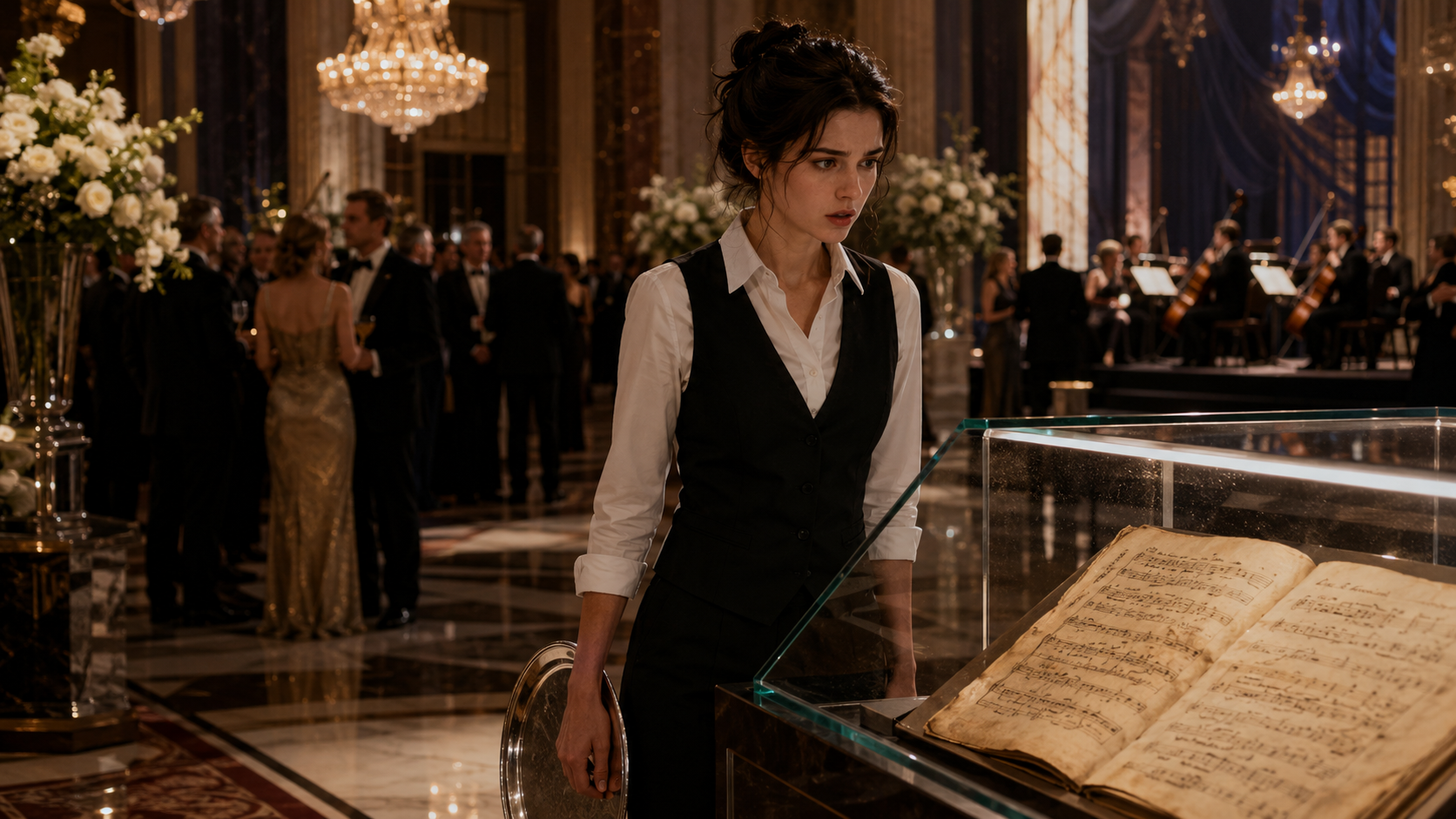
The first wrong note appeared at exactly nine seventeen.
Almost no one in the Bellwether Ballroom noticed it.
The guests were too busy admiring one another beneath the crystal chandeliers. Politicians compared invitations. Investors spoke in lowered voices about acquisitions. Women in silk gowns raised glasses beneath clouds of white winter flowers. Photographers moved between the tables, capturing diamonds, handshakes, and practiced smiles.
But Lena Marlowe heard the mistake immediately.
She stopped beside a table of empty dessert plates, balancing a silver serving tray against her shoulder.
On the stage, a twelve-piece chamber orchestra continued rehearsing the music that would open the midnight auction. The melody was elegant and melancholy, rising slowly through the violins before passing into the deeper voices of the cellos.
Then the second violin entered one beat too early.
Lena’s fingers tightened around the tray.
“Measure forty-three,” she whispered.
The orchestra continued.
The conductor frowned but did not stop them. Perhaps he had not heard it. Perhaps he had heard it and decided the error was too small to matter during a private rehearsal.
To Lena, it mattered.
Every note mattered.
She carried the tray through the ballroom, placed the plates inside the service station, and forced herself to keep moving.
She had accepted the banquet shift for one reason only.
At midnight, the Bellwether Arts Trust planned to auction the original handwritten score of a forgotten symphony called Dawn Over Ashwater. According to the gala catalogue, the work had been composed thirty years earlier by Celeste Crane, the late wife of industrialist Victor Crane.
The manuscript was expected to sell for more than two million dollars.
The proceeds would fund a new concert hall bearing the Crane family name.
There was only one problem.
Celeste Crane had not written the symphony.
Lena’s mother had.
The manuscript was displayed inside a glass case near the ballroom entrance. Lena had already passed it six times while carrying trays of champagne.
Each time, she had seen her mother’s handwriting.
The narrow musical symbols.
The long tails on the eighth notes.
The tiny circles drawn around passages that needed revision.
Even the faded blue stain in the lower corner of the first page was familiar. Lena had caused it when she was seven years old by knocking over a cup of paint beside her mother’s piano.
She remembered crying.
Her mother, Miriam, had laughed and kissed the top of her head.
“Now the music has a little piece of you in it,” she had said.
Twenty-three years later, that same stain sat beneath museum glass while wealthy strangers praised the generosity of the Crane family.
“Server.”
The sharp voice came from behind her.
Lena turned.
Damian Crane stood beside the display case.
He was Victor Crane’s only son and the public face of the family foundation. His tailored tuxedo fit perfectly. His dark hair had been arranged to appear effortless. A television presenter stood at his side, holding a microphone while a cameraman adjusted his position.
Damian looked at the empty glasses on Lena’s tray.
“Table twelve has been waiting for champagne.”
“I’ll take care of it.”
His attention shifted to the manuscript.
“You’ve been staring at this all evening.”
Lena said nothing.
Damian smiled toward the camera.
“She probably thinks sheet music is decorative handwriting.”
The presenter gave a polite laugh.
Lena looked through the glass at the first page.
“The tempo marking has been changed.”
Damian’s smile weakened.
“What?”
“The original marking was andante con memoria. Slowly, with memory. Someone crossed out the final two words.”
The presenter lowered her microphone slightly.
Damian studied Lena as though she had performed a trick at his expense.
“And how would a banquet server know that?”
“Because whoever edited the catalogue misunderstood the piece.”
He glanced toward the cameraman.
“Turn that off.”
The cameraman obeyed.
Damian stepped closer to Lena.
“You are here to carry drinks, not offer opinions about my family’s collection.”
“It isn’t your family’s collection.”
His expression became still.
The music from the stage continued behind them.
“You should be careful,” he said quietly.
“So should anyone selling something that does not belong to them.”
Damian’s eyes narrowed.
Before he could answer, Lena’s supervisor hurried across the ballroom.
Saira Patel had managed hotel events for fifteen years. She rarely appeared frightened by anyone, but the color had drained from her face.
“Mr. Crane, is there a problem?”
“Your employee seems confused about her responsibilities.”
Saira turned to Lena.
“Please return to the service corridor.”
“I need five minutes.”
“You need to do as your supervisor says,” Damian replied.
Lena looked at him.
“My mother wrote that symphony.”
For the first time, Damian had no immediate answer.
The presenter stared at Lena. The cameraman slowly raised his camera again.
Damian noticed and pointed toward the exit.
“Both of you, leave.”
Then he turned back to Lena.
“Your mother?”
“Miriam Marlowe.”
The name seemed to reach someone on the stage.
An elderly cellist stopped playing.
The music collapsed around him.
The conductor struck his music stand with the baton.
“Mr. Brand?”
The cellist rose slowly from his chair.
His name was Theodore Brand. He had performed with major orchestras for nearly five decades. Lena knew his face from old photographs stored inside a cardboard box beneath her childhood bed.
Theodore stepped off the stage.
“Who said Miriam Marlowe?”
Lena’s throat tightened.
“I did.”
He approached her, studying her face.
Then his eyes widened.
“You’re Lena.”
She nodded.
Theodore covered his mouth with one hand.
“I haven’t seen you since your mother’s funeral.”
Damian moved between them.
“Mr. Brand, this employee is making an absurd accusation.”
Theodore ignored him.
He looked through the glass case at the manuscript.
“Where did this come from?”
“My father purchased it legally,” Damian said. “It was found among my mother’s private papers after her death.”
Theodore leaned closer to the glass.
“That is Miriam’s handwriting.”
Several musicians left the stage and gathered nearby.
The guests began noticing the disturbance. Conversations faded. Heads turned. Phones appeared.
Damian’s father stood near the center table.
Victor Crane was nearly seventy, with silver hair and the tired posture of a man who had spent decades pretending that control and peace were the same thing.
He approached the display.
“What is happening?”
Damian spoke before anyone else could.
“A member of the hotel staff claims Mother stole the auction manuscript.”
Lena faced Victor.
“Did your wife ever tell you where she found it?”
Victor looked at the score.
“She said it had been given to her by a composer who wished to remain anonymous.”
“My mother never met your wife.”
“You cannot possibly know that.”
“I was there when my mother wrote every movement.”
Damian laughed.
“You would have been a child.”
“I was.”
“That is not evidence.”
“No,” Lena said. “But the music is.”
Damian turned to Saira.
“Remove her.”
Saira hesitated.
Theodore stepped beside Lena.
“Do not touch her.”
Damian’s face hardened.
“This is my family’s event.”
“No,” said a new voice. “It is the foundation’s event.”
Dr. Beatrice Wynn, chairwoman of the Bellwether Arts Trust, emerged from the crowd. She was small, silver-haired, and dressed in a dark green gown. Unlike the other guests, she wore no jewelry.
She looked at Lena.
“You believe you can prove authorship through the music?”
“Yes.”
“How?”
Lena pointed toward the stage.
“Let the orchestra play the fourth movement.”
The conductor shook his head.
“We have not rehearsed it. The final pages are incomplete.”
“They are not incomplete.”
He frowned.
“The manuscript ends in the middle of the coda.”
“That is because those are not the final pages.”
Damian folded his arms.
“And I suppose you conveniently know the missing ending.”
Lena met his eyes.
“I do.”
The ballroom became silent.
Dr. Wynn considered her for several seconds.
“Take the stage.”
Damian turned toward her.
“You cannot be serious.”
“The manuscript is being sold under the authority of this foundation. If its provenance is being challenged, we have a duty to investigate.”
“By allowing a waitress to conduct an orchestra?”
Lena removed her black service jacket.
Underneath, she wore the hotel’s plain white shirt.
“I don’t need anyone to believe me before I begin.”
She placed the jacket over a chair.
“I only need them to listen.”
Lena walked toward the stage.
Every step awakened a memory.
Her mother at the piano before sunrise.
Her mother writing music at the kitchen table because the apartment was too cold in the practice room.
Her mother conducting an imaginary orchestra with a wooden spoon while soup boiled on the stove.
Her mother coughing into a handkerchief and hiding the blood before Lena could see it.
After Miriam died, unpaid medical bills consumed everything the family owned. The piano was sold. The apartment was emptied. Boxes of manuscripts disappeared after the storage company auctioned their belongings.
Lena had been sixteen.
For years, she believed the symphony had been destroyed.
Then, six weeks earlier, she saw a photograph of the Bellwether auction catalogue.
The blue stain was visible in the corner.
She applied for a temporary position at the hotel the following morning.
Lena reached the conductor’s podium.
The musicians watched her with uncertainty.
Theodore returned to his cello.
“Begin at the final variation,” she told the orchestra.
The conductor did not move.
Dr. Wynn called from the floor.
“Maestro, give her your baton.”
Reluctantly, he handed it to Lena.
It felt lighter than she expected.
Her mother had never owned a real conductor’s baton. She had used pencils, knitting needles, wooden spoons, and once a rolled-up electricity bill.
Lena lifted her arms.
“Cellos alone for the first four measures. Violas enter beneath them. The violins should sound distant, almost like something being remembered incorrectly.”
The musicians exchanged glances.
Then Theodore placed his bow against the strings.
The first note filled the ballroom.
Low.
Warm.
Uncertain.
The violas joined.
Lena’s hands moved without hesitation. The orchestra responded slowly at first, then with growing confidence. A melody unfolded through the room, fragile as a voice traveling across water.
People lowered their glasses.
Waiters stood motionless beside the walls.
Kitchen staff watched through the service doors.
Lena guided the music toward the unfinished passage.
The melody climbed.
The violins reached the final written measure.
Then the orchestra stopped.
The silence that followed felt like the edge of a cliff.
Lena lowered the baton.
“This is where the auction manuscript ends,” she said.
Damian called from the floor.
“Because the composer never finished it.”
“My mother finished it eleven years before she died.”
“Then where are the pages?”
“She never wrote them down.”
A murmur moved through the guests.
Damian smiled.
“So there is no proof.”
“The ending was a promise between us.”
Lena turned toward the orchestra.
“When I was a child, I was afraid of thunderstorms. My mother created a melody to calm me. Four notes descending, three notes rising. She hid that melody throughout the symphony.”
Theodore’s eyes filled with recognition.
“I remember,” he said. “She called it the lantern theme.”
Lena nodded.
“She told me the symphony could not end until the lantern found its way home.”
She raised the baton again.
“Follow me.”
The orchestra waited.
Lena breathed in.
Then she began to conduct the unwritten coda.
The cellos introduced the four descending notes.
The violins answered with three rising notes.
Woodwinds carried the melody upward. The harmony widened, growing brighter with each repetition. What had begun as a private lullaby became a storm of sound.
Lena heard the music exactly as her mother had imagined it.
She remembered sitting beneath the piano while Miriam played.
She remembered her mother saying that music was not a monument built for important people.
It was a door.
Anyone could walk through it.
The orchestra reached the final progression.
Lena gave the signal.
Every instrument joined the lantern theme.
The sound filled the ballroom with such force that the glass pendants of the chandeliers trembled.
Then Lena closed her fist.
The final note vanished.
No one moved.
Theodore was the first to stand.
He placed his cello beside the chair and began applauding.
The other musicians followed.
Then the hotel employees near the service doors.
Then the guests.
Within seconds, the entire ballroom was on its feet.
Lena remained on the podium, holding the baton at her side.
Damian was not applauding.
“A performance proves nothing,” he said.
Theodore turned toward him.
“It proves she knows music that was never included in your manuscript.”
“She could have invented that ending.”
“She did not.”
Theodore opened his cello case and removed a yellow envelope.
“I brought this tonight because I believed the auction catalogue contained an error. I did not realize the error was deliberate.”
He carried the envelope to Dr. Wynn.
Inside were three photographs, an old rehearsal programme, and a small cassette tape.
The first photograph showed Miriam Marlowe sitting at a piano.
On the stand before her was the first page of the symphony.
The blue stain was clearly visible.
The second showed Theodore and Miriam rehearsing the fourth movement.
The third showed a teenage Lena asleep beneath the piano while her mother wrote music above her.
The rehearsal programme listed the work under its original title:
The Lantern Sea, composed by Miriam Marlowe.
Theodore held up the cassette.
“This is a recording of our final rehearsal. Miriam speaks at the beginning. She explains the lantern theme and says the completed work belongs to Lena.”
Victor Crane sat down heavily.
Everyone looked at him.
Damian approached his father.
“Say something.”
Victor stared at the manuscript.
After a long silence, he spoke.
“Celeste bought several boxes at an estate auction many years ago. She found the score inside one of them.”
Lena stepped down from the podium.
“Why is her name on it?”
Victor closed his eyes.
“She admired the work. She planned to donate it anonymously.”
Damian interrupted.
“My mother is not here to defend herself.”
Victor looked at his son.
“Your mother never claimed she composed it.”
The words struck the room harder than a shout.
Damian’s face changed.
Victor continued.
“The attribution was added this year.”
Dr. Wynn turned toward Damian.
“By whom?”
He said nothing.
She repeated the question.
“By whom, Mr. Crane?”
Damian looked around the ballroom. Cameras were recording. Donors whispered to one another. Members of the trust board stepped away from him.
Finally, he answered.
“My office prepared the catalogue.”
Victor stared at his son.
“You knew?”
“I knew there were questions about the manuscript.”
“You placed your mother’s name on another woman’s work.”
“I was protecting the family.”
“No,” Lena said. “You were protecting a story that made your family look generous.”
Damian faced her.
“You have no idea what it takes to maintain an institution like this.”
“I know exactly what it costs when institutions decide some names matter more than others.”
Dr. Wynn closed the auction catalogue.
“The sale is cancelled.”
Damian took a step toward her.
“You cannot do that.”
“I just did.”
She instructed security to seal the manuscript case and transfer it to independent conservators.
Then she addressed the guests.
“The Bellwether Arts Trust will conduct a formal provenance investigation. Until it is complete, the Crane family will have no authority over the collection or tonight’s funds.”
Damian looked toward his father.
Victor did not defend him.
One by one, members of the board removed the small gold Crane Foundation pins from their clothing and placed them on the nearest table.
Damian walked toward the ballroom doors.
Lena called after him.
He stopped.
“You spoke to me as though my uniform told you everything about my life,” she said. “Even if my mother had never written a note, you would still have been wrong to treat me that way.”
Damian opened his mouth.
No answer came.
He left the room.
The clock above the entrance showed eleven fifty-eight.
Dr. Wynn approached Lena.
“At midnight, we were supposed to announce the construction of the Crane Concert Hall.”
Lena looked toward the hotel workers gathered beside the service doors.
“What will you announce instead?”
“I was hoping you might tell me.”
Lena thought about her mother.
Miriam had spent her life composing between temporary jobs. She taught children whose parents could not afford lessons. She wrote music in borrowed rooms. She died believing that her greatest work would never be heard.
Lena looked at the manuscript beneath glass.
“Do not build another hall with a wealthy person’s name on it.”
The room remained quiet.
“Use the money to find artists whose work has been lost, stolen, or ignored. Restore their names. Pay for instruments. Pay for rehearsal rooms. Pay people while they create, so they do not have to choose between art and rent.”
Dr. Wynn smiled.
“That sounds less like a building.”
“It sounds more useful than one.”
The grandfather clock began to strike midnight.
Dr. Wynn walked onto the stage and took the microphone.
She announced that the auction had been cancelled. She promised an independent investigation and the immediate return of the manuscript to Miriam Marlowe’s estate.
Then she revealed the creation of the Lantern Archive, a programme dedicated to recovering misattributed work and supporting artists from families without institutional influence.
The first recovered composition would be The Lantern Sea.
The first public performance would take place in three months.
Admission would be free.
Dr. Wynn invited Lena to lead the project.
Lena accepted one condition.
Every hotel employee who had worked the gala would be invited to the premiere as an honored guest.
Not through the service entrance.
Not in the upper balcony.
Through the front doors.
The applause that followed was louder than anything the auction organizers had planned.
At two in the morning, after the donors and photographers had gone, the Bellwether Ballroom looked entirely different.
The expensive flowers remained, but the formal table arrangements had disappeared.
Cooks sat beside violinists.
Dishwashers ate cake beneath the chandeliers.
Housekeepers drank coffee from porcelain cups.
Security guards tested the acoustics by clapping at different corners of the room.
Lena sat at the grand piano with Theodore beside her.
Saira approached carrying two plates of untouched chocolate dessert.
“I suppose this means you are quitting,” she said.
Lena smiled.
“Not tonight.”
She played the four descending notes of the lantern theme.
Theodore answered by singing the three rising notes badly and without embarrassment.
The people around them laughed.
Then Lena began again.
This time, the room joined her.
Some hummed.
Some sang.
Some simply listened.
Outside, snow drifted between the buildings.
Inside, the music no longer belonged to the family with the largest donation, the most influential friends, or the most impressive name.
It belonged to the woman who had written it.
It belonged to the daughter who remembered it.
And for the first time in thirty years, the lantern found its way home.