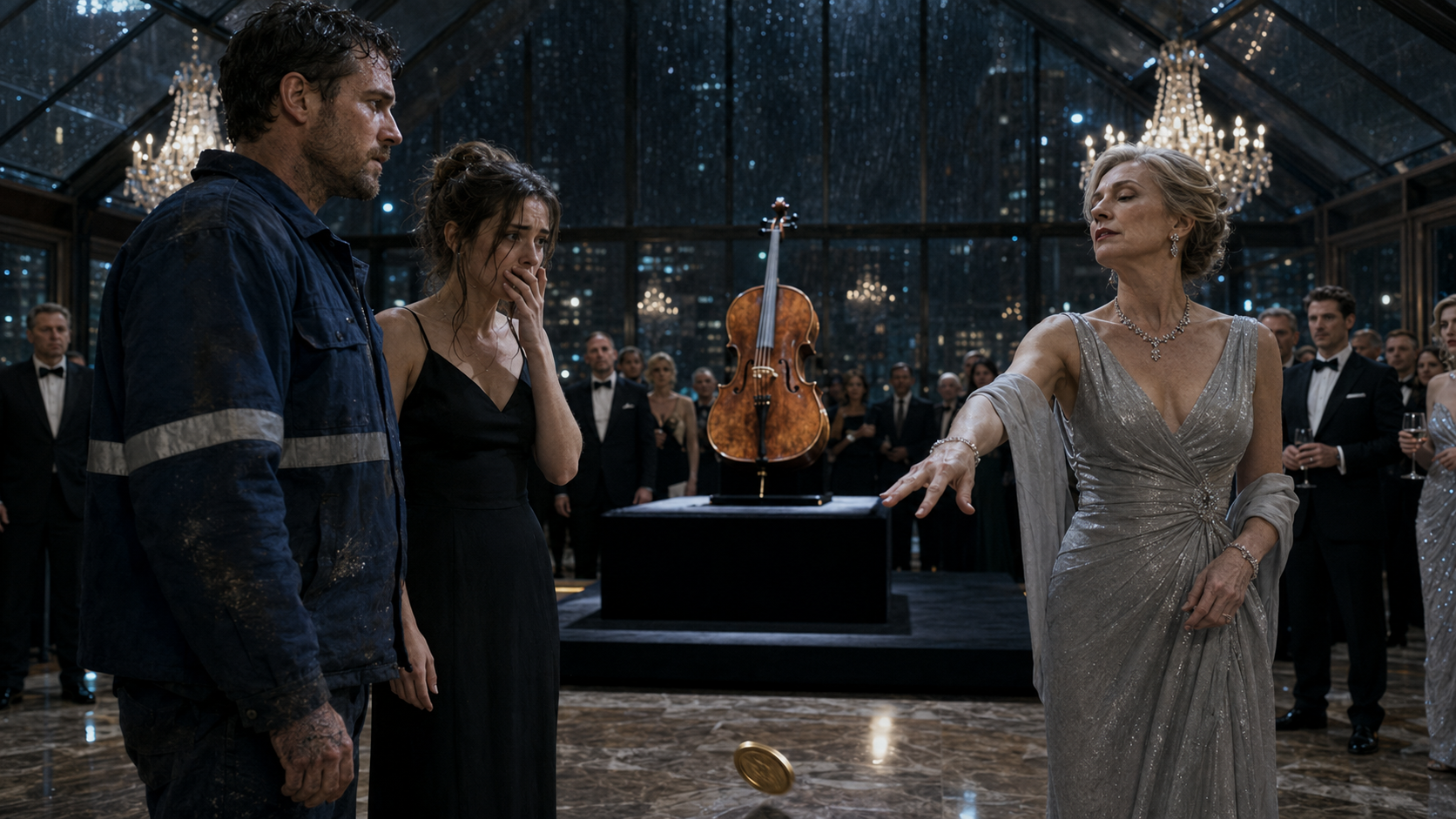
Rain hammered the glass roof of the Aurelia Conservatory, turning the city lights above it into rivers of gold and silver.
Inside, however, nothing looked touched by the storm.
Crystal chandeliers floated over a ballroom filled with politicians, collectors, celebrities, and heirs to fortunes old enough to have their own legends. Waiters moved silently between the guests, carrying narrow glasses of champagne. A string quartet played beneath a wall of white orchids while cameras followed anyone whose name might appear in tomorrow’s society pages.
At the center of the ballroom stood a circular platform covered in black velvet.
Resting upon it was a cello.
Its dark wooden body shone under the lights. Fine silver lines curled around its edges, and a small sun had been carved beneath the bridge.
The auction catalogue described it as an anonymous eighteenth-century masterpiece.
Mara Solis knew better.
“That’s my father’s cello,” she whispered.
Beside her stood Elias Reed, still wearing the navy work jacket from his evening shift. A reflective stripe crossed his chest. Rain darkened his shoulders, and a faint streak of machine grease marked one sleeve.
He looked more prepared to repair a subway signal than attend the most exclusive charity auction in the city.
“Are you certain?” he asked.
Mara stared at the carved sun.
“He made that mark himself. He said every instrument needed one secret that belonged only to its maker.”
Her voice trembled.
The cello had disappeared eleven years earlier, shortly after her father died. Mara had been seventeen. Creditors had emptied his workshop, and a private dealer had purchased most of the remaining instruments before she even understood what was happening.
She had spent years searching.
Then, three days ago, the Aurelia Foundation announced the cello as the final attraction of its annual auction.
Mara had received an invitation from an unknown sender.
Elias had insisted on coming with her.
“You should have changed clothes,” she said quietly.
“I came straight from work.”
“You knew what kind of people would be here.”
“I know exactly what kind of people are here.”
Mara studied him.
Elias worked nights maintaining the automated rail system beneath the eastern district. He rarely discussed his past. He lived in a small apartment above a bakery, fixed broken radios for his neighbors, and refused to buy anything he could repair.
He had never appeared uncomfortable around wealth.
He simply seemed uninterested in it.
A woman in a silver evening gown turned toward them.
Her name was Vivienne Kade, president of the Aurelia Foundation and host of the auction. Diamonds circled her throat, and her white hair was cut with geometric precision. Two younger women stood beside her, both holding champagne and watching Mara with theatrical curiosity.
Vivienne’s gaze traveled slowly from Mara’s plain black dress to Elias’s wet work jacket.
“I’m afraid the service entrance is downstairs,” she said.
Elias looked behind him.
“I don’t see any service workers.”
One of the younger women laughed into her glass.
Vivienne’s smile tightened.
“I was speaking to you.”
“So was I.”
Mara touched Elias’s arm.
“We’re invited guests.”
Vivienne lifted one eyebrow.
“Guests?”
Mara opened her small handbag and produced the ivory invitation. Vivienne glanced at it but did not take it.
“How fascinating,” she said. “We sent those only to donors, collectors, and patrons.”
“Then perhaps your office made an exception.”
“My office does not make exceptions.”
Several nearby guests had begun listening.
The younger woman in emerald earrings whispered, loudly enough to be heard, “Maybe they found it on the pavement.”
Her companion giggled.
Mara’s face flushed.
Elias remained still.
Vivienne stepped closer to him.
“What exactly do you do?”
“I keep trains from crashing.”
The young women laughed again.
Vivienne reached into a small jeweled purse and removed a round golden cloakroom token.
“You must be exhausted,” she said. “Why don’t you take the evening off?”
She flicked the token toward Elias.
It struck his jacket, fell onto the marble floor, and rolled in a wide circle between the guests.
The quartet continued playing for several seconds before the first violinist noticed the silence in the room.
The music stopped.
The token spun beneath the chandelier.
Vivienne smiled.
“There,” she said. “Perhaps that will cover your journey home.”
Someone raised a phone.
Then another.
Mara stepped forward, but Elias gently caught her hand.
“Don’t,” he said.
The token wobbled and fell flat.
Vivienne waited for him to pick it up.
Instead, Elias looked toward the cello.
“How did you acquire that instrument?” he asked.
Vivienne’s expression changed almost imperceptibly.
“The foundation received it from a private European collection.”
“Which collection?”
“That information is confidential.”
“Was its ownership history independently verified?”
A nervous murmur passed through the crowd.
Vivienne gave a short laugh.
“You repair railway cables, Mr…?”
“Reed.”
“Mr. Reed. I doubt you understand the complexities of international art ownership.”
“I understand shipping records.”
“That is hardly the same thing.”
“Sometimes it is exactly the same thing.”
The ballroom doors opened.
A tall man wearing a dark suit entered with two uniformed officers. Behind them came a woman carrying a silver evidence case.
The guests turned.
Vivienne’s smile disappeared.
The man in the suit approached Elias first.
“Mr. Reed,” he said. “We recovered the final ledger.”
Vivienne stared at him.
The man continued.
“It matches the warehouse manifests, the insurance claims, and the foundation’s private acquisition records.”
One of the guests lowered his champagne glass.
Another stopped recording.
Vivienne spoke sharply.
“Who allowed these people inside?”
The man showed his identification.
“Financial Crimes Division.”
For the first time that evening, the confidence left Vivienne’s eyes.
Elias bent down and picked up the golden token.
He examined it under the chandelier.
On one side was the Aurelia Foundation’s emblem.
On the other was a serial number.
“Interesting,” he said.
“What?” Mara asked.
“This isn’t a cloakroom token.”
The investigator took it from him and placed it in a transparent evidence pouch.
“It belongs to the foundation’s private storage facility,” he explained. “These tokens are issued to authorized warehouse visitors.”
Vivienne’s face became pale.
The young woman with emerald earrings quietly stepped away from her.
Mara looked from the evidence pouch to the cello.
“What is happening?”
Elias faced her.
“Your father’s instrument wasn’t sold to pay his debts.”
Mara stopped breathing.
“It was removed from his workshop before the legal inventory began,” Elias continued. “The auction documents were forged later.”
“Who took it?”
He looked at Vivienne.
No one laughed now.
Mara shook her head.
“You knew?”
“I suspected.”
“For how long?”
“Since I saw the photograph in the auction announcement.”
“And you didn’t tell me?”
“I needed proof before I gave you hope.”
Vivienne recovered enough composure to straighten her shoulders.
“This is absurd. The foundation has handled thousands of donations. I cannot personally verify every object that passes through our facilities.”
The investigator opened the silver case.
Inside were several folders, two encrypted drives, and a stack of photographs.
“You personally approved the transfers,” he said. “You also received payments through three consulting companies.”
Vivienne turned toward the ballroom.
“My attorneys will address this misunderstanding.”
“They’re welcome to try.”
She looked at Elias again.
“You arranged this?”
“Part of it.”
“Who are you?”
A distant mechanical sound came from above them.
The glass roof began to open.
Rain-cooled air swept into the ballroom as the panels separated. Guests looked upward. Beyond the roof, a black rescue helicopter descended toward the private landing platform.
Its rotors sent water streaming across the glass.
Vivienne watched it in disbelief.
The helicopter bore the emblem of Northline Emergency Systems, the company responsible for medical transport, disaster communications, and rail safety networks across six countries.
Its founder had never appeared in interviews.
He had never attended award ceremonies.
Newspapers used an outdated university photograph whenever they mentioned him.
Mara slowly turned toward Elias.
“No,” she whispered.
He looked almost embarrassed.
A woman in a flight jacket entered through the rooftop corridor.
“Elias, the board is connected,” she said. “Oslo, Montreal, and Singapore are waiting. The transport ministry also wants your report before midnight.”
Mara stared at him.
“You own Northline?”
“I started it.”
“You told me you repaired train systems.”
“I do repair train systems.”
“You let me believe you were a maintenance worker.”
“I am a maintenance worker.”
“You are also a billionaire.”
Elias glanced around the ballroom.
“That part has never been particularly useful.”
Despite everything, Mara gave a breathless, disbelieving laugh.
Vivienne took a step backward.
“You came here disguised.”
“No,” Elias said. “I came here directly from my job.”
The answer landed harder than an accusation.
He walked to the auction platform and stopped beside the cello.
“The Aurelia Foundation sold stolen instruments through charity auctions,” he said. “The buyers received impressive tax documents. The foundation received clean money. Families like Mara’s were told their property had disappeared into bankruptcy sales.”
Vivienne’s voice sharpened.
“You have no idea what you’re destroying.”
“I know exactly what I’m ending.”
The ballroom doors opened again.
This time, more than a dozen people entered.
An elderly violinist walked with a cane. A young man carried a faded photograph of a trumpet. A mother held the hand of a little girl whose grandfather’s harp had vanished from a conservatory during a renovation.
They were families of musicians, craftsmen, teachers, and collectors.
People whose stolen instruments had passed through Aurelia warehouses.
Elias looked at them before turning back to the crowd.
“Every recovered instrument will be returned,” he said. “When the original owner is gone, it will go to the family. When no family can be found, it will be placed in a public music program under the owner’s name.”
The room remained silent.
Mara approached the cello.
Her fingers hovered over the carved sun but did not touch it.
“My father built this during the last year of his life,” she said. “He wanted me to perform with it.”
“Then you should,” Elias replied.
“I haven’t played in years.”
“That doesn’t mean the music is gone.”
The investigator signaled to the officers.
They moved toward Vivienne.
She looked at the guests who had praised her only minutes earlier.
None of them met her eyes.
As an officer reached for her arm, Vivienne looked at Elias with pure hatred.
“You think returning a few old instruments makes you noble?”
“No.”
He took the golden token from the evidence pouch after the investigator photographed it.
Then he placed it carefully in Vivienne’s palm.
“It only makes them returned.”
Her fingers closed around it automatically.
The officers led her away.
Outside, the rain began to weaken.
The first pale line of morning appeared beyond the city towers.
Mara sat on the edge of the auction platform and lifted the cello between her knees. The strings were old, and the bow needed restoration, but when she drew it across them, a low, imperfect note filled the ballroom.
It trembled through the chandeliers.
It moved across the marble.
It silenced every whispered excuse.
Mara played a second note.
Then a third.
Elias stood nearby in his wet railway jacket, listening.
The guests who had mocked his clothes now watched him with uncertainty, wondering how much he had heard, how much he knew, and whether their own names might be hidden somewhere in the recovered ledgers.
Elias did not look at them.
He looked only at Mara.
“Why didn’t you tell me who you were?” she asked when the final note faded.
He thought for a moment.
“Because everyone behaved differently when they knew.”
“And now?”
“Now you know.”
Mara studied his tired face, the grease on his sleeve, and the rainwater still shining on his shoulders.
She reached down, took his rough hand, and placed it against the carved wooden sun.
“My father used to say an instrument remembers every hand that protects it.”
Elias smiled.
“Do you believe that?”
“I do now.”
Behind them, the glass roof closed slowly over the waking city.
The chandeliers dimmed.
The cameras were lowered.
And for the first time in eleven years, the cello was no longer an auction item, an investment, or a secret locked inside a warehouse.
It was home.

