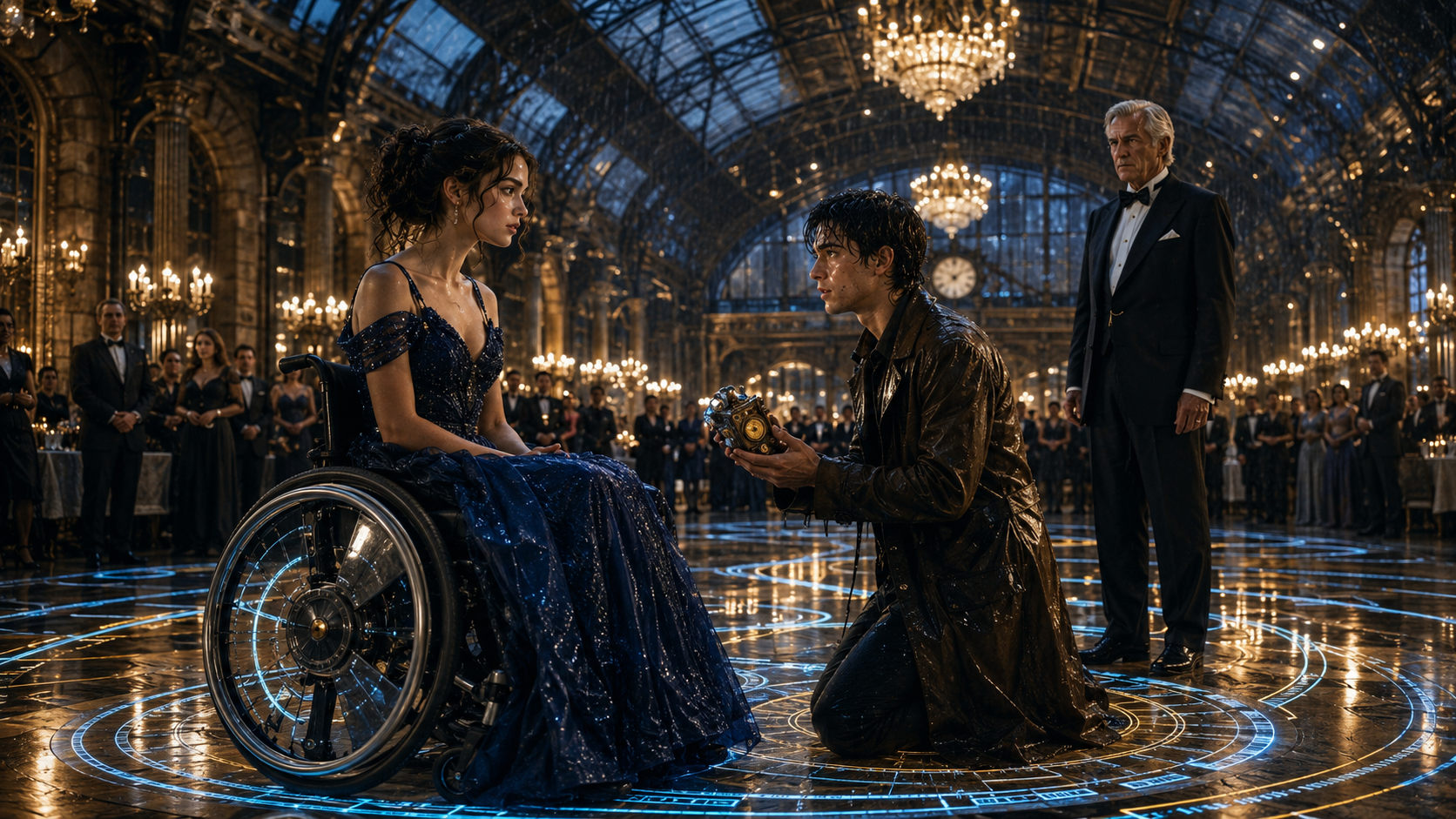
By the time the orchestra began its first waltz, Meridian Hall no longer looked like an abandoned railway station.
Thousands of candles glowed beneath the restored glass roof. White roses climbed the iron columns, crystal chandeliers hung above the old platforms, and waiters moved through the crowd carrying silver trays of champagne.
Politicians, actors, investors, and heirs had gathered to celebrate the launch of the Sterling Foundation’s newest project: a revolutionary mobility system known as Aster One.
At the center of the ballroom sat seventeen-year-old Mira Sterling.
Her midnight-blue dress had been designed to fall perfectly around her wheelchair. Tiny silver threads shimmered across the fabric whenever she moved, making her look as though she were wrapped in a piece of the night sky.
Guests stopped beside her every few minutes.
They praised her courage.
They told her she was inspiring.
They spoke slowly and gently, as though the accident that had damaged her spine had also taken away her ability to understand ordinary conversation.
Mira smiled because she had been trained to smile.
Her father had taught her how.
Conrad Sterling stood a few steps away, surrounded by reporters and potential investors. Tall, silver-haired, and perfectly composed, he possessed the calm confidence of a man who had never been forced to accept the word no.
“Tonight is not merely about technology,” he announced from the stage. “It is about giving independence back to those who have lost it.”
The audience applauded.
A spotlight found Mira.
She lifted one hand and smiled again.
Nobody noticed that her fingers were clenched around the edge of her chair.
Aster One was being presented as her father’s greatest invention. Its sensors could respond to body movement, guide a wheelchair through crowded rooms, and communicate with lights, doors, and other devices.
The newspapers called it a miracle.
Mira called it familiar.
The first time she saw the design, she had recognized the curved control panel, the circular movement patterns, and the sequence of blue, gold, and white lights.
She had drawn those patterns when she was nine years old.
But she had not drawn them alone.
“Ladies and gentlemen,” Conrad continued, “my daughter’s strength inspired every detail of this system.”
Mira looked at him.
He did not look back.
A sudden metallic sound came from the entrance.
One of the golden doors had been pushed open.
Cold rain blew into the ballroom.
The orchestra lost its rhythm.
A young man stood in the doorway.
He was perhaps eighteen, with dark hair plastered against his forehead and rain running from his worn brown coat. Heavy work boots left muddy marks across the polished floor. A canvas bag hung from one shoulder, and he carried a small brass device in his right hand.
Two security guards immediately approached him.
“This is a private event,” one said.
“I know.”
“Invitation?”
“I wasn’t invited.”
Several guests laughed.
Conrad stopped speaking.
The young man looked past the guards, past the reporters, and past the enormous Aster One display.
His eyes found Mira.
For the first time that evening, her practiced smile disappeared.
The young man raised two fingers to his lips and whistled three notes.
Low.
High.
Low.
Mira’s heart seemed to stop.
She had not heard that signal in eight years.
“Julian?” she whispered.
The guards seized his arms.
“Wait!” Mira called.
Her voice cut through the ballroom.
Everyone turned toward her.
Conrad stepped down from the stage.
“Mira, you don’t know this person.”
“Yes,” she said. “I do.”
Julian Cross did not resist as the guards held him. He simply watched her with the same serious gray eyes she remembered from childhood.
His face had changed.
His voice would be deeper now.
But the three-note signal belonged to only one person.
Conrad approached him.
“How did you get inside?”
“Through the maintenance tunnel beneath Platform Nine.”
“That tunnel has been locked for years.”
Julian glanced at the brass device in his hand.
“Locks are only difficult when you don’t know who built them.”
Conrad’s expression hardened.
“Remove him.”
Mira moved her wheelchair forward.
“I said wait.”
The guests exchanged surprised looks. Mira had appeared beside her father at hundreds of public events, but she had never interrupted him before.
Julian gently pulled his arms free when the guards hesitated.
Then he walked toward her.
Mud darkened the floor behind him. Diamonds flashed as people moved out of his way. The orchestra had stopped completely, leaving only the sound of the rain striking the glass roof.
When Julian reached Mira, he lowered himself onto one knee.
Conrad’s jaw tightened.
Julian placed the brass device on the floor between them.