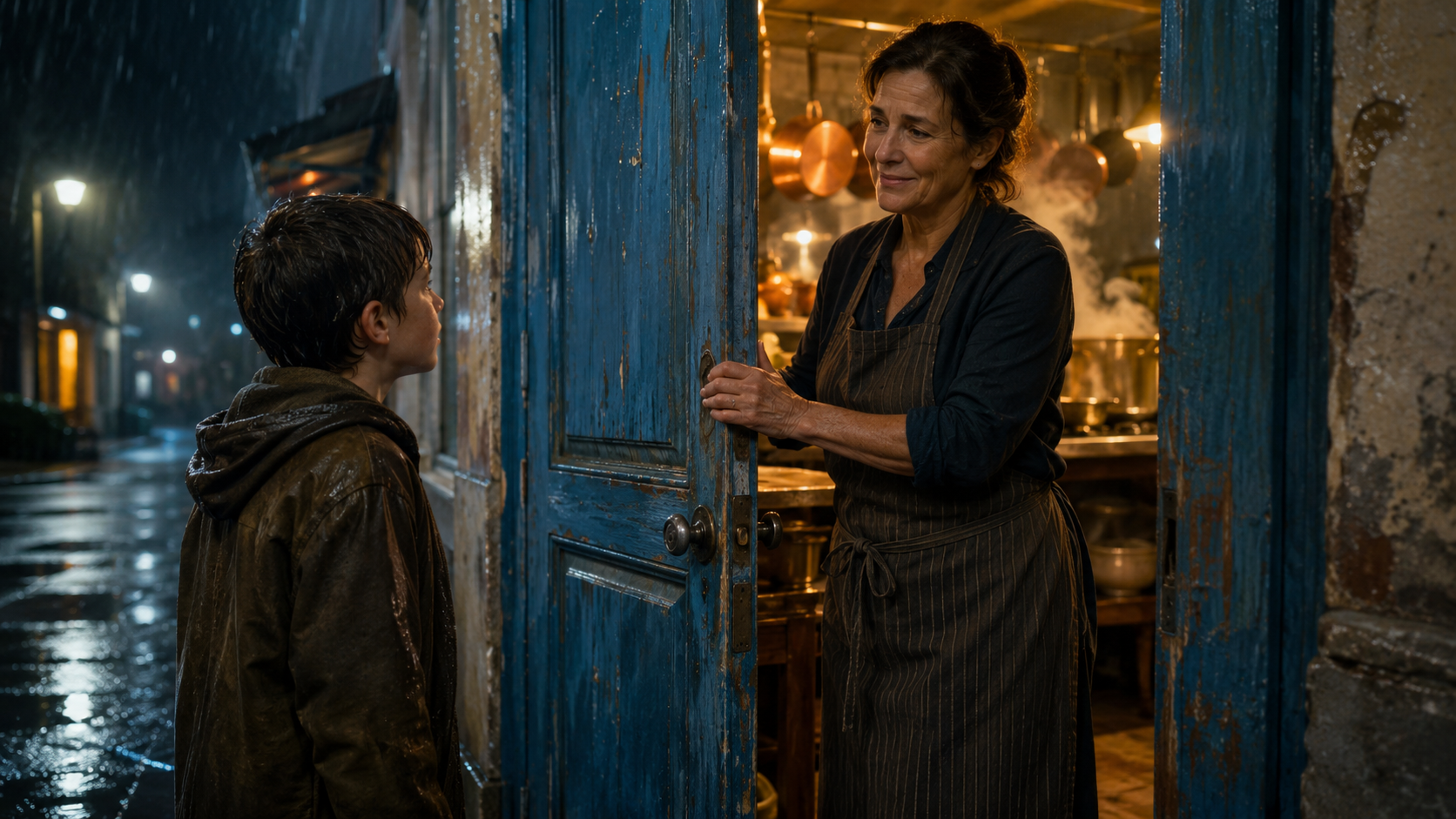
The Boy Who Came Through the Blue Door

On the coldest night of January, the wind swept througaven as if it were searching for something it had lost.

Rain struck the windows of the old buildings, ran beneath locked doors, and turned the narrow sidewalks into black mirrors. Most people hurried home with their collars raised and their eyes fixed on the ground. They passed the glowing restaurants without noticing the warmth behind the glass or the shadows hiding beyond it.

At the end of Harbor Street stood a small restaurant called The Copper Ladle.

It was not fashionable. It had no celebrity reviews, no velvet rope, and no dishes arranged like paintings. Its wooden tables were scratched by generations of elbows, the floorboards complained beneath every step, and the brass bell above the entrance rang a little too loudly.

But the soup was hot, the bread was baked every morning, and nobody who entered hungry was ever made to feel ashamed.

Behind the restaurant, beside the blue kitchen door, a twelve-year-old boy sat beneath a broken fire escape.

His name was Noah Reed.

His jacket was too thin for winter. One of his shoes had been repaired with silver tape, and his wet hair clung to his forehead. He had been sitting there for nearly an hour, watching the kitchen staff carry rubbish bags toward the bins.

Noah was not waiting to steal.

He was waiting for something to be thrown away.

His mother, Evelyn, worked temporary cleaning jobs whenever her health allowed it. Three weeks earlier, she had collapsed while scrubbing the halls of an office building. Since then, unpaid bills had gathered on the kitchen table like silent judges.

That evening, there had been nothing in their apartment except half a jar of mustard and a heel of bread Noah had insisted his mother eat.

He told her he had already eaten at school.

It was a lie.

When the blue door opened, Noah lowered his eyes.

He expected a waiter carrying rubbish.

Instead, a woman in a white chef’s jacket stepped into the rain.

Mara Ellison was forty-three years old, with tired green eyes, silver beginning to show in her dark hair, and a burn scar across the back of her right hand. She owned The Copper Ladle and had spent most of her life in its kitchen.

She noticed the boy immediately.

“You’ve been sitting beside my door for forty-seven minutes,” she said.

Noah stood quickly.

“I’m leaving.”

“I didn’t ask whether you were leaving.”

He glanced toward the street.

“I wasn’t doing anything.”

“That is exactly what worries me.”

Mara studied his soaked jacket and trembling hands.

“Are you waiting for someone?”

“No.”

“Did somebody send you here?”

“No.”

“Have you eaten?”

Noah answered too quickly.

“Yes.”

At that moment, his stomach made a long, unmistakable sound.

The rain seemed to grow quieter.

Noah’s face burned with humiliation.

Mara did not laugh. She did not offer him money or look at him with the exaggerated sadness adults sometimes used when they wanted to feel generous.

She simply opened the blue door wider.

“Come inside.”

“I can’t pay.”

“Good,” she said. “Because the kitchen is closed, and I’m not selling you anything.”

“My mother says I shouldn’t follow strangers.”

“Your mother is a sensible woman. My name is Mara Ellison. I own this restaurant, I overcook carrots when I’m distracted, and I live in the apartment above the bakery across the street. Now I’m no longer a stranger.”

Noah hesitated.

Warm air escaped through the doorway, carrying the smell of roasted onions, thyme, butter, and bread.

Mara waited without reaching for him.

Finally, Noah stepped inside.

The kitchen was smaller than it appeared from the street. Copper pans hung above a central table. Steam clouded the windows, and an old radio played softly beside a row of spice jars.

Mara placed a bowl of chicken stew in front of Noah. She added two thick slices of bread and a mug of warm milk.

He stared at the meal.

“Is something wrong?” she asked.

“No.”

“Then eat before it gets cold.”

At first, Noah took careful spoonfuls, as if someone might change their mind and remove the bowl. After the third bite, caution gave way to hunger. He ate quickly, trying not to appear desperate and failing completely.

Mara pretended not to notice.

When he finished, she refilled the bowl.

“I shouldn’t,” he whispered.

“That is not an argument.”

“My mother needs food too.”

Without speaking, Mara packed another portion of stew into a container. She added bread, two apples, and a small piece of lemon cake.

Noah watched her close the bag.

“I’ll repay you.”

Mara leaned against the counter.

“No.”

“I will. When I’m older.”

“That is a dangerous promise.”

“Why?”

“Because people spend their lives keeping count. They remember every favor, every insult, every debt. Eventually, they forget how to give anything freely.”

She handed him the bag.

“Don’t repay me, Noah. Just remember the blue door.”

He frowned.

“What does that mean?”

“It means that one day you may find someone standing outside the warmth. When you do, open the door.”

Noah held the bag against his chest.

“What if I don’t have a restaurant?”

“Everyone has a door.”

He returned the following evening.

This time, he did not sit outside. He knocked.

Mara put him to work washing potatoes before she fed him. The next day, he polished cutlery. By the end of the week, he had learned how to peel carrots without wasting half of each one.

Mara never called the meals charity.

She called them wages, although Noah knew that no restaurant in the world paid a child with enough food for two people.

During the following months, the kitchen became his refuge.

Mara taught him how to chop onions, how to rescue a sauce, and how to recognize fresh fish by its eyes. She showed him that bread dough could not be hurried and that soup tasted different when cooked by someone who was angry.

“Food remembers the hands that make it,” she told him.

Noah rolled his eyes.

“That doesn’t make sense.”

“Most important things don’t, at first.”

He learned that Mara had inherited the restaurant from her father. He had opened it after returning from military service with almost nothing except a dented soup pot and the belief that a full table could repair nearly any disagreement.

Mara learned that Noah loved drawing buildings.

He sketched them on receipts, paper bags, and the backs of old menus. He drew apartment houses with gardens on their roofs, schools with enormous windows, and shelters that looked like homes rather than institutions.

One afternoon, she found him drawing The Copper Ladle.

In his picture, the blue kitchen door had become twice its actual size.

“Why did you make it so big?” she asked.

“So everyone can find it.”

Mara pinned the drawing above her desk.

Noah continued visiting until early summer.

Then, without warning, he disappeared.

For three evenings, Mara prepared an extra bowl.

On the fourth, she walked to the apartment address Noah had once mentioned. The building manager told her Evelyn Reed had been offered a position at a hotel several hundred miles away. Mother and son had left before sunrise.

“They were behind on the rent,” the manager added. “They didn’t have time for goodbyes.”

Mara wrote a note and slipped it beneath the apartment door anyway.

It remained there until the building was renovated and the old door was replaced.

Years passed.

Harbor Street changed.

The tailor’s shop became a mobile phone store. The family bakery became a chain café. Old brick homes were purchased, emptied, polished, and rented to visitors at prices local families could never afford.

The Copper Ladle survived longer than most.

It survived a recession, two floods, a kitchen fire, and the arrival of a luxury restaurant whose menu described ordinary potatoes in six different ways.

Mara survived too.

Her hair turned white. The burn scar on her hand faded, and arthritis made it difficult to lift the largest pots. Her niece, Sophie, began managing the dining room and handling the accounts.

Mara still arrived before sunrise every morning.

She still baked bread.

And she never changed the color of the blue kitchen door.

Thirty-two years after Noah disappeared, a storm struck Bellhaven.

It began with heavy rain and ended with water surging through Harbor Street. The restaurant’s basement flooded. The refrigeration system failed, the wooden floor warped, and part of the kitchen ceiling collapsed.

Insurance covered only a fraction of the repairs.

For the first time in more than sixty years, The Copper Ladle remained dark for an entire week.

Then came the second blow.

A development company named Alder Crest had purchased the restaurant’s mortgage from the local bank. The company planned to transform the entire block into luxury residences, private shops, and an underground parking garage.

The letter Sophie received was polite, precise, and devastating.

The remaining debt had to be paid within thirty days.

Otherwise, the property would be seized.

Sophie read the letter twice before carrying it into the damaged kitchen.

Mara was standing beneath the broken ceiling, staring at rainwater dripping into an empty stockpot.

“Aunt Mara,” Sophie said quietly.

Mara looked at the papers.

“How long?”

“Thirty days.”

“And the repairs?”

“More than we can afford.”

“We have savings.”

“Not enough.”

“We can sell the apartment.”

“And then where will you live?”

Mara did not answer.

Sophie placed the letter on the counter.

“We can contact the newspapers. People love this place.”

“Love does not always survive an invoice.”

“The neighborhood will help.”

“The neighborhood is fighting the same battle.”

Sophie’s eyes filled with tears.

“So that’s it? We let them take everything?”

Mara touched the edge of the old stove.

“Buildings are not everything.”

“This one is.”

“No. The people who came through it are everything.”

During the following weeks, word spread that The Copper Ladle might close.

Former employees returned to help repair the dining room. Customers brought tools, paint, and envelopes containing whatever money they could spare. A retired carpenter replaced the damaged floorboards without charging for his labor.

Children painted small blue doors on pieces of cardboard and hung them in the windows.

But the donations were not enough.

On the final day, the restaurant opened one last time.

There was no printed menu. Mara cooked what she had always cooked: stew, roasted vegetables, fresh bread, and lemon cake.

Nobody was asked to pay.

By noon, every table was occupied.

People shared stories about first dates, birthdays, reconciliations, and meals Mara had quietly provided during hard times. A former dishwasher told the room that Mara had once kept him employed for six months even though she knew he was sleeping in the railway station.

An elderly woman lifted her bowl.

“You fed my children when I could not,” she said. “They never knew we were poor.”

Mara lowered her eyes.

At four o’clock, two representatives from Alder Crest entered the restaurant.

Their dark coats were spotless despite the rain. One carried a leather case; the other held a ring of newly cut keys.

“Ms. Ellison?” the taller man asked.

“Yes.”

“We are here to complete the property transfer.”

Sophie stepped between them and the counter.

“You said we had until five.”

“We are prepared to wait.”

“Then wait outside.”

The man’s expression remained calm.

“We are not responsible for the terms of the loan.”

“No,” Sophie replied. “You are only responsible for profiting from them.”

The room fell silent.

Mara placed a hand on Sophie’s shoulder.

“It’s all right.”

“No, it isn’t.”

“It is not their decision.”

The taller representative checked his watch.

“Someone from our executive office is joining us. We cannot proceed until he arrives.”

“Why?” Sophie asked.

“I wasn’t informed.”

At exactly half past four, a dark gray car stopped outside.

A man stepped onto the wet sidewalk.

He appeared to be in his mid-forties. His coat was simple but perfectly tailored. Gray touched his temples, and a narrow scar crossed his chin. He carried no umbrella and had no assistant beside him.

He remained across the street for several seconds, looking at the restaurant.

Then he walked toward the entrance.

The brass bell rang when he opened the door.

Both Alder Crest representatives stood straighter.

“Mr. Reed,” one of them said. “We expected you at the regional office.”

The newcomer did not respond.

His gaze moved across the room, past the crowded tables, the repaired floor, and the photographs covering the walls.

Then he saw Mara.

She stood behind the counter in her white chef’s jacket, one hand resting beside a bowl of stew.

The man’s composure faltered.

“Mara Ellison?”

She studied his face.

“Yes?”

He took a step closer.

“You still put thyme in the chicken stew.”

Mara’s eyes narrowed.

“Most people do.”

“But you crush it between your palms first.”

Something changed in her expression.

The man reached into his coat and removed a folded piece of paper, yellow with age.

He placed it on the counter.

It was a child’s drawing of The Copper Ladle.

The proportions were uneven. The windows leaned to one side, and the chimney was far too tall. At the back of the building stood an enormous blue door.

Mara covered her mouth.

“Noah?”

The man smiled, but his eyes filled with tears.

“You remembered.”

“You drew buildings.”

“I still do.”

She came around the counter and touched his face as though she needed proof that he was real.

“You vanished.”

“My mother got a job in another city. We left in the middle of the night because she was afraid the landlord would stop us. I came back three years later, but the restaurant was closed for renovations.”

“I looked for you.”

“I know.”

“How could you know?”

“I found your note.”

Mara stared at him.

“The note beneath the apartment door?”

“The new owner found it when he replaced the frame. He kept it because my drawing was on the envelope. Years later, I tracked him down.”

Noah unfolded the old note.

The ink had faded, but Mara recognized her handwriting.

There will always be a bowl waiting for you. Remember the blue door.

She pressed the paper to her chest.

Sophie looked from Mara to Noah.

“You’re Noah Reed?”

One of the customers whispered the name to the person beside him.

Recognition moved through the dining room.

Noah Reed was an architect and the founder of Open Threshold, an international organization that transformed abandoned properties into affordable homes, community kitchens, and vocational schools.

He had designed hospitals, shelters, and entire residential districts.

His buildings were famous for one unusual detail.

Every one of them had a blue entrance.

Mara looked toward the Alder Crest representatives.

“Why did they call you Mr. Reed?”

Noah turned to them.

The taller man opened the leather case.

“Mr. Reed became the controlling owner of Alder Crest this morning.”

Sophie’s face hardened.

“You bought the company that is taking our restaurant?”

“I bought the company that was taking the neighborhood.”

Noah faced the room.

“For the past six months, my organization has been investigating property acquisitions on Harbor Street. Alder Crest intended to remove fourteen businesses and sixty-three households from this district.”

He looked at Mara.

“Yesterday, I discovered the name of this restaurant in the final transfer documents.”

Mara gripped the counter.

“And now?”

Noah took the ring of keys from the representative’s hand.

“Now there will be no transfer.”

The room remained silent, as though nobody trusted what they had heard.

Noah continued.

“The debt has been cleared. The building will be placed in a community trust, which means it cannot be sold to private developers. The apartments above the shops will be restored and protected as affordable housing.”

Sophie blinked.

“What about the restaurant?”

“That decision belongs to Mara.”

Everyone turned toward her.

Mara looked around the dining room—the cracked photographs, the mismatched chairs, the people who had carried the restaurant through floods, grief, unemployment, loneliness, and time.

“My hands are not what they used to be,” she said.

Noah nodded.

“Then we will find you more hands.”

“The kitchen needs rebuilding.”

“We will rebuild it.”

“Some customers cannot afford restaurant prices.”

“They will not need to.”

Noah placed the keys on the counter.

“I want The Copper Ladle to become the first permanent Open Threshold kitchen. At night, it can operate as the restaurant you created. During the day, it will serve meals to anyone who needs one. It will also train young people who have nowhere else to go.”

Mara stared at him.

“You planned all this today?”

“No. I began planning it thirty-two years ago.”

He pointed to the drawing.

“You told me everyone has a door. I spent my life building them.”

Mara shook her head slowly.

“I gave you a few bowls of stew.”

“You gave my mother enough food to recover. You gave me a place where I was not treated like a problem. You showed me that dignity can be served with bread.”

“I told you not to repay me.”

“I’m not repaying you.”

Noah moved the keys closer to her.

“I’m opening the door.”

A sound came from the back of the room.

Someone began to clap.

Then another person joined.

Within seconds, the restaurant filled with applause. Sophie wrapped her arms around Mara, who finally allowed herself to cry.

Noah stood beside them, no longer an important architect or a company owner.

For a moment, he was simply a hungry boy who had found his way back to the warmest room he had ever known.

The Copper Ladle reopened five months later.

The damaged kitchen was replaced, but the old stove remained. The tables were restored rather than discarded. The photographs returned to the walls, and Noah’s childhood drawing was placed in a wooden frame near the entrance.

Mara insisted that the blue kitchen door remain exactly as it had been.

A small community pantry was built beside it. People could leave food there or take what they needed without asking permission.

Every weekday afternoon, teenagers learned to cook under Mara’s supervision. She taught them to sharpen knives, season soup, bake bread, and remain patient with themselves.

Noah visited whenever his work brought him to Bellhaven.

Sometimes he arrived in a suit after a meeting. Sometimes he came early in the morning, rolled up his sleeves, and peeled potatoes in the same corner where he had worked as a child.

One winter evening, he noticed a girl standing outside the blue door.

She was perhaps ten years old. Her coat was wet, and she was staring at the pantry without touching anything.

Noah opened the door.

She stepped back.

“I wasn’t stealing,” she said.

“I know.”

“I don’t have money.”

“Good,” Noah replied. “Because this meal isn’t for sale.”

Behind him, Mara looked up from the stove.

For an instant, Noah saw the past and the present standing in the same doorway.

He invited the girl inside.

Mara placed three bowls on the table.

Outside, the winter wind continued through the city, cold and restless.

Inside, bread was broken, soup was shared, and an old promise quietly became a new beginning.

Because kindness does not always return as money.

Sometimes it returns as a building saved from demolition.

Sometimes it returns as a key placed on a counter.

And sometimes, after traveling through decades of hardship, memory, and hope, it returns to open the same blue door.